LaTeX renderer
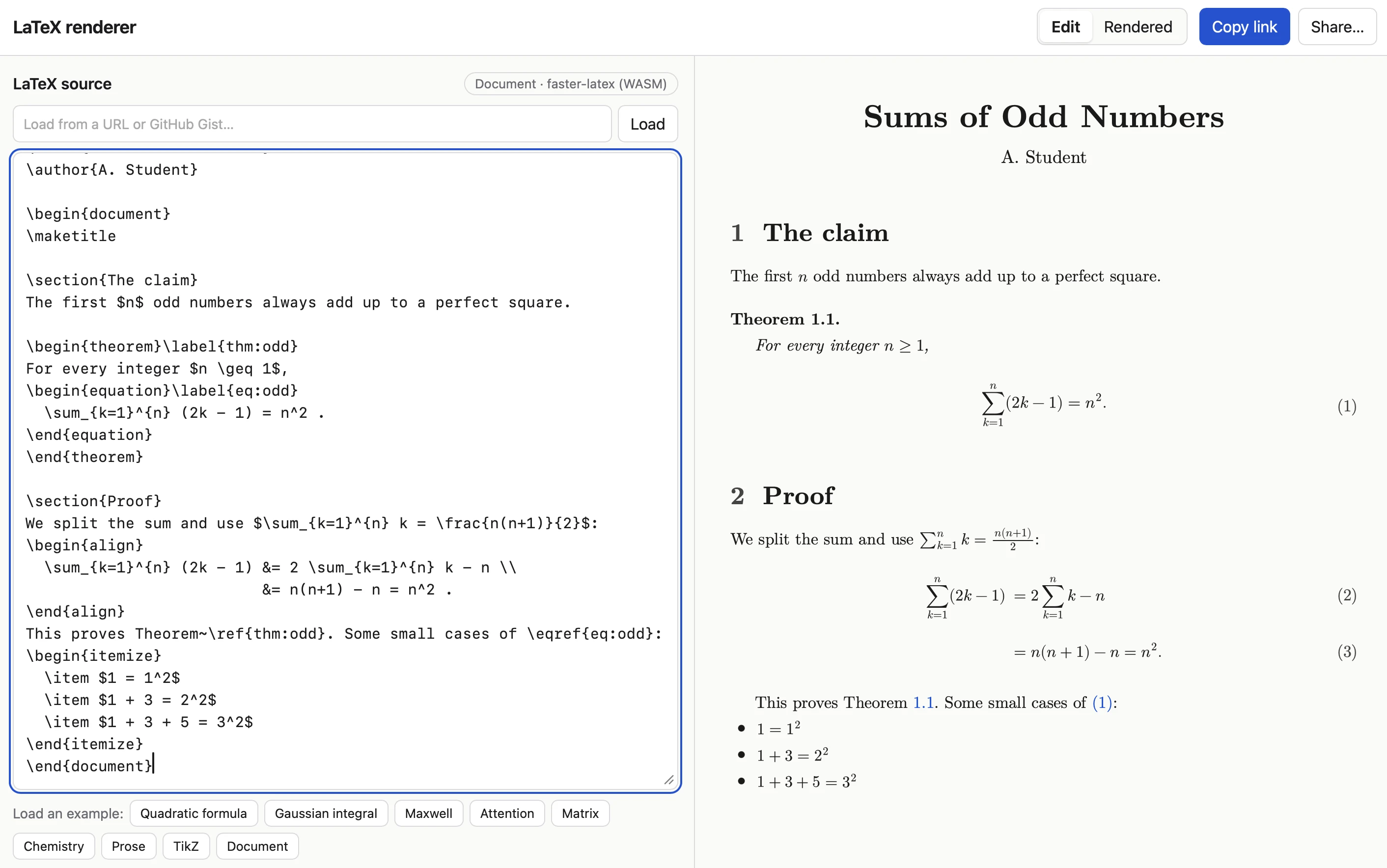
Simon Willison introduces a new LaTeX renderer that promises to enhance web-based mathematical typesetting.
Key takeaways
- Simon Willison has announced a new web-based LaTeX renderer.
- The renderer focuses on performance and usability for mathematical typesetting.
- It aims to support a wide range of LaTeX commands for complex expressions.
- The initiative is open for community feedback and contributions.
- It is designed to be responsive and accessible across various devices.
The recent announcement by Simon Willison regarding a new LaTeX renderer marks a significant advancement in the realm of web-based mathematical typesetting. This new tool is designed to simplify the process of rendering complex mathematical expressions directly in web browsers, making it easier for developers and educators to incorporate high-quality typesetting into their online content. With the increasing reliance on digital platforms for education and information dissemination, the need for effective mathematical rendering has never been more critical. Willison's initiative aims to bridge the gap between traditional LaTeX typesetting and modern web technologies, providing a seamless solution for users who require precise mathematical formatting.
The LaTeX renderer is built with a focus on performance and usability. It leverages modern web standards and technologies to ensure that mathematical expressions are not only rendered accurately but also displayed quickly and responsively. This is particularly important for users accessing content on various devices, from desktops to smartphones. By optimizing the rendering process, Willison aims to provide a tool that can handle the demands of real-time rendering in educational tools, scientific publications, and interactive web applications. The renderer is expected to support a wide range of LaTeX commands, allowing users to create intricate mathematical expressions with ease.
Key facts
| Field | Detail |
|---|---|
| Developer | Simon Willison |
| Technology | Web-based LaTeX renderer |
| Purpose | Simplify mathematical typesetting for web applications |
| Key Features | Performance optimization, responsive design, extensive LaTeX support |
| Target Users | Educators, developers, researchers |
| Release Date | Announced recently (exact date TBD) |
| Accessibility | Designed for use on various devices |
| Integration | Compatible with existing web frameworks |
| Community Feedback | Open for user suggestions and improvements |
| Future Updates | Planned enhancements based on user input |
Who's involved
Simon Willison, a prominent figure in the tech community known for his contributions to web development and data science, is the driving force behind this new LaTeX renderer. His previous work includes significant contributions to Django and various open-source projects, showcasing his commitment to improving web technologies. The initiative is likely to attract attention from educators, developers, and researchers who rely on precise mathematical typesetting in their work. Additionally, the open-source nature of the project invites collaboration and feedback from the broader community, ensuring that the tool evolves to meet user needs.
The development of this LaTeX renderer comes at a time when the demand for effective online educational tools is surging. With the rise of remote learning and digital classrooms, educators are increasingly seeking ways to present complex mathematical concepts clearly and engagingly. This renderer is poised to fill that gap, offering a solution that integrates seamlessly into existing web applications and educational platforms. The emphasis on performance and responsiveness is particularly relevant as more users access content on mobile devices, where traditional typesetting methods may fall short.
Historically, LaTeX has been the go-to solution for typesetting complex mathematical documents, especially in academia. However, its integration into web applications has often been cumbersome, requiring additional libraries or plugins that may not always function optimally across different browsers and devices. Willison's new renderer aims to streamline this process, providing a lightweight and efficient solution that can be easily integrated into various web frameworks. This shift represents a significant evolution in how mathematical content is presented online, moving away from heavy reliance on server-side rendering towards a more dynamic, client-side approach.
The introduction of this LaTeX renderer also reflects broader trends in web development, where performance and user experience are paramount. As web technologies continue to advance, developers are increasingly looking for tools that not only meet their functional requirements but also enhance the overall user experience. By focusing on speed and responsiveness, Willison's renderer aligns with these trends, offering a solution that can adapt to the fast-paced nature of online content consumption.
What you can do with it
- Integrate into Educational Platforms: Use the renderer to enhance online courses and tutorials with high-quality mathematical typesetting.
- Develop Interactive Applications: Create web applications that require real-time rendering of mathematical expressions, such as calculators or simulation tools.
- Collaborate on Open Source: Contribute to the development of the renderer by providing feedback, suggesting features, or even contributing code.
- Experiment with LaTeX Commands: Explore the extensive support for LaTeX commands to create complex mathematical expressions for various applications.
- Optimize for Mobile: Ensure that your web applications utilizing the renderer are responsive and accessible on mobile devices, enhancing user engagement.
What we're watching
As the LaTeX renderer gains traction, it will be interesting to observe how the community responds to its capabilities and performance. User feedback will play a crucial role in shaping future updates and enhancements, particularly regarding the range of LaTeX commands supported and the overall user experience. Additionally, the potential for integration with popular web frameworks and educational platforms will be a key area to watch, as developers seek to leverage this tool in their projects.
Looking ahead, the success of this LaTeX renderer could pave the way for further innovations in web-based typesetting and mathematical rendering. As more users adopt the tool, it may inspire similar projects aimed at improving the accessibility and usability of complex content on the web. The ongoing evolution of web technologies and user expectations will undoubtedly influence the direction of this initiative, making it a focal point for those interested in the intersection of mathematics and web development.
Source: Simon Willison's Weblog · Read original →
Instagram & TikTok: copy the link and paste into a Story, Reel, or caption.
Digest
AI news by email
Weekly Friday briefings plus midweek notes when models or research drop. Sources included — unsubscribe anytime.
Discussion
Comment here after signing in, or share the story to continue the conversation elsewhere.
Instagram & TikTok: copy the link and paste into a Story, Reel, or caption.
Log in or create an account to comment — Google / GitHub / X when those providers are configured.
No comments yet — start the thread.