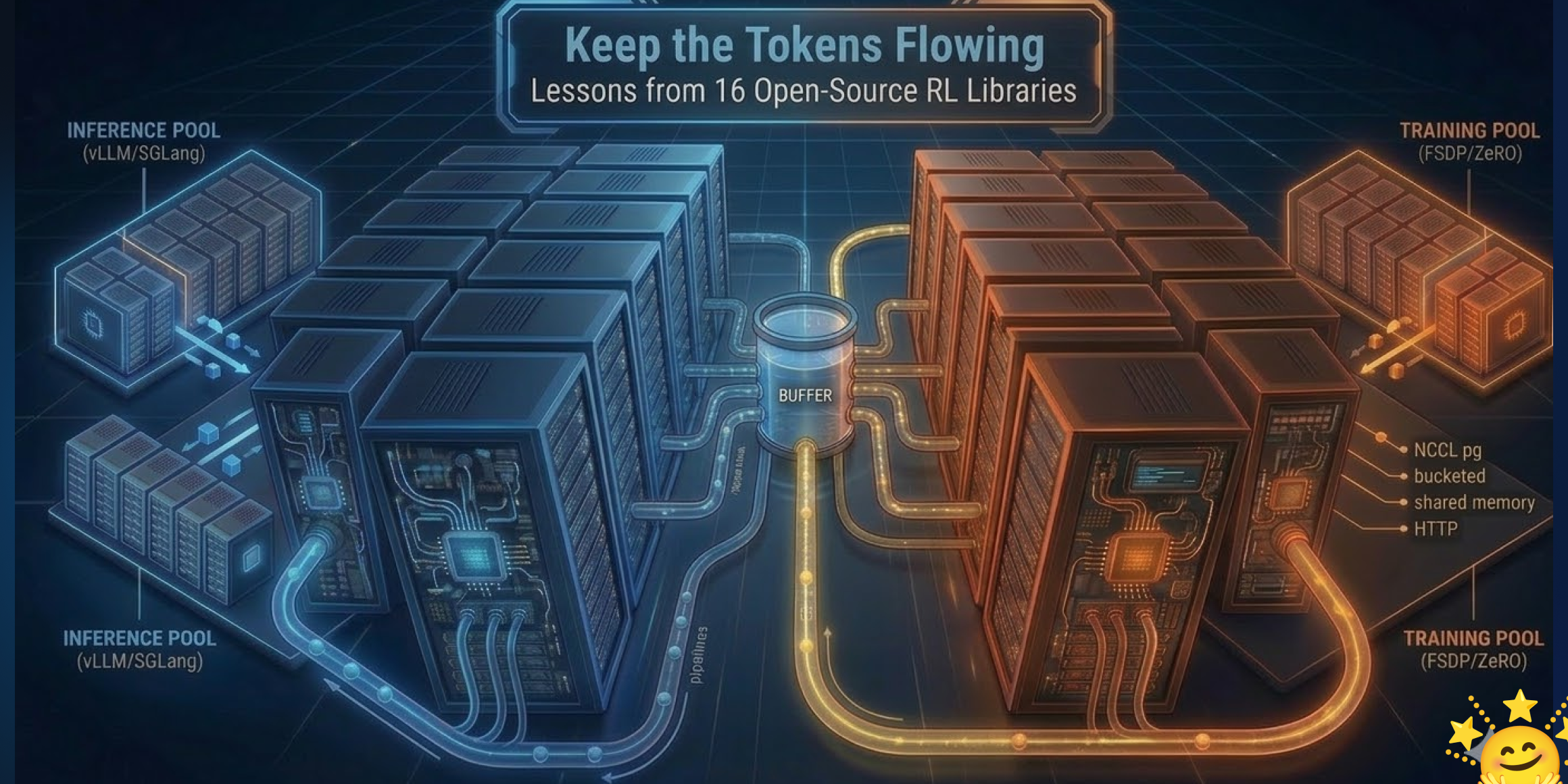
Keep the Tokens Flowing: Lessons from 16 Open-Source RL Libraries
New insights from 16 open-source reinforcement learning libraries reveal best practices for token management.
The Hugging Face Blog recently published an in-depth analysis of 16 popular open-source reinforcement learning (RL) libraries, shedding light on critical lessons regarding token management. This comprehensive exploration aims to equip developers with actionable insights that can enhance the efficiency and effectiveness of AI model training. By examining these libraries, the blog highlights common pitfalls and best practices that can significantly impact the performance of RL algorithms, which are increasingly being used in various applications from robotics to game playing.
Among the libraries analyzed are well-known names like OpenAI's Gym, Stable Baselines, and Ray Rllib, which have become staples in the reinforcement learning community. Each library offers unique features and approaches to token management, which is crucial for optimizing the training process. The blog emphasizes that effective token management can lead to improved resource utilization, faster training times, and ultimately, more robust AI models. As developers continue to push the boundaries of what RL can achieve, understanding these nuances becomes ever more critical.
Key facts
| Field | Detail |
|---|---|
| Libraries Analyzed | 16 popular open-source RL libraries |
| Focus Area | Token management in reinforcement learning |
| Target Audience | Developers in AI and machine learning |
| Key Takeaway | Best practices for efficient training |
| Source | Hugging Face Blog |
The importance of token management in reinforcement learning cannot be overstated. In RL, tokens often represent actions, states, or rewards that the agent interacts with during training. Poor management of these tokens can lead to inefficiencies, such as excessive computational overhead or suboptimal learning rates. The insights from the Hugging Face analysis serve as a guide for developers to refine their approaches, ensuring that they can leverage the full potential of the libraries at their disposal. This is particularly relevant as the demand for more sophisticated AI applications continues to grow, necessitating a deeper understanding of the underlying mechanics of RL.
As the field of reinforcement learning evolves, the lessons drawn from these libraries will likely influence future developments. With the rapid pace of innovation in AI, new libraries and frameworks are constantly emerging, each promising to improve upon its predecessors. The insights shared by Hugging Face not only provide a snapshot of the current state of open-source RL but also set the stage for future enhancements in the field. Developers who adopt these best practices can expect to see tangible improvements in their projects, making it easier to experiment and iterate on complex models.
Looking ahead, the ongoing development of RL libraries will continue to focus on optimizing token management strategies. As new techniques and algorithms are introduced, the community will benefit from shared knowledge and experiences. This collaborative approach is essential for advancing the capabilities of reinforcement learning, ensuring that developers are well-equipped to tackle the challenges that lie ahead in AI model training and deployment.
Source: Hugging Face Blog · Read original →
Discussion
Comment here after signing in, or share the story to continue the conversation elsewhere.
Instagram & TikTok: copy the link and paste into a Story, Reel, or post caption.
Log in or create an account to comment — Google / GitHub / X when those providers are configured.
No comments yet — start the thread.