

Use decision models with Amazon Bedrock AgentCore Evaluations
Amazon Bedrock introduces decision models to enhance agent evaluations, streamlining the process for developers and businesses.
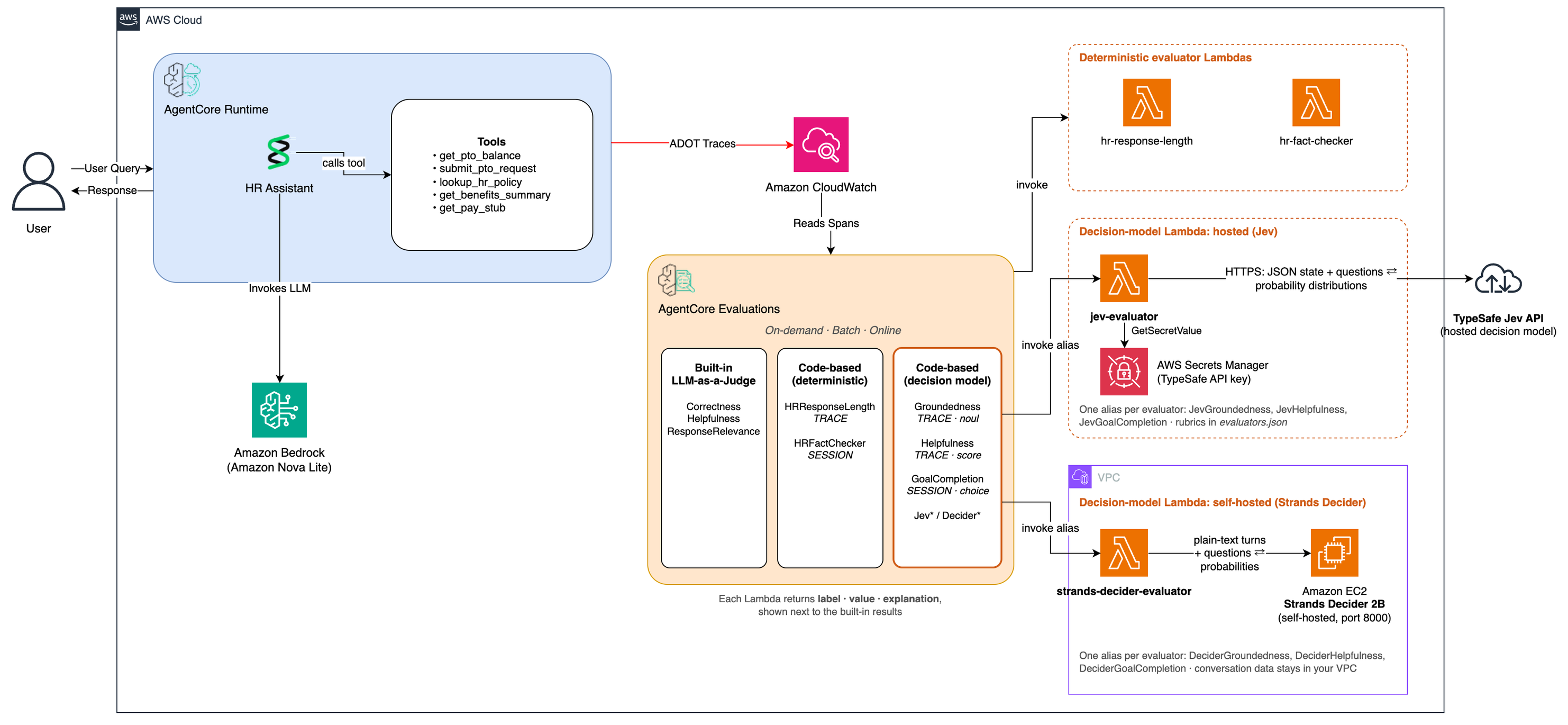
Amazon Web Services (AWS) has recently unveiled a powerful integration of decision models with its Amazon Bedrock AgentCore Evaluations, a move that promises to streamline the evaluation process for AI agents. This integration allows developers to connect two specific decision models, Jev and Strands Decider, to the evaluation framework through code-based evaluators. By employing these decision models, developers can tackle narrow and repeatable evaluation questions with precision, thereby improving the overall reliability of their AI agents. The announcement is particularly significant as it addresses a common challenge faced by developers: ensuring that their AI models are not only effective but also reliable in real-world applications.
The integration of decision models into the Amazon Bedrock ecosystem is a strategic enhancement that reflects AWS's commitment to providing robust tools for AI development. Decision models like Jev and Strands Decider are designed to facilitate structured decision-making processes, allowing developers to validate their AI agents' performance before launching them into production. This capability is crucial for businesses that rely on AI-driven solutions, as it helps mitigate risks associated with deploying untested models. By incorporating these decision models, AWS aims to empower developers to create more reliable and efficient AI systems that can meet the demands of various industries.
Key facts
| Field | Detail |
|---|---|
| Product | Amazon Bedrock AgentCore Evaluations |
| Decision Models | Jev and Strands Decider |
| Integration Method | Code-based evaluators |
| Purpose | To answer narrow and repeatable agent-evaluation questions |
| Validation Process | Decision-model checks before gating a release |
| Target Users | AI developers and businesses utilizing Amazon Bedrock for AI solutions |
| Release Date | Announced recently (exact date not specified) |
| Industry Impact | Enhances reliability and efficiency of AI agents in various sectors |
| AWS Commitment | Ongoing investment in AI and machine learning tools for developers |
| Future Developments | Potential for additional decision models and enhanced features in Amazon Bedrock |
The players
- Amazon Web Services (AWS): The cloud computing giant behind the Amazon Bedrock platform.
- Jev and Strands Decider: The two decision models integrated into the AgentCore Evaluations framework.
- AI Developers: The primary users who will benefit from the enhanced evaluation capabilities.
The introduction of decision models into Amazon Bedrock is part of a broader trend within the AI and machine learning landscape, where the focus is shifting towards creating more reliable and interpretable AI systems. In recent years, the demand for AI solutions that can make transparent and justifiable decisions has grown significantly. This shift has been driven by the increasing complexity of AI applications and the need for businesses to ensure that their AI systems are not only effective but also trustworthy.
Prior to this development, many AI evaluation processes relied heavily on traditional metrics and subjective assessments, which often led to inconsistencies and uncertainty regarding the performance of AI agents. The integration of decision models like Jev and Strands Decider represents a paradigm shift, as it allows for a more structured approach to evaluation. By providing a framework for answering specific evaluation questions, these decision models help developers gain deeper insights into their AI agents' behavior and performance.
Moreover, the ability to validate decision-model checks before gating a release is a game-changer for developers. This validation process ensures that any potential issues are identified and addressed before an AI agent is deployed, ultimately reducing the risk of failures in production environments. As businesses increasingly rely on AI-driven solutions, the importance of robust evaluation frameworks cannot be overstated.
How to read the numbers
While the announcement does not provide specific numerical benchmarks for the performance of the decision models, it is essential to understand the implications of integrating structured decision-making processes into AI evaluations. The effectiveness of decision models can be gauged through qualitative assessments, such as user feedback and case studies, which will likely emerge as developers begin to implement these tools in their workflows.
What you can do with it
- Integrate Decision Models: Leverage Jev and Strands Decider in your AI evaluation processes to enhance reliability.
- Conduct Validation Checks: Implement decision-model checks before releasing AI agents to ensure performance standards are met.
- Streamline Evaluation Processes: Use code-based evaluators to automate and simplify the evaluation of AI agents.
- Monitor Performance: Continuously assess the performance of AI agents using the structured insights provided by decision models.
What we're watching
As AWS continues to develop the Amazon Bedrock platform, we are keenly observing the introduction of additional decision models and features that could further enhance the evaluation process. The potential for new integrations and capabilities could significantly impact how developers approach AI evaluations, leading to more sophisticated and reliable AI systems.
Looking ahead, the integration of decision models into Amazon Bedrock is likely to set a new standard for AI evaluations across the industry. As businesses seek to adopt AI solutions that are not only effective but also trustworthy, the demand for structured decision-making frameworks will continue to grow. The success of this integration will depend on how well developers can leverage these tools to improve their AI agents' performance and reliability in real-world applications.
Source: AWS Machine Learning · Read original →
Instagram & TikTok: copy the link and paste into a Story, Reel, or caption.
Digest
AI news by email
Weekly Friday briefings plus midweek notes when models or research drop. Sources included — unsubscribe anytime.
Discussion
Comment here after signing in, or share the story to continue the conversation elsewhere.
Instagram & TikTok: copy the link and paste into a Story, Reel, or caption.
Log in or create an account to comment — Google / GitHub / X when those providers are configured.
No comments yet — start the thread.


