Unlocking Agentic RL Training for GPT-OSS: A Practical Retrospective
Hugging Face reveals how agentic reinforcement learning enhances GPT-OSS training, improving model performance and efficiency.
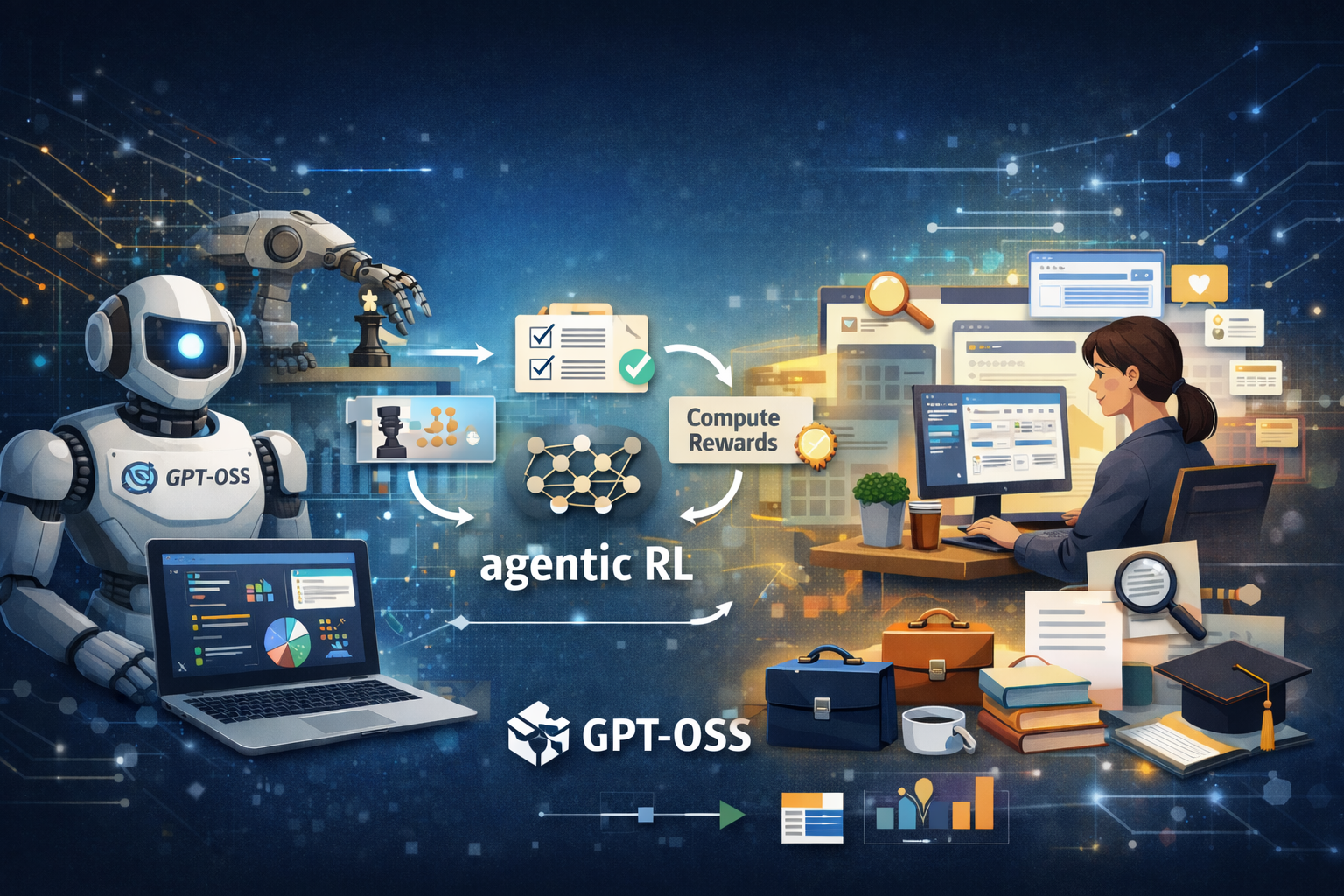
Hugging Face has unveiled a new approach to training its GPT-OSS model through the implementation of agentic reinforcement learning (RL) techniques. This innovative method aims to enhance the model's performance across various tasks, showcasing significant improvements in efficiency and capability. The retrospective shared by Hugging Face not only highlights the advancements made but also provides practical insights for developers and researchers looking to leverage these techniques in their own projects. With the growing demand for more robust AI models, this development comes at a crucial time for the industry.
The introduction of agentic RL techniques marks a pivotal shift in how AI models are trained, moving away from traditional supervised learning methods. By enabling the model to learn from its own actions and decisions in a more autonomous manner, Hugging Face is setting a new standard for training methodologies. This approach allows for a more dynamic learning environment where models can adapt and improve based on real-time feedback, ultimately leading to better performance in complex tasks. The implications of this shift are vast, as it opens up new avenues for AI applications in various fields, from natural language processing to robotics.
Key facts
| Field | Detail |
|---|---|
| Technique | Agentic Reinforcement Learning |
| Model | GPT-OSS |
| Focus | Enhanced model training and performance |
| Target Audience | Developers and researchers |
| Practical Insights Shared | Yes |
| Performance Improvement | Significant gains in task performance |
The broader AI landscape has been evolving rapidly, with various organizations exploring innovative training techniques to improve model capabilities. Agentic reinforcement learning is not entirely new; it builds on principles established in earlier works, such as Deep Q-Learning and Proximal Policy Optimization. However, Hugging Face's application of these principles to the GPT-OSS model represents a fresh approach that could inspire further research and development in the field. As AI continues to permeate various sectors, the ability to train models that can learn and adapt in real-time will be increasingly valuable.
Looking ahead, the success of agentic RL in training GPT-OSS could lead to its adoption in other AI models and frameworks. Researchers and developers are likely to explore how these techniques can be integrated into existing systems, potentially revolutionizing the way AI is trained across the board. The next steps will involve not only refining these techniques but also assessing their applicability in diverse real-world scenarios, paving the way for more intelligent and capable AI solutions in the near future.
Source: Hugging Face Blog · Read original →
Discussion
Comment here after signing in, or share the story to continue the conversation elsewhere.
Instagram & TikTok: copy the link and paste into a Story, Reel, or post caption.
Log in or create an account to comment — Google / GitHub / X when those providers are configured.
No comments yet — start the thread.