Understanding BigBird's Block Sparse Attention
BigBird's block sparse attention revolutionizes NLP by efficiently processing long sequences with reduced memory usage.
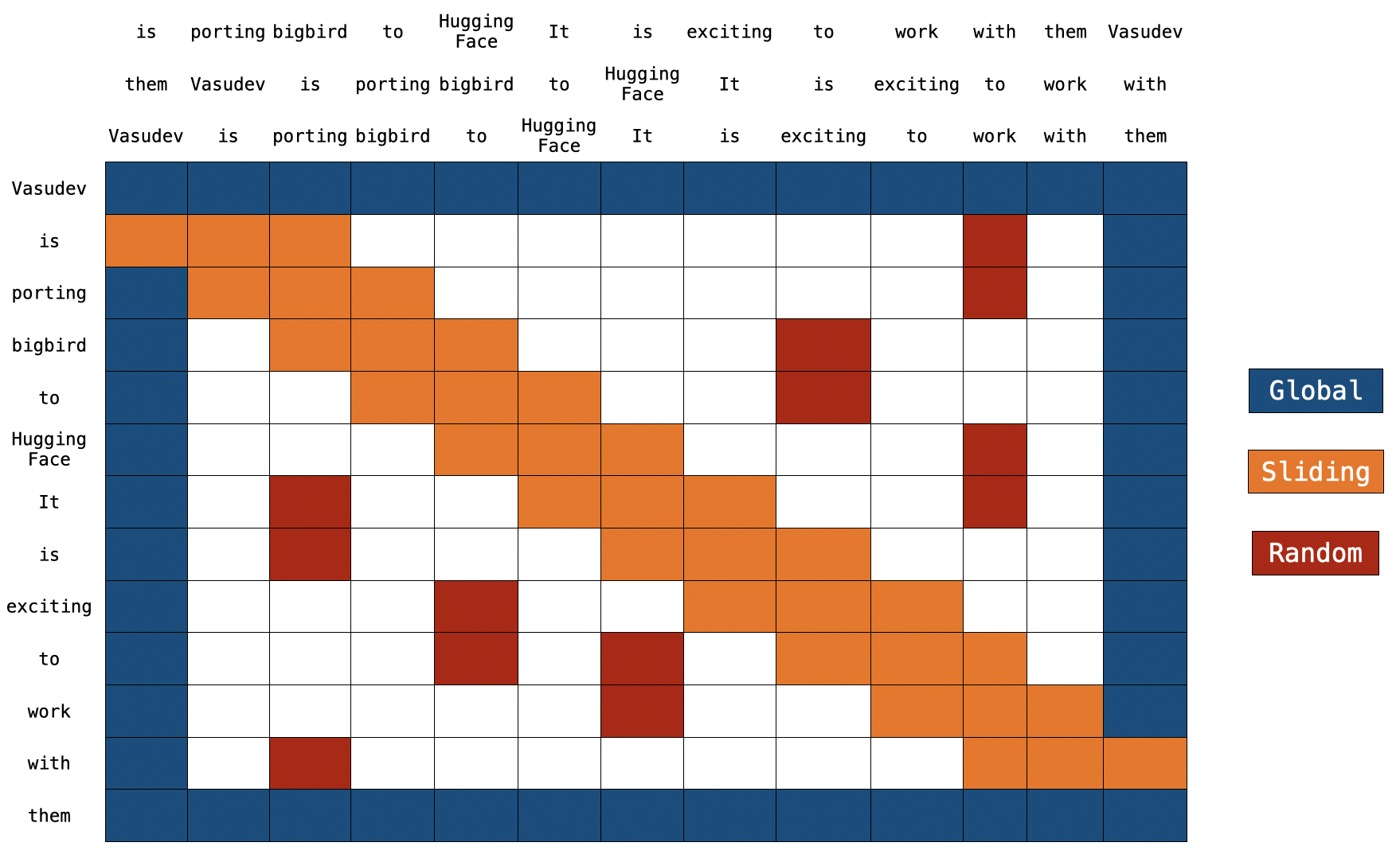
BigBird, a model developed by Google Research, has made significant strides in natural language processing (NLP) by introducing block sparse attention mechanisms that efficiently handle long sequences. This innovative approach allows BigBird to process sequences of up to 8,192 tokens, a substantial increase compared to many existing models that struggle with longer inputs. The model's design is particularly suited for complex NLP tasks such as document classification and question answering, where understanding context over extended text is crucial. By leveraging block sparse attention, BigBird not only enhances performance but also optimizes resource utilization, making it a game-changer for developers and researchers alike.
The introduction of BigBird comes at a time when the demand for processing larger datasets in NLP is surging. Traditional transformer models often face limitations due to their quadratic scaling in memory and computation with respect to input length. BigBird's block sparse attention mitigates this issue by focusing on a subset of tokens, thereby reducing memory usage by up to 80%. This efficiency is vital for organizations that need to analyze vast amounts of text data without incurring prohibitive costs associated with high computational resources. As a result, BigBird positions itself as a powerful tool for those looking to push the boundaries of what is possible in NLP.
Key facts
| Field | Detail |
|---|---|
| Model | BigBird |
| Maximum Sequence Length | 8,192 tokens |
| Memory Usage Reduction | Up to 80% |
| Primary Use Cases | Document classification, question answering |
| Developed By | Google Research |
Understanding the broader implications of BigBird's capabilities requires a look at the evolution of attention mechanisms in NLP. The original transformer architecture, introduced in the paper "Attention is All You Need," revolutionized the field by allowing models to weigh the importance of different words in a sequence. However, as datasets have grown, the limitations of traditional attention mechanisms have become apparent. BigBird's block sparse attention represents a significant advancement, enabling models to maintain performance while scaling to longer sequences. This is particularly relevant in applications such as legal document analysis or scientific research, where lengthy texts are commonplace.
Looking ahead, the introduction of BigBird raises questions about how it will be integrated into existing NLP frameworks and whether it will inspire further innovations in attention mechanisms. As researchers and developers begin to adopt BigBird, its performance in real-world applications will be closely monitored. The potential for this model to influence future designs in NLP is substantial, and its success could lead to a new wave of models that prioritize efficiency without sacrificing capability. The ongoing exploration of block sparse attention may also prompt other AI research teams to investigate similar strategies, further enhancing the landscape of NLP technologies.
Source: Hugging Face Blog · Read original →
Discussion
Comment here after signing in, or share the story to continue the conversation elsewhere.
Instagram & TikTok: copy the link and paste into a Story, Reel, or post caption.
Log in or create an account to comment — Google / GitHub / X when those providers are configured.
No comments yet — start the thread.