Securing AI agent identity with X.509 PKI on AWS
AWS unveils a new architecture to secure AI agent identities using X.509 PKI, enhancing trust in multi-agent systems.
Key takeaways
- AWS has introduced a new architecture for securing AI agent identities using X.509 PKI.
- The architecture includes features like signed request envelopes and audience-scoped tokens.
- Keyfactor EJBCA is utilized for managing digital certificates within the framework.
- Real-time OCSP revocation ensures immediate updates on certificate statuses, enhancing security.
- This initiative aims to prevent request forgery and improve trust in multi-agent AI systems.
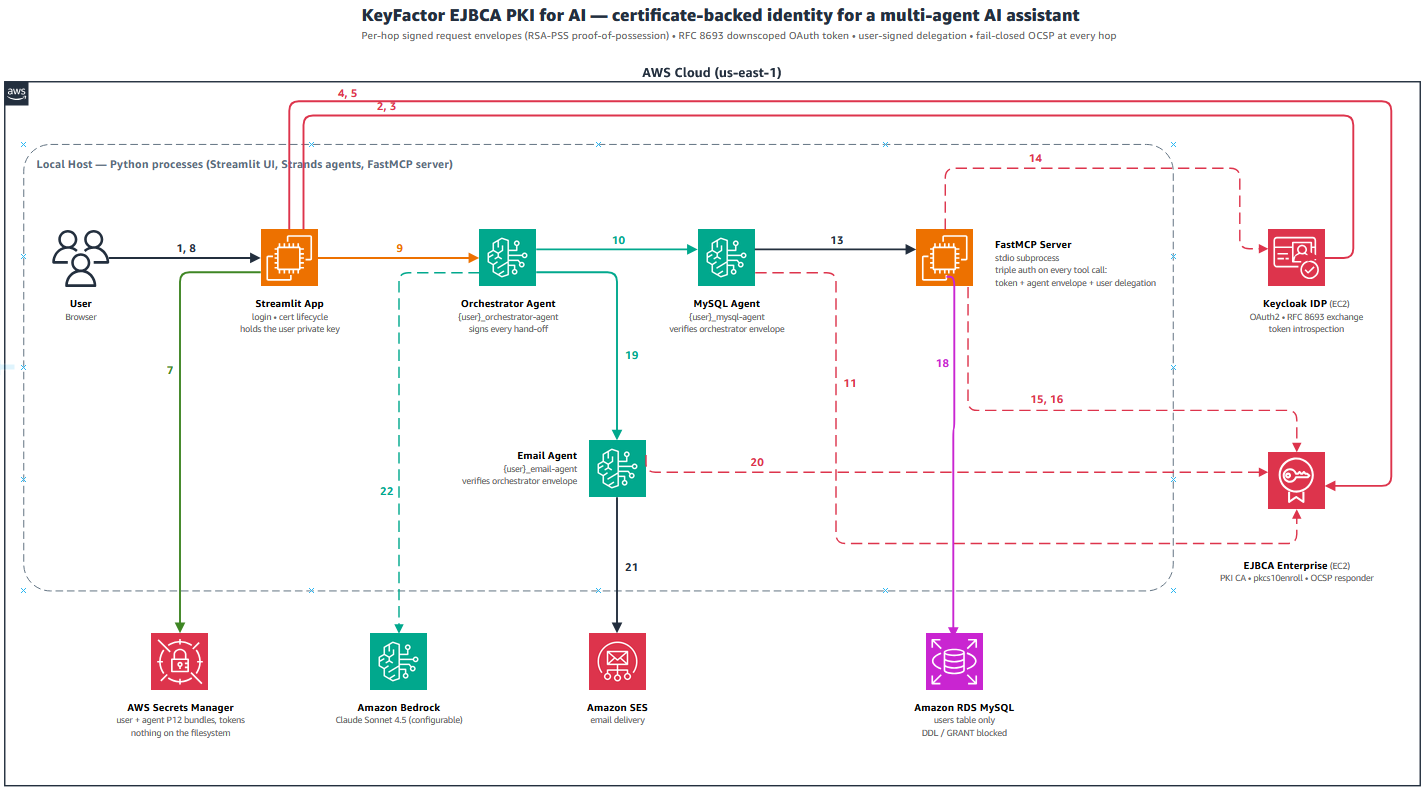
In a move that could redefine security protocols for artificial intelligence systems, AWS has introduced a reference architecture designed to secure the identities of AI agents through the use of X.509 Public Key Infrastructure (PKI). This architecture integrates several advanced cryptographic techniques, including signed request envelopes, user-signed delegation assertions, and RFC 8693 audience-scoped tokens. By implementing these methods, AWS aims to enhance the integrity and authenticity of communications between AI agents, thereby preventing request forgery and ensuring that interactions within multi-agent systems are both secure and reliable.
The architecture leverages Keyfactor EJBCA, a robust certificate authority (CA) solution that facilitates the issuance and management of digital certificates. This integration allows for the establishment of a secure identity framework for AI agents, which is critical in environments where multiple agents interact and share sensitive data. With the rise of AI applications across various sectors, including finance, healthcare, and autonomous systems, the need for secure agent-to-agent communication has never been more pressing. AWS's approach not only addresses these security concerns but also sets a new standard for identity verification in AI systems.
Key facts
| Field | Detail |
|---|---|
| Technology | X.509 Public Key Infrastructure (PKI) |
| Key Component | Keyfactor EJBCA |
| Security Features | Signed request envelopes, user-signed delegation assertions, audience-scoped tokens |
| Purpose | To secure multi-agent AI systems and prevent request forgery |
| Compliance | RFC 8693 for audience-scoped tokens |
| Revocation Mechanism | Real-time Online Certificate Status Protocol (OCSP) |
| Target Users | Developers and organizations utilizing multi-agent AI systems |
| Industry Applications | Finance, healthcare, autonomous systems, and more |
| Release Date | Announced in October 2023 |
| Availability | Accessible through AWS services |
The players
The key players involved in this initiative include AWS, a leading cloud service provider, and Keyfactor, a company specializing in identity and security solutions. Together, they are working to enhance the security framework for AI systems, particularly those that rely on multiple agents for operation. This collaboration signifies a growing trend in the tech industry towards prioritizing security in AI applications.
The introduction of this architecture comes at a time when the AI landscape is rapidly evolving, with increasing reliance on multi-agent systems that require secure communication channels. Previous security measures often fell short in addressing the complexities and vulnerabilities associated with agent interactions. The integration of X.509 PKI into AWS's offerings represents a significant advancement in this regard.
Historically, securing AI systems has posed unique challenges, particularly as the number of agents and their interactions have increased. Traditional security measures, such as simple API keys or static credentials, have proven inadequate in preventing sophisticated attacks, including request forgery and impersonation. The introduction of cryptographic identities through X.509 certificates marks a pivotal shift in how developers can secure their AI systems, providing a more robust and scalable solution.
In the past, many organizations have struggled with the complexities of managing identities across multiple agents. The reliance on centralized identity management systems often led to bottlenecks and vulnerabilities. However, with the new architecture from AWS, developers can leverage decentralized identity verification methods that enhance both security and performance. This shift not only improves the overall security posture of AI systems but also simplifies the management of agent identities.
How to read the numbers
While specific performance metrics for the new architecture have not been disclosed, the implementation of X.509 PKI is expected to significantly enhance the security and reliability of multi-agent systems. The following table outlines key security features that can be anticipated with this architecture:
| Security Feature | Expected Impact |
|---|---|
| Signed Request Envelopes | Ensures authenticity of requests between agents |
| User-Signed Delegation Assertions | Allows agents to delegate authority securely |
| Audience-Scoped Tokens | Limits token usage to specific audiences |
| Real-time OCSP Revocation | Provides immediate updates on certificate status |
| Enhanced Identity Management | Simplifies identity verification processes |
What you can do with it
For developers and organizations looking to implement this new architecture, here are some practical takeaways:
- Integrate X.509 PKI: Begin by integrating X.509 PKI into your existing AI systems to enhance identity verification.
- Utilize Keyfactor EJBCA: Leverage Keyfactor EJBCA for managing digital certificates and ensuring secure communications between agents.
- Implement Signed Request Envelopes: Use signed request envelopes to guarantee the authenticity of requests made by AI agents.
- Adopt Audience-Scoped Tokens: Implement audience-scoped tokens to restrict access and enhance security during agent interactions.
- Monitor Certificate Status: Utilize real-time OCSP to monitor the status of certificates and ensure that revoked certificates are not used.
What we're watching
As AWS rolls out this new architecture, the tech community will be closely monitoring its adoption and effectiveness in real-world applications. Key questions remain regarding how organizations will implement these security measures and the potential challenges they may face. Additionally, the response from competitors in the cloud services space will be critical, as they may seek to develop similar or alternative solutions to enhance security in AI systems.
Looking ahead, the implications of this architecture extend beyond just security; it could pave the way for more complex and capable AI systems that can operate with a higher degree of trust. As organizations increasingly rely on AI agents for critical operations, ensuring their secure identity will be paramount. The success of AWS's initiative may influence industry standards and best practices, shaping the future of AI security protocols for years to come.
Source: AWS Machine Learning · Read original →
Instagram & TikTok: copy the link and paste into a Story, Reel, or caption.
Digest
AI news by email
Weekly Friday briefings plus midweek notes when models or research drop. Sources included — unsubscribe anytime.
Discussion
Comment here after signing in, or share the story to continue the conversation elsewhere.
Instagram & TikTok: copy the link and paste into a Story, Reel, or caption.
Log in or create an account to comment — Google / GitHub / X when those providers are configured.
No comments yet — start the thread.