Run multi-node inference workloads using Ray LLM Deep Learning Containers
AWS introduces multi-node inference capabilities for large language models using Ray LLM Deep Learning Containers on Amazon EKS.
“By separating prefill and decode nodes, AWS's new offering optimizes resource allocation, significantly enhancing the performance of large language model deployments.”
Key takeaways
- AWS has launched multi-node inference workloads for large language models using Ray LLM Deep Learning Containers.
- The deployment is facilitated on Amazon Elastic Kubernetes Service (EKS) with an OpenAI-compatible API.
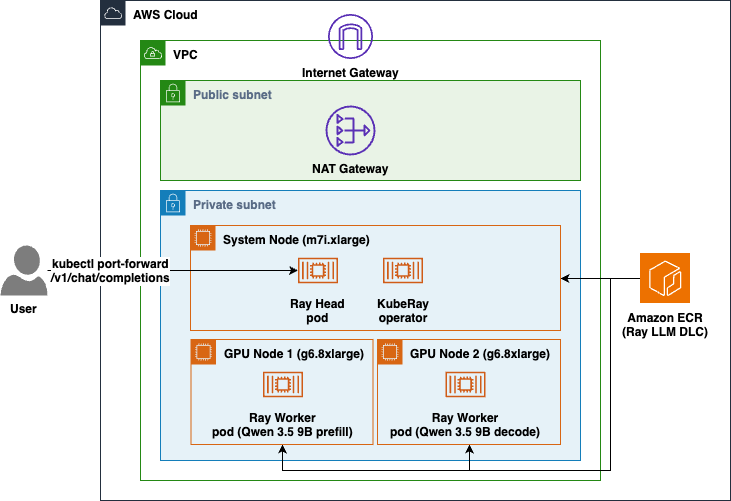
- This architecture allows for separate prefill and decode nodes, improving throughput and reducing latency.
- The pre-built containers simplify the deployment process, enabling developers to focus on configuration rather than assembly.
- Organizations can leverage this capability to enhance their AI applications and streamline their machine learning workflows.
Amazon Web Services (AWS) has unveiled a significant enhancement to its machine learning capabilities with the introduction of multi-node inference workloads using Ray LLM Deep Learning Containers. This new feature allows developers to deploy large language models (LLMs) across multiple GPU nodes on Amazon Elastic Kubernetes Service (EKS). By leveraging separate prefill and decode nodes, users can streamline their inference processes while maintaining compatibility with OpenAI's API, making it easier for developers to integrate advanced AI functionalities into their applications.
The Ray LLM Deep Learning Containers come pre-built with the complete inference stack, enabling users to focus on configuration rather than assembly. This approach simplifies the deployment process, allowing organizations to harness the power of LLMs without needing extensive expertise in machine learning infrastructure. The multi-node setup is particularly beneficial for applications that require high throughput and low latency, as it allows for the distribution of workloads across multiple GPUs, thereby improving performance and scalability.
Key facts
| Field | Detail |
|---|---|
| Launch Date | October 2023 |
| Technology | Ray LLM Deep Learning Containers |
| Deployment Platform | Amazon Elastic Kubernetes Service (EKS) |
| Compatibility | OpenAI-compatible API |
| Node Configuration | Separate prefill and decode nodes |
| Use Case | Multi-node inference for large language models |
| Target Users | Developers and organizations utilizing LLMs for various applications |
| Performance Benefit | Improved throughput and reduced latency for inference workloads |
| Pre-built Container | Ships with full inference stack for ease of deployment |
| Focus | Simplifying the deployment of large language models across multiple GPU nodes |
The players
The key players involved in this development include Amazon Web Services (AWS), which is spearheading the deployment of Ray LLM Deep Learning Containers, and the Ray community, which has contributed to the development of the Ray framework. Additionally, organizations that rely on large language models for their applications stand to benefit significantly from this new capability.
Ray, an open-source framework for distributed computing, has gained traction in the machine learning community for its ability to simplify the process of scaling applications across multiple nodes. By integrating Ray with AWS's infrastructure, developers can now deploy LLMs more efficiently, leveraging the cloud's scalability and flexibility.
Historically, deploying large language models has been a complex and resource-intensive process. Traditional methods often required extensive manual configuration and optimization, which could be a barrier for many organizations looking to adopt AI technologies. With the introduction of multi-node inference workloads, AWS aims to reduce these barriers, making it easier for developers to implement advanced AI solutions.
The evolution of machine learning infrastructure has seen significant advancements in recent years. Previous generations of deployment methods often relied on single-node setups, which limited performance and scalability. As AI applications have become more demanding, the need for multi-node architectures has grown. AWS's latest offering aligns with this trend, providing a robust solution for organizations looking to leverage the power of LLMs without the complexities typically associated with such deployments.
How to read the numbers
While specific performance metrics for the multi-node inference workloads have not been disclosed, the architecture's design suggests substantial improvements in throughput and latency. The separation of prefill and decode nodes allows for optimized resource allocation, which can lead to enhanced performance in real-world applications. Developers can expect to see improvements in response times and the ability to handle larger volumes of requests simultaneously.
What you can do with it
- Deploy LLMs with Ease: Utilize the pre-built Ray LLM Deep Learning Containers to quickly set up large language models on AWS EKS.
- Optimize Performance: Take advantage of the multi-node architecture to distribute workloads across multiple GPUs, enhancing throughput and reducing latency.
- Integrate with Existing Systems: Leverage the OpenAI-compatible API to seamlessly integrate LLM capabilities into your existing applications.
- Experiment and Scale: Use the flexibility of AWS's cloud infrastructure to experiment with different configurations and scale your deployments as needed.
- Focus on Development: Shift your focus from infrastructure management to application development, allowing for faster innovation cycles.
What we're watching
As AWS continues to roll out this new capability, the machine learning community will be keenly observing user adoption rates and performance benchmarks. The success of multi-node inference workloads could pave the way for further enhancements in cloud-based AI solutions. Additionally, how competitors respond to this offering will be crucial in shaping the future landscape of machine learning deployment.
Looking ahead, AWS's integration of Ray LLM Deep Learning Containers represents a pivotal moment in the deployment of large language models. As organizations increasingly seek to harness the power of AI, the ability to efficiently deploy and scale these models will be paramount. The combination of AWS's robust infrastructure and Ray's distributed computing capabilities positions this offering as a game-changer for developers and businesses alike. With the rapid pace of innovation in the AI space, the implications of this development could extend far beyond just improved performance, potentially influencing the broader adoption of AI technologies across various industries.
Source: AWS Machine Learning · Read original →
Instagram & TikTok: copy the link or quote and paste into a Story, Reel, or caption.
Digest
AI news by email
Weekly Friday briefings plus midweek notes when models or research drop. Sources included — unsubscribe anytime.
Discussion
Comment here after signing in, or share the story to continue the conversation elsewhere.
Instagram & TikTok: copy the link and paste into a Story, Reel, or caption.
Log in or create an account to comment — Google / GitHub / X when those providers are configured.
No comments yet — start the thread.