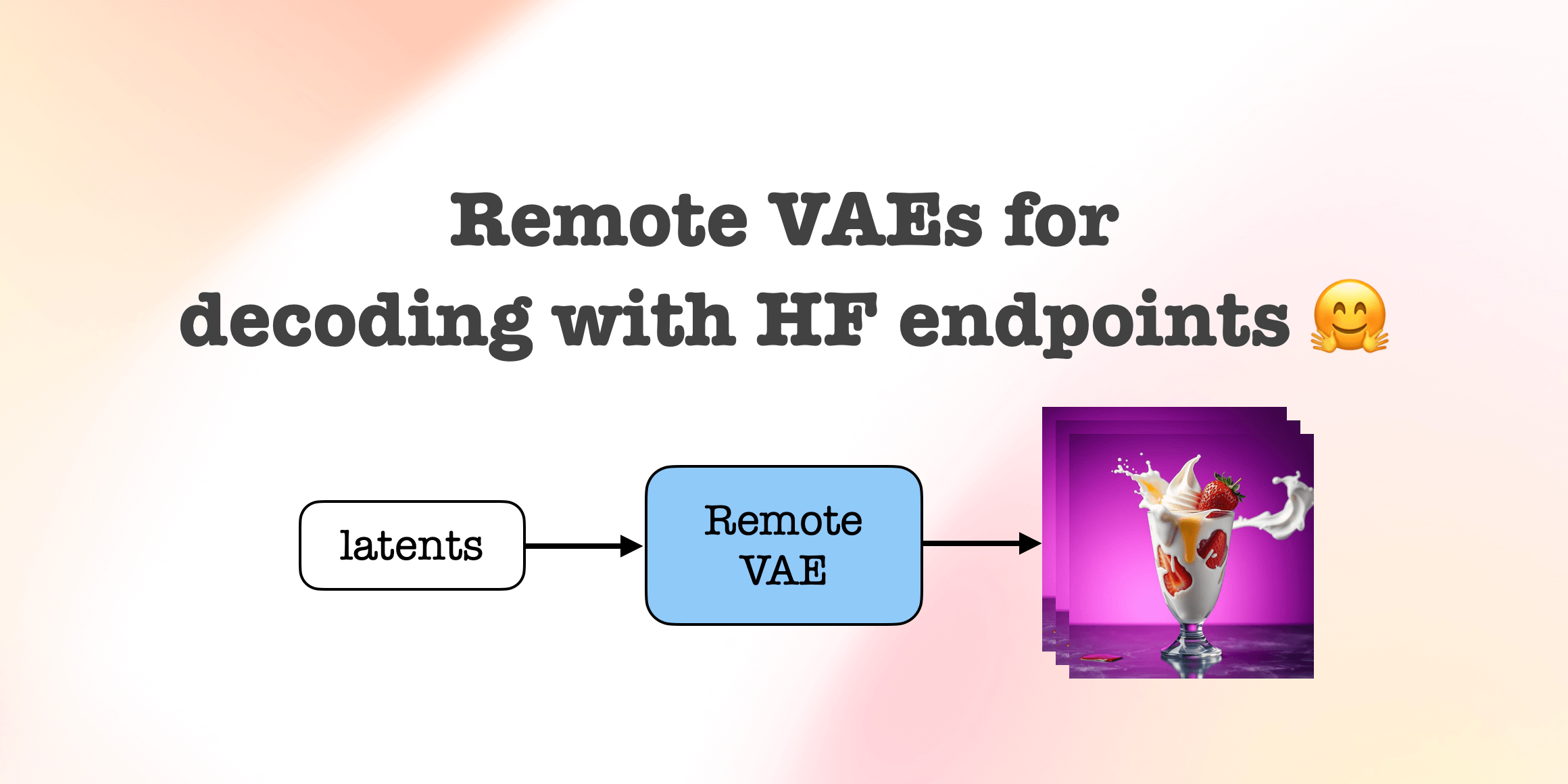
Remote VAEs for decoding with Inference Endpoints 🤗
Hugging Face introduces Remote VAEs to enhance decoding capabilities with Inference Endpoints.
Hugging Face has unveiled Remote Variational Autoencoders (VAEs) designed to enhance decoding capabilities through their Inference Endpoints. This new feature aims to support efficient decoding for large-scale models, making it easier for developers to deploy complex AI systems in production environments. By integrating seamlessly with Hugging Face's Inference API, Remote VAEs promise to optimize performance, particularly for applications that require real-time processing.
The introduction of Remote VAEs marks a significant advancement in the way developers can leverage Hugging Face's platform. With the growing demand for AI applications that can handle large datasets and complex tasks, the ability to efficiently decode outputs from large models is crucial. The Remote VAEs are engineered to address these challenges, providing a robust solution that can scale with the needs of various applications, from natural language processing to image generation.
Key facts
| Field | Detail |
|---|---|
| Product | Remote Variational Autoencoders (VAEs) |
| Integration | Hugging Face Inference API |
| Primary Function | Enhances decoding capabilities for large-scale models |
| Performance Optimization | Tailored for real-time applications |
| Deployment Efficiency | Facilitates faster model deployment |
The broader implications of Remote VAEs extend beyond just decoding capabilities. Variational Autoencoders have long been a staple in generative modeling, allowing for the creation of new data points that resemble a training dataset. By enhancing these capabilities in a remote setting, Hugging Face is positioning itself as a leader in the AI space, particularly for developers looking to implement sophisticated models without the overhead of managing local resources. This aligns with the industry's shift towards cloud-based solutions, where scalability and efficiency are paramount.
As the demand for real-time AI applications continues to rise, the introduction of Remote VAEs could set a new standard for how models are deployed and utilized. Developers will likely find that the combination of efficient decoding and seamless integration with existing APIs allows for quicker iterations and more innovative applications. Looking ahead, it will be interesting to see how this technology influences the development of future AI models and whether other platforms will follow suit in offering similar capabilities.
Source: Hugging Face Blog · Read original →
Discussion
Comment here after signing in, or share the story to continue the conversation elsewhere.
Instagram & TikTok: copy the link and paste into a Story, Reel, or post caption.
Log in or create an account to comment — Google / GitHub / X when those providers are configured.
No comments yet — start the thread.