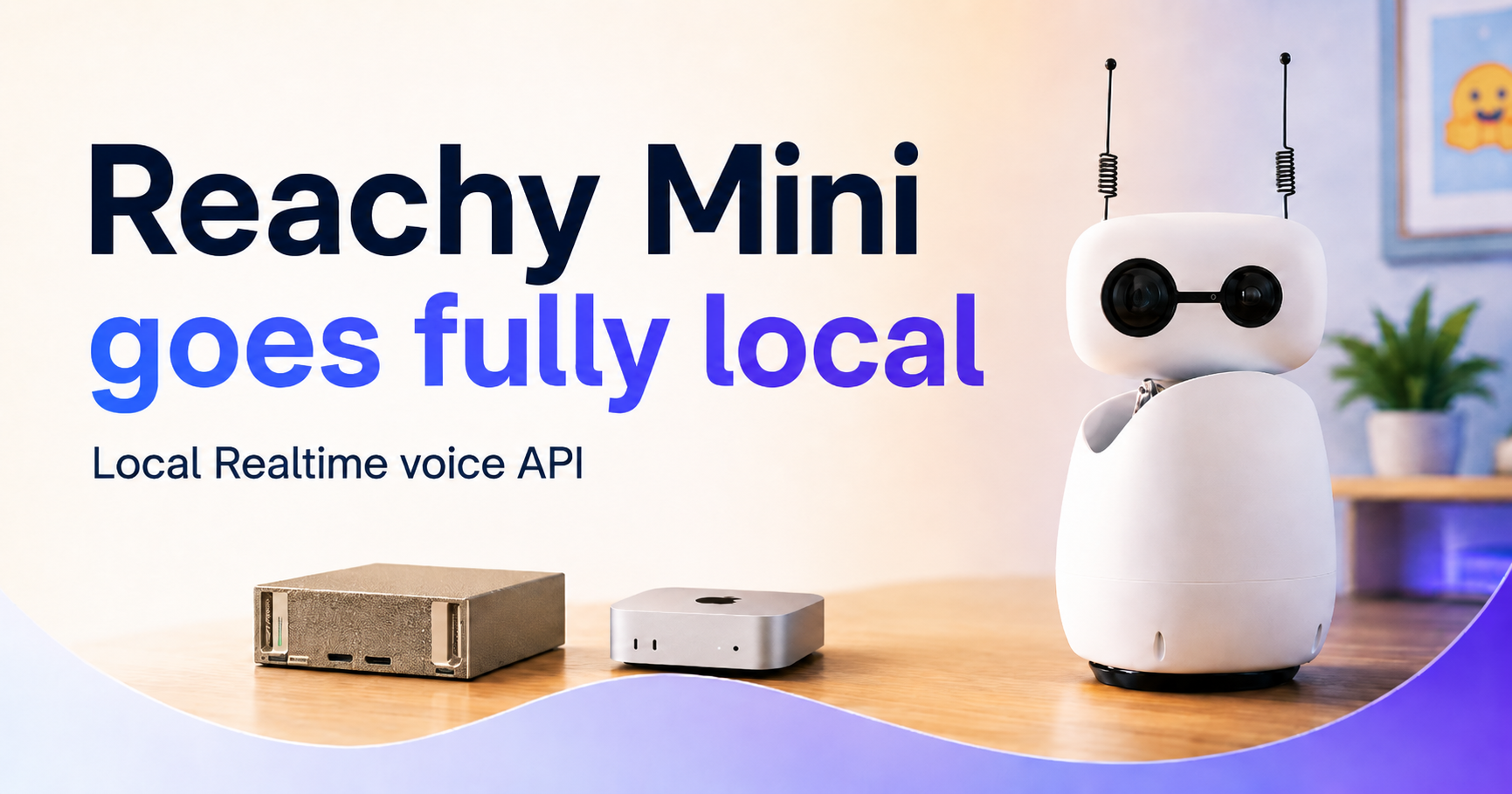
Reachy Mini goes fully local
Reachy Mini's latest update allows for fully local processing, boosting efficiency and security for AI developers.
Reachy Mini, the versatile robotic platform developed by Hugging Face, has announced a significant update that enables fully local processing capabilities. This advancement is poised to enhance the efficiency and security of AI developers who utilize the platform for their projects. By shifting from cloud-based processing to local execution, Reachy Mini allows developers to run AI models directly on the robot, reducing latency and increasing data privacy. This move aligns with the growing demand for more autonomous and secure AI solutions in various applications, from research to industrial automation.
The decision to implement local processing comes as part of a broader trend in the AI and robotics industries, where developers are increasingly seeking ways to minimize reliance on cloud infrastructure. With local processing, Reachy Mini can operate in environments where internet connectivity may be limited or unreliable, making it a more robust option for developers working in diverse settings. This update not only improves performance but also addresses concerns regarding data security, as sensitive information can be processed without being transmitted over the internet.
Key facts
| Field | Detail |
|---|---|
| Product Name | Reachy Mini |
| New Feature | Fully local processing capabilities |
| Developer | Hugging Face |
| Benefits | Enhanced efficiency and security for AI models |
| Use Cases | Robotics, industrial automation, research |
| Connectivity Requirement | No internet required for local processing |
The introduction of local processing capabilities is particularly relevant in the context of the ongoing evolution of AI technologies. As organizations increasingly adopt AI solutions, the need for real-time processing and data privacy has become paramount. Local processing enables developers to deploy AI models that can respond to inputs instantaneously, which is crucial for applications in robotics where timing and precision are essential. This shift mirrors similar developments in other sectors, such as edge computing, where processing power is moved closer to the data source to improve responsiveness and security.
Moreover, the move to local processing could potentially set a new standard for how robotics platforms are developed and utilized. As AI models become more complex and capable, the ability to run them locally on devices like Reachy Mini could lead to a new wave of innovation in autonomous systems. Developers may find new ways to leverage this technology, creating applications that were previously thought to be limited by cloud dependency. The implications for industries such as healthcare, logistics, and manufacturing could be profound, as robots become more capable of making decisions and executing tasks independently.
Looking ahead, it will be interesting to see how developers adapt to these new capabilities and what innovative applications emerge from this shift. The success of Reachy Mini's local processing could encourage other robotics platforms to follow suit, potentially leading to a more decentralized approach to AI development. As the demand for secure and efficient AI solutions continues to rise, the industry may witness a significant transformation in how robots are integrated into various workflows, paving the way for smarter, more autonomous systems.
Source: Hugging Face Blog · Read original →
Discussion
Comment here after signing in, or share the story to continue the conversation elsewhere.
Instagram & TikTok: copy the link and paste into a Story, Reel, or post caption.
Log in or create an account to comment — Google / GitHub / X when those providers are configured.
No comments yet — start the thread.
