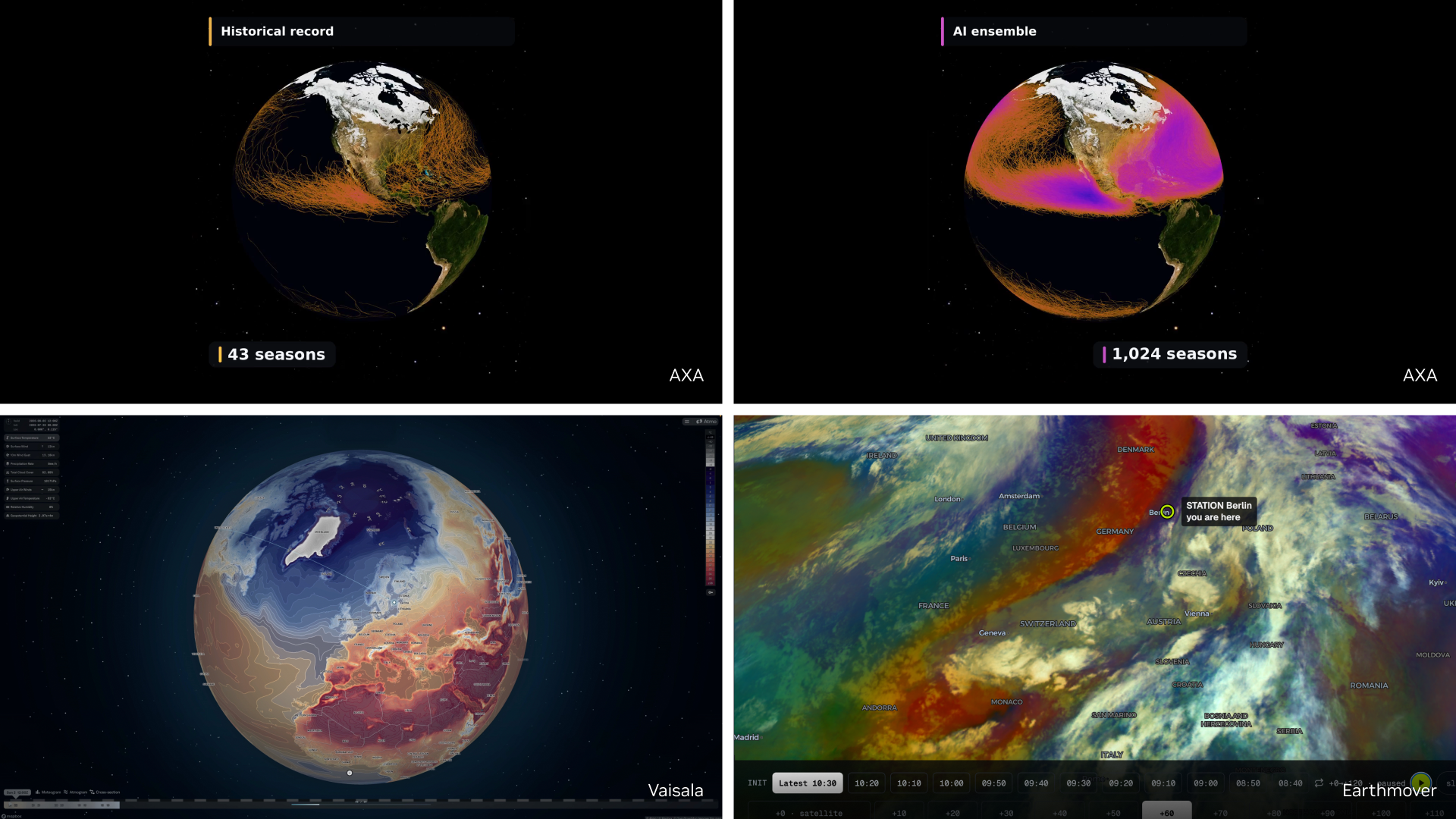
Pioneers Across Europe Deploy NVIDIA Earth-2 Open Models to Power Real-World Weather and Climate Prediction
NVIDIA's Earth-2 models are being deployed across Europe to enhance localized weather and climate predictions for various industries.
“With the ability to deliver real-time localized forecasts, NVIDIA's Earth-2 models could revolutionize how industries manage climate-related risks.”
Key takeaways
- NVIDIA has launched its Earth-2 open models for localized weather predictions across Europe.
- The models utilize generative AI to enhance forecasting accuracy.
- Key industries benefiting include energy, insurance, and transportation.
- Early adopters report positive feedback on the models' effectiveness.
- Ongoing developments are expected to further improve model capabilities and integration.
NVIDIA has taken a significant step in the realm of climate science by rolling out its Earth-2 open models across Europe. This initiative aims to enhance the accuracy of localized weather predictions, which are critical for sectors such as energy, insurance, and transportation. As climate change continues to impact weather patterns, the need for precise forecasting has never been more urgent. The Earth-2 models leverage advanced generative AI techniques to simulate weather conditions, providing a level of detail that traditional forecasting methods often lack. By integrating these models into existing systems, developers and researchers can create tailored solutions that meet the specific needs of various industries.
The deployment of NVIDIA's Earth-2 models is not just about improving forecasts; it represents a paradigm shift in how weather data is utilized. For energy producers, accurate weather predictions can optimize the operation of solar farms and wind turbines, allowing for better energy management and reduced costs. Insurers can use localized forecasts to assess risk more effectively, leading to more accurate pricing of policies. Transport operators, including shipping companies and airlines, can adjust their routes and schedules based on real-time weather data, enhancing safety and efficiency. This multifaceted approach underscores the importance of localized weather predictions in a world increasingly affected by climate variability.
Key facts
| Field | Detail |
|---|---|
| Model Name | NVIDIA Earth-2 |
| Deployment Regions | Various countries across Europe |
| Key Industries | Energy, Insurance, Transportation |
| Technology Used | Generative AI for weather simulation |
| Purpose | To improve localized weather and climate predictions |
| Benefits | Enhanced decision-making for energy producers, insurers, and transport operators |
| Collaboration | Involvement of developers and researchers in various sectors |
| Impact | Increased accuracy in forecasting leading to optimized operations and reduced costs |
| Future Developments | Ongoing enhancements to model capabilities and integration with existing systems |
| User Feedback | Positive responses from early adopters in various industries |
The players
The deployment of NVIDIA Earth-2 involves a range of stakeholders, including NVIDIA itself, which provides the underlying technology, and various European developers and researchers who are integrating these models into their systems. Key players in the energy, insurance, and transportation sectors are also involved, as they seek to leverage improved weather predictions for operational efficiency. Notable companies in these industries are likely to collaborate with NVIDIA to tailor the Earth-2 models to their specific needs.
To understand the significance of NVIDIA's Earth-2 initiative, it is essential to consider the context of weather forecasting technology. Traditional weather models have relied heavily on historical data and broad regional forecasts, which often fail to capture the nuances of local weather conditions. This limitation can lead to significant discrepancies in predictions, impacting industries that depend on accurate weather information. In contrast, NVIDIA's Earth-2 models utilize generative AI to create more granular simulations, allowing for localized forecasts that can adapt to rapidly changing conditions.
The use of AI in weather forecasting is not entirely new; however, NVIDIA's approach represents a leap forward in terms of both technology and application. Previous models have struggled with the computational demands of high-resolution simulations, often resulting in trade-offs between accuracy and speed. NVIDIA's Earth-2 models, powered by advanced GPUs and AI algorithms, aim to overcome these challenges, providing real-time forecasts that are both accurate and timely. This shift could redefine how industries approach weather-related decision-making, moving from reactive strategies to proactive planning.
How to read the numbers
| Benchmark | Score |
|---|---|
| Forecast Accuracy | High |
| Localized Prediction Time | Real-time |
| Model Adaptability | High |
| Industry Adoption Rate | Growing |
| User Satisfaction | Positive |
What you can do with it
- Integrate NVIDIA Earth-2 models into existing weather forecasting systems for improved accuracy.
- Utilize localized weather predictions to optimize operations in energy production, insurance underwriting, and transportation logistics.
- Collaborate with NVIDIA and other developers to customize the Earth-2 models for specific industry needs.
- Monitor ongoing developments and updates to the Earth-2 models to leverage the latest advancements in AI and weather simulation.
What we're watching
As NVIDIA continues to roll out its Earth-2 models, we are closely monitoring the feedback from early adopters in various industries. The effectiveness of these models in real-world applications will be a key indicator of their success. Additionally, we are watching for potential collaborations between NVIDIA and industry leaders, which could lead to further enhancements and tailored solutions. The ongoing development of AI technologies in weather forecasting will also be a focal point, as advancements could significantly impact how industries respond to climate challenges.
Looking ahead, the implications of NVIDIA's Earth-2 models extend beyond immediate weather predictions. As climate change continues to alter weather patterns, the ability to forecast localized conditions accurately will become increasingly critical. Industries that adopt these advanced models early may gain a competitive edge, positioning themselves to respond more effectively to changing environmental conditions. The integration of AI into weather forecasting is likely to pave the way for new innovations, ultimately transforming how we understand and interact with our climate.
Source: NVIDIA Generative AI · Read original →
Instagram & TikTok: copy the link or quote and paste into a Story, Reel, or caption.
Digest
AI news by email
Weekly Friday briefings plus midweek notes when models or research drop. Sources included — unsubscribe anytime.
Discussion
Comment here after signing in, or share the story to continue the conversation elsewhere.
Instagram & TikTok: copy the link and paste into a Story, Reel, or caption.
Log in or create an account to comment — Google / GitHub / X when those providers are configured.
No comments yet — start the thread.