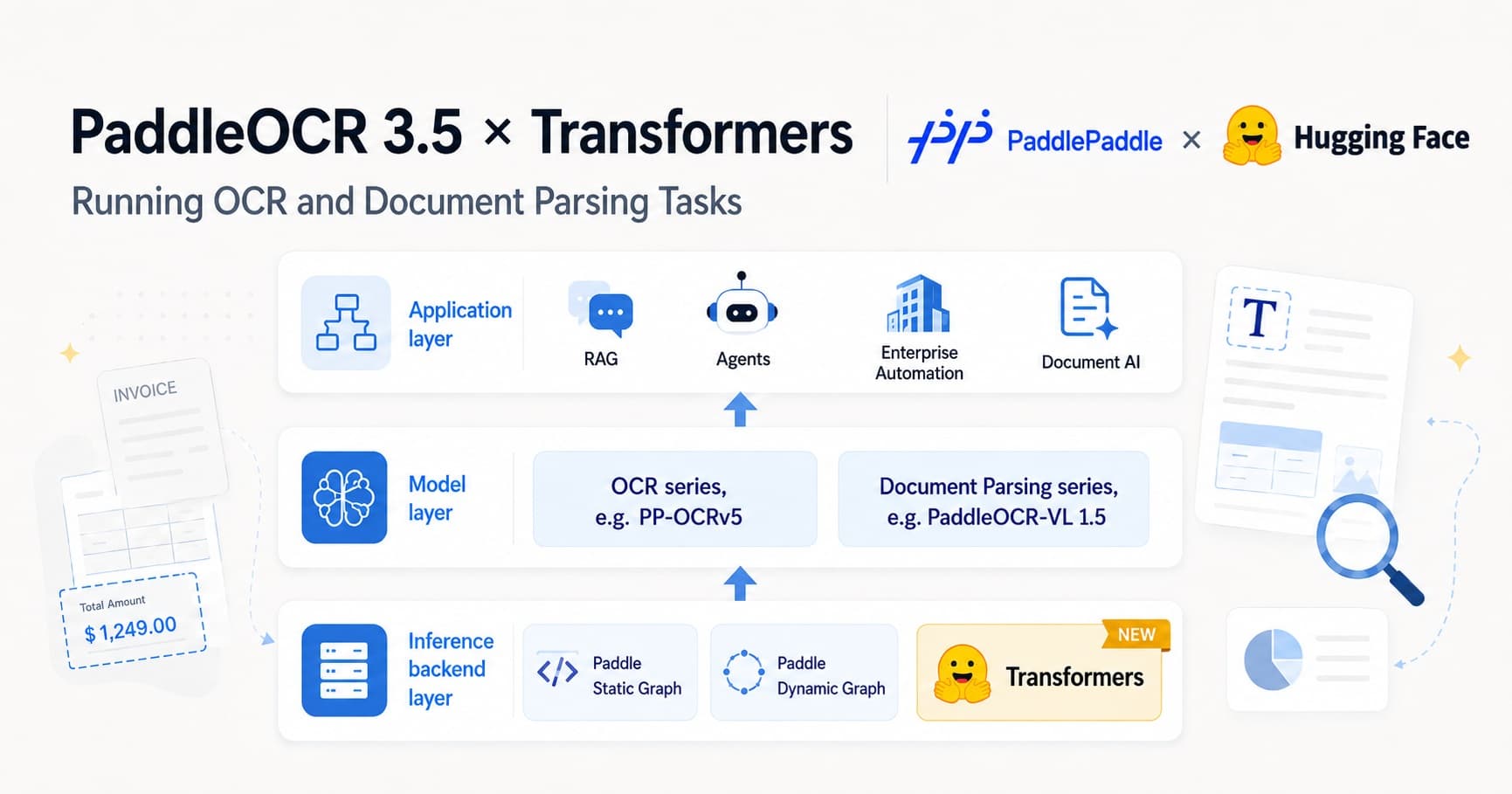
PaddleOCR 3.5: Running OCR and Document Parsing Tasks with a Transformers Backend
PaddleOCR 3.5 introduces enhanced OCR capabilities with Transformers, supporting over 80 languages and boosting document parsing accuracy.
PaddleOCR has officially released version 3.5, marking a significant upgrade in its optical character recognition (OCR) capabilities. This latest iteration integrates a Transformers backend, which enhances the model's ability to understand and process text from images and documents. With support for over 80 languages, PaddleOCR 3.5 aims to cater to a global audience, making it a valuable tool for developers and businesses that require efficient document processing across diverse linguistic contexts.
The introduction of Transformers into PaddleOCR is particularly noteworthy, as this architecture has revolutionized various natural language processing tasks in recent years. By leveraging the strengths of Transformers, PaddleOCR 3.5 not only improves the accuracy of text recognition but also enhances the overall performance of document parsing tasks. This means that users can expect more reliable outputs when extracting information from scanned documents, images, and other visual formats, which is crucial for applications in sectors like finance, legal, and education.
Key facts
| Field | Detail |
|---|---|
| Version | 3.5 |
| Backend Technology | Transformers |
| Language Support | Over 80 languages |
| Key Improvements | Enhanced OCR accuracy and document parsing |
| Target Users | Developers and businesses requiring OCR |
PaddleOCR is part of the broader trend in AI and machine learning where traditional OCR technologies are being augmented with deep learning techniques. The integration of Transformers aligns PaddleOCR with other leading OCR solutions that have adopted similar methodologies, such as Google's Tesseract and Amazon Textract. These advancements are not just about improving accuracy; they also focus on making OCR technology more accessible and user-friendly, allowing developers to integrate sophisticated text recognition capabilities into their applications with minimal effort.
The implications of PaddleOCR 3.5 extend beyond just improved accuracy and language support. As businesses increasingly rely on digital documentation, the ability to accurately parse and extract information from various formats becomes essential. This version's enhancements can significantly reduce the time and resources spent on manual data entry and increase operational efficiency. Moreover, the support for a wide array of languages positions PaddleOCR as a competitive option in the global market, appealing to organizations that operate in multilingual environments.
Looking ahead, the release of PaddleOCR 3.5 sets the stage for further innovations in OCR technology. As more developers adopt this tool, we can expect to see a surge in applications that utilize its capabilities for automated data extraction and processing. Additionally, the ongoing advancements in AI and machine learning will likely lead to even more sophisticated OCR solutions in the near future, potentially incorporating features like real-time text recognition and enhanced contextual understanding.
Source: Hugging Face Blog · Read original →
Discussion
Comment here after signing in, or share the story to continue the conversation elsewhere.
Instagram & TikTok: copy the link and paste into a Story, Reel, or post caption.
Log in or create an account to comment — Google / GitHub / X when those providers are configured.
No comments yet — start the thread.
