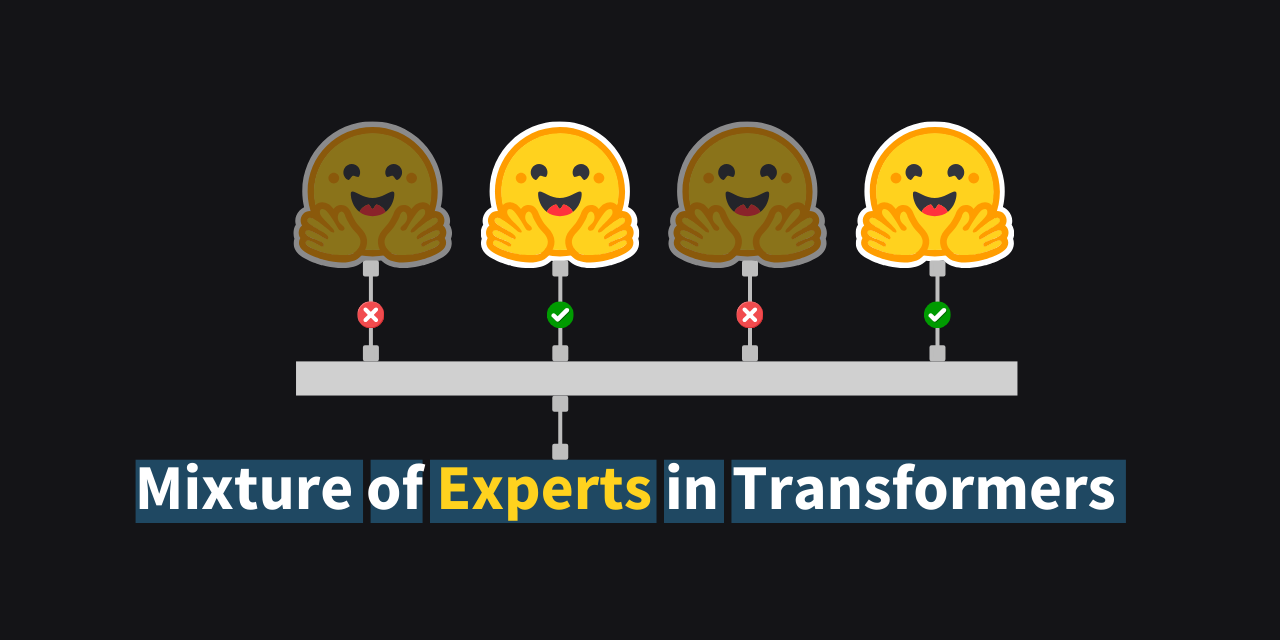
Mixture of Experts (MoEs) in Transformers
Transformers are now utilizing Mixture of Experts to enhance performance while reducing computational costs.
Recent advancements in transformer architecture have introduced the concept of Mixture of Experts (MoEs), a technique that allows models to activate only a subset of their parameters during training and inference. This innovation promises to significantly enhance both performance and efficiency, particularly in natural language processing (NLP) tasks. By leveraging MoEs, developers can create models that not only perform better but also do so at a fraction of the computational cost typically associated with traditional transformer models. The implications of this are profound, as it opens up new avenues for deploying AI solutions across various applications.
The implementation of MoEs involves a strategic selection of which parameters to activate based on the input data, allowing the model to focus its computational resources where they are most needed. This selective activation is crucial for scaling models effectively, especially as datasets continue to grow in size and complexity. Recent studies have shown that models utilizing MoEs can outperform their traditional counterparts in several NLP benchmarks, indicating a significant leap in both efficiency and capability. The research community is taking notice, and the excitement around this technique is palpable as more developers explore its potential.
Key facts
| Field | Detail |
|---|---|
| Technique | Mixture of Experts (MoEs) |
| Primary Benefit | Reduced computational costs |
| Application | Natural Language Processing (NLP) |
| Performance Comparison | Outperforms traditional models in various tasks |
| Scalability | Efficient scaling with larger datasets |
The introduction of MoEs into transformer models is part of a broader trend in AI and machine learning towards more efficient architectures. Traditionally, deep learning models have required vast amounts of computational power, often leading to prohibitive costs for developers and researchers. Techniques like MoEs are a response to this challenge, enabling models to maintain high performance while minimizing resource consumption. This shift is not only beneficial for large organizations but also democratizes access to advanced AI capabilities for smaller teams and startups.
As the AI landscape evolves, the adoption of MoEs could redefine how models are trained and deployed. The potential for faster training times and reduced operational costs means that businesses can iterate more quickly and innovate without the heavy burden of computational expenses. Looking ahead, the challenge will be to refine these techniques further and ensure they can be integrated seamlessly into existing workflows. Researchers are likely to continue exploring the boundaries of MoEs, seeking to unlock even greater efficiencies and capabilities in future AI models.
Source: Hugging Face Blog · Read original →
Discussion
Comment here after signing in, or share the story to continue the conversation elsewhere.
Instagram & TikTok: copy the link and paste into a Story, Reel, or post caption.
Log in or create an account to comment — Google / GitHub / X when those providers are configured.
No comments yet — start the thread.