Introducing 🤗 Accelerate
Hugging Face launches 🤗 Accelerate to optimize and speed up PyTorch model training.
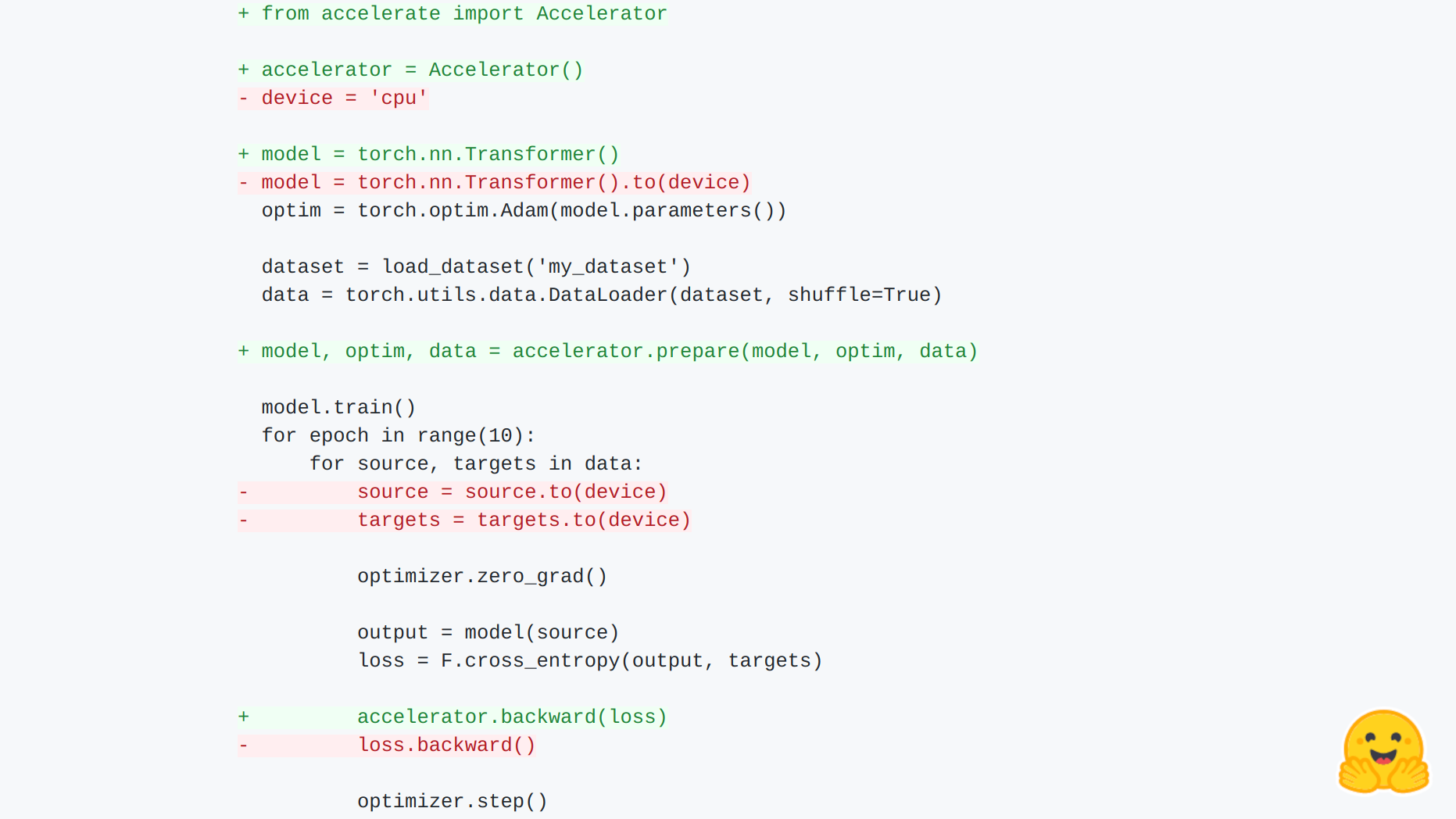
Hugging Face has unveiled 🤗 Accelerate, a new tool designed to streamline the training of PyTorch models, significantly enhancing the speed and efficiency of the process. This innovative framework is tailored for developers and researchers who are looking to optimize their machine learning workflows without the need for extensive code modifications. By simplifying the setup and execution of training processes, 🤗 Accelerate promises to reduce the time it takes to train models, allowing users to focus more on experimentation and less on configuration.
The introduction of 🤗 Accelerate comes at a time when the demand for faster and more efficient model training is at an all-time high. As machine learning models grow in complexity and size, the computational resources required for training also increase. Hugging Face aims to address these challenges by providing a solution that not only supports multi-GPU and TPU setups but also minimizes the amount of code changes necessary to implement these optimizations. This means that developers can quickly adopt 🤗 Accelerate into their existing workflows, maximizing their productivity without a steep learning curve.
Key facts
| Field | Detail |
|---|---|
| Tool Name | 🤗 Accelerate |
| Supported Framework | PyTorch |
| Multi-GPU/TPU Support | Yes |
| Code Changes Required | Minimal |
| Main Benefit | Significantly reduces training time |
The launch of 🤗 Accelerate is particularly relevant in the context of the growing competition in the AI and machine learning space. As organizations strive to develop and deploy models faster than ever, tools that can optimize training processes are becoming increasingly valuable. Previous frameworks, such as TensorFlow's Keras and NVIDIA's Apex, have also aimed to streamline model training, but 🤗 Accelerate's focus on minimal code changes and ease of integration sets it apart. This could potentially lead to a wider adoption of Hugging Face's ecosystem among developers who are already familiar with PyTorch.
Moreover, the ability to leverage multi-GPU and TPU setups is crucial for scaling up training processes. As models become larger and datasets more complex, the need for parallel processing capabilities becomes essential. 🤗 Accelerate not only facilitates this but does so in a way that is accessible to users who may not have extensive experience with distributed computing. This democratization of advanced training techniques could empower a new wave of developers to tackle ambitious AI projects that were previously out of reach.
Looking ahead, the real test for 🤗 Accelerate will be its adoption within the community and its performance in real-world applications. As developers begin to integrate this tool into their workflows, feedback will be critical in shaping its future iterations. Additionally, Hugging Face's commitment to open-source principles means that users can expect ongoing improvements and community-driven enhancements, which will be vital for maintaining relevance in a rapidly evolving field. The success of 🤗 Accelerate could also inspire similar initiatives from other AI frameworks, further driving innovation in model training efficiency.
Source: Hugging Face Blog · Read original →
Discussion
Comment here after signing in, or share the story to continue the conversation elsewhere.
Instagram & TikTok: copy the link and paste into a Story, Reel, or post caption.
Log in or create an account to comment — Google / GitHub / X when those providers are configured.
No comments yet — start the thread.