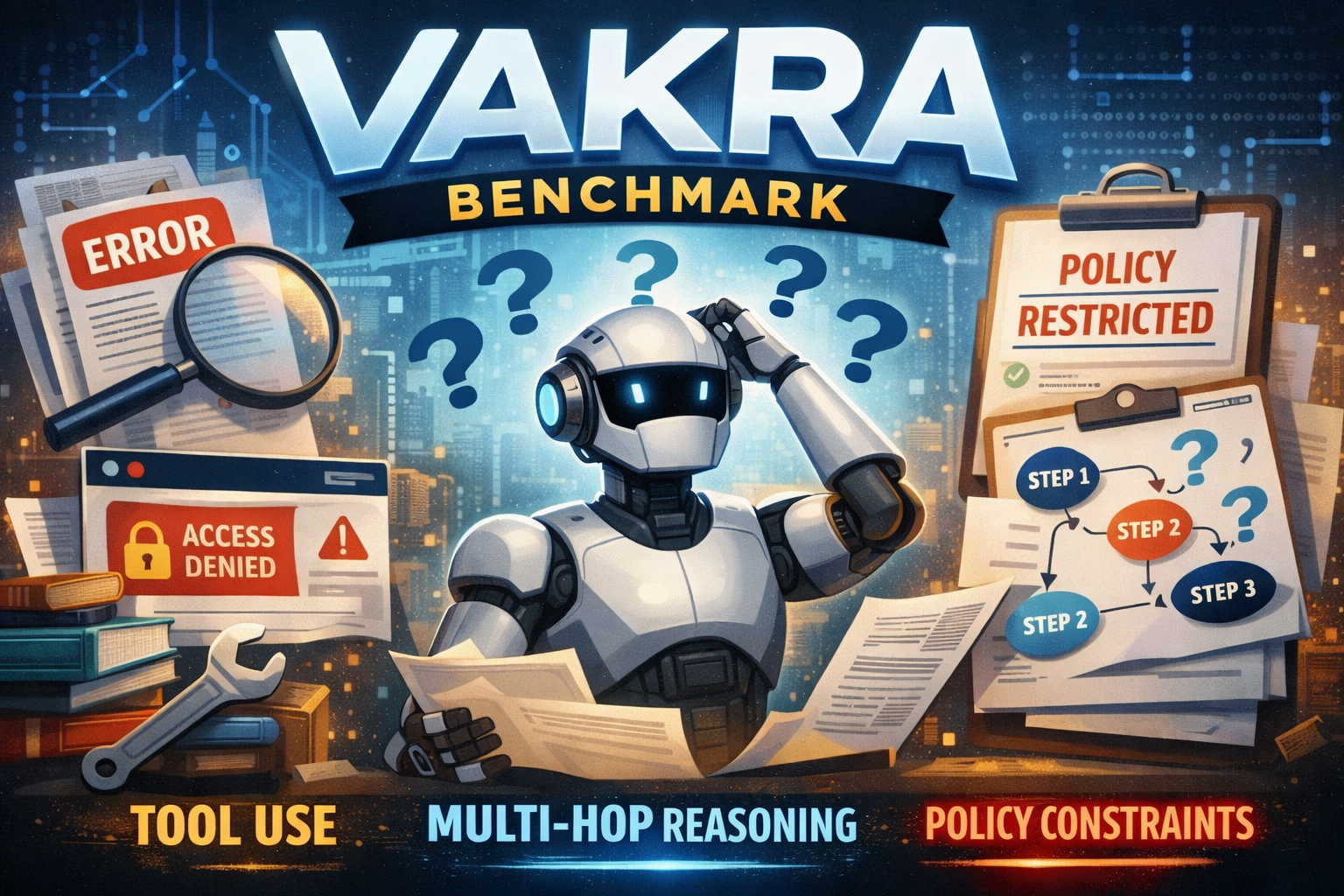
Inside VAKRA: Reasoning, Tool Use, and Failure Modes of Agents
Hugging Face unveils VAKRA, a model that enhances agent reasoning and tool use while addressing common AI failure modes.
Hugging Face has introduced VAKRA, a groundbreaking model designed to significantly enhance the reasoning capabilities of AI agents. This innovative approach not only improves how agents process information but also integrates tool use, allowing them to perform tasks more effectively. By addressing prevalent failure modes that often hinder AI performance, VAKRA aims to set a new standard in the development of intelligent agents capable of tackling complex challenges across various domains.
The development of VAKRA comes at a crucial time when the demand for more sophisticated AI agents is on the rise. As industries increasingly rely on AI for decision-making, automation, and problem-solving, the limitations of existing models have become more apparent. VAKRA's introduction signals a shift towards more capable AI systems that can reason through problems, utilize tools efficiently, and minimize errors that have plagued earlier iterations of AI agents. This model is expected to have a wide-ranging impact, from enhancing customer service bots to improving data analysis tools in finance and healthcare.
Key facts
| Field | Detail |
|---|---|
| Model Name | VAKRA |
| Developer | Hugging Face |
| Key Features | Enhanced reasoning, tool use integration, failure mode mitigation |
| Target Applications | Complex task performance across various industries |
| Release Date | Announced, available for further exploration |
VAKRA's focus on reasoning and tool use is particularly noteworthy in the context of AI's evolution. Historically, AI agents have struggled with tasks that require a nuanced understanding of context or the ability to employ external tools effectively. For instance, earlier models often failed in scenarios that required multi-step reasoning or the application of knowledge to new situations. VAKRA's advancements could potentially bridge these gaps, offering a more robust solution that learns from its interactions and adapts accordingly.
Looking ahead, the implications of VAKRA's capabilities are vast. As organizations begin to integrate this model into their workflows, it will be essential to monitor its performance in real-world applications. The model's ability to reduce failure rates and enhance task execution will be critical in determining its success. Furthermore, the AI community will likely scrutinize how VAKRA compares to existing models, such as OpenAI's ChatGPT or Google's Bard, particularly in terms of reasoning and tool utilization. The ongoing development and testing of VAKRA will be pivotal in shaping the future of intelligent agents and their role in various sectors.
Source: Hugging Face Blog · Read original →
Discussion
Comment here after signing in, or share the story to continue the conversation elsewhere.
Instagram & TikTok: copy the link and paste into a Story, Reel, or post caption.
Log in or create an account to comment — Google / GitHub / X when those providers are configured.
No comments yet — start the thread.

