Improve TTFT for multi-turn agentic workloads with bi-directional KV transfer in vLLM
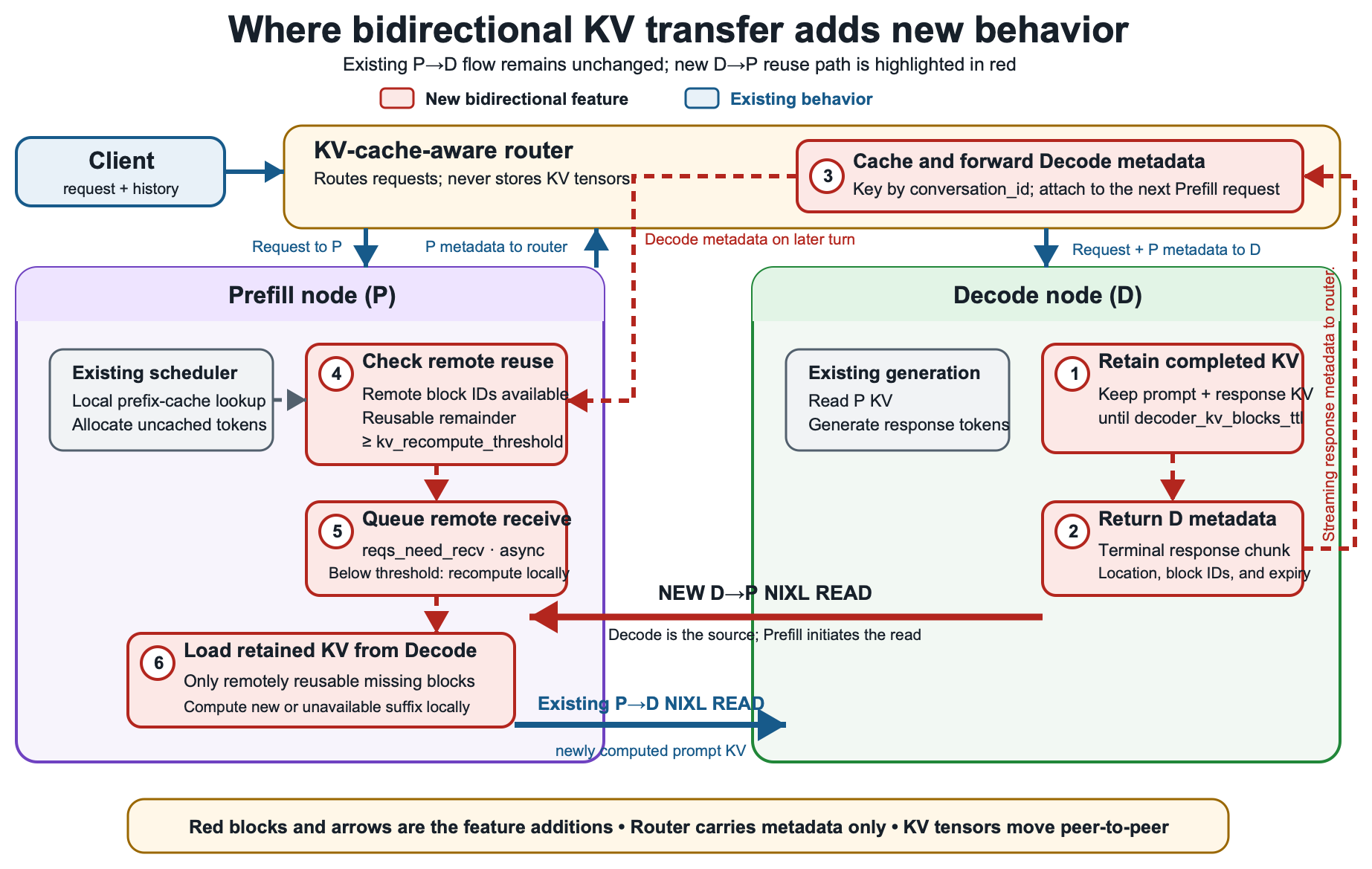
AWS introduces bi-directional KV transfer to enhance efficiency in multi-turn agentic workloads, significantly reducing latency.
“The bi-directional KV cache transfer can reduce latency by up to 3.3 times, revolutionizing the efficiency of multi-turn conversational AI.”
Key takeaways
- AWS has introduced bi-directional KV cache transfer to enhance multi-turn agentic workloads.
- The new method reduces time to first token by up to 3.3 times for specific models.
- This technology is deployed on Amazon EC2 P5en instances with EFA for optimal performance.
- The improvement addresses significant latency issues in conversational AI applications.
- Developers are encouraged to integrate this feature to enhance user experience.
The landscape of artificial intelligence is constantly evolving, and Amazon Web Services (AWS) has recently made a significant stride in optimizing multi-turn agentic workloads through the introduction of bi-directional key-value (KV) cache transfer in their vLLM framework. This innovative approach addresses one of the most pressing challenges in AI conversational models: latency. As the complexity of conversations increases with each turn, the need for efficient processing becomes paramount. AWS's latest enhancement promises to cut the time to first token (TTFT) dramatically, making it a game-changer for developers and businesses relying on real-time conversational AI solutions.
Multi-turn agentic workloads are characterized by their ability to maintain context over several exchanges, which is crucial for applications such as customer service bots, interactive virtual assistants, and any AI that engages in extended dialogues. Traditionally, as the conversation progresses, the model must reprocess an ever-growing context, leading to increased latency and slower response times. AWS's bi-directional KV transfer allows for the reuse of previously computed context across turns, significantly improving efficiency. For instance, the new method has demonstrated a reduction in TTFT by up to 1.6 times for the Qwen3-32B model and an impressive 3.3 times for the GLM-5-FP8 model when deployed on Amazon EC2 P5en instances with Elastic Fabric Adapter (EFA) technology.
Key facts
| Field | Detail |
|---|---|
| Technology | Bi-directional KV cache transfer |
| Models Affected | Qwen3-32B, GLM-5-FP8 |
| Performance Improvement | Up to 1.6x for Qwen3-32B, 3.3x for GLM-5-FP8 |
| Deployment | Amazon EC2 P5en instances with EFA |
| Use Case | Multi-turn agentic workloads |
| Latency Issue Addressed | Growing conversation context |
| Key Feature | Prefill and decode nodes reuse context |
| Target Users | Developers of conversational AI applications |
| Release Date | Recent announcement in October 2023 |
| Impact | Enhanced efficiency in AI-driven conversations |
The players
The key players involved in this development include Amazon Web Services, which is at the forefront of cloud computing and AI services. The specific models mentioned, Qwen3-32B and GLM-5-FP8, are products of ongoing research and development in the field of natural language processing (NLP). These models are designed to handle complex conversational tasks and are now enhanced by AWS's latest technological advancements.
To understand the significance of AWS's bi-directional KV transfer, it's essential to consider the broader context of AI conversational models. Multi-turn dialogues have become increasingly prevalent in various applications, from customer service to personal assistants. However, the challenge of managing context over multiple exchanges has often hindered performance. Prior to this advancement, many models struggled with latency issues, especially as the conversation lengthened. The introduction of bi-directional KV caching represents a substantial leap forward, allowing models to maintain context without the computational overhead that typically accompanies longer dialogues.
Historically, AI models have relied on unidirectional context management, where each turn in a conversation required the model to re-evaluate the entire context from scratch. This approach not only increased latency but also limited the scalability of conversational applications. With AWS's new bi-directional KV transfer, the model can now efficiently access and utilize previously computed context, thereby streamlining the processing of multi-turn dialogues. This shift not only enhances performance but also opens up new possibilities for more complex and engaging conversational experiences.
Benchmark snapshot
Benchmark snapshot
| Benchmark | Performance Improvement |
|---|---|
| Qwen3-32B TTFT | 1.6x reduction |
| GLM-5-FP8 TTFT | 3.3x reduction |
| Latency Reduction | Significant for multi-turn workloads |
| Context Reuse Efficiency | Enhanced by bi-directional transfer |
| Deployment Environment | EC2 P5en with EFA |
The implications of this advancement are profound for developers and businesses leveraging AI in their operations. By significantly reducing latency, AWS's bi-directional KV transfer enables faster and more responsive interactions in conversational applications. This improvement not only enhances user experience but also allows businesses to handle a higher volume of interactions without sacrificing quality. For instance, customer service bots can now respond more quickly to inquiries, leading to improved customer satisfaction and engagement.
Practical takeaways
- Explore the integration of bi-directional KV transfer in existing conversational AI applications to enhance performance.
- Consider deploying on Amazon EC2 P5en instances with EFA for optimal results.
- Monitor the impact of reduced latency on user engagement and satisfaction metrics.
- Stay updated on further developments from AWS regarding enhancements to vLLM and related technologies.
What we're watching
As AWS continues to innovate in the realm of AI and machine learning, the next milestone to watch will be the broader adoption of bi-directional KV transfer across various conversational models. Additionally, the response from competitors in the AI space will be crucial, as they may seek to implement similar or alternative solutions to address the latency challenges in multi-turn dialogues. The ongoing evolution of AI capabilities will undoubtedly lead to new applications and use cases that capitalize on these advancements.
The introduction of bi-directional KV transfer marks a pivotal moment in the development of conversational AI. As businesses increasingly rely on AI-driven interactions, the ability to maintain context efficiently will be paramount. This advancement not only sets a new standard for performance in multi-turn agentic workloads but also raises questions about how other AI models will adapt to meet the growing demands of users. The future of conversational AI is bright, and AWS's latest innovation is a significant step towards realizing its full potential.
Source: AWS Machine Learning · Read original →
Instagram & TikTok: copy the link or quote and paste into a Story, Reel, or caption.
Digest
AI news by email
Weekly Friday briefings plus midweek notes when models or research drop. Sources included — unsubscribe anytime.
Discussion
Comment here after signing in, or share the story to continue the conversation elsewhere.
Instagram & TikTok: copy the link and paste into a Story, Reel, or caption.
Log in or create an account to comment — Google / GitHub / X when those providers are configured.
No comments yet — start the thread.