

How Deepgram optimized voice AI at scale with AWS Trainium
Deepgram enhances its voice AI capabilities by optimizing its Nova-3 model for AWS Trainium, achieving significant performance improvements.
“The shift to AWS Trainium not only boosts Deepgram's performance but also sets a precedent for future AI model optimizations across the industry.”
Key takeaways
- Deepgram optimized its Nova-3 speech-to-text model for AWS Trainium, enhancing performance.
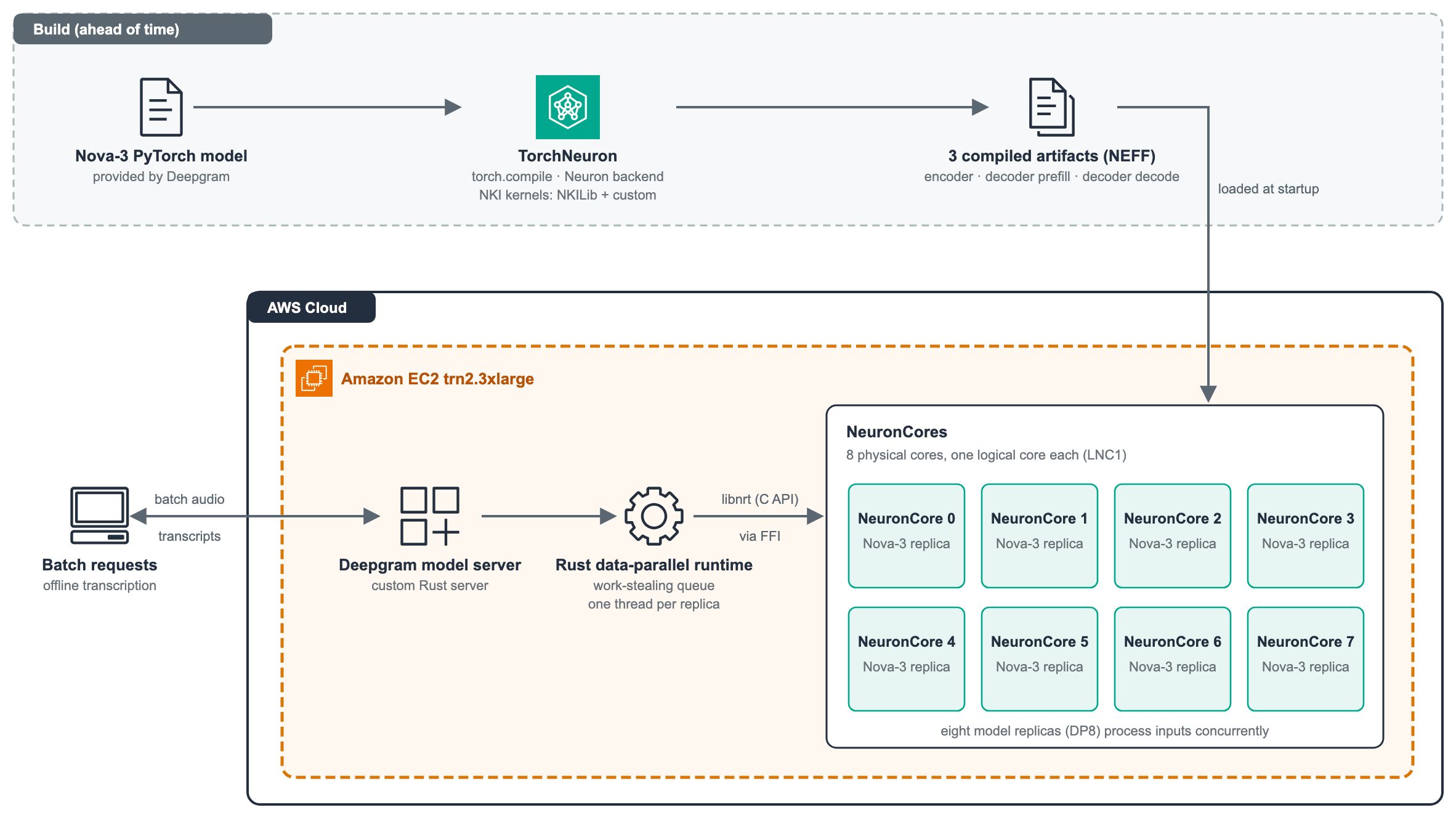
- The collaboration involved kernel-level tuning and a data-parallel Rust runtime.
- AWS Trainium is designed specifically for machine learning workloads, improving efficiency.
- The optimization aims to address latency and cost issues in large-scale deployments.
Deepgram, a leading player in the voice AI sector, has made significant strides in optimizing its Nova-3 speech-to-text model by porting it to AWS Trainium. This collaboration with the AWS Forward Deployed Engineering team aims to leverage the capabilities of AWS's custom silicon to enhance the performance of Deepgram's voice recognition technology. The optimization process involved several technical advancements, including kernel-level tuning and the development of a data-parallel Rust runtime, which together have resulted in impressive throughput and cost efficiencies for offline batch inference tasks.
The transition to AWS Trainium marks a pivotal moment for Deepgram as it seeks to scale its operations and improve the efficiency of its services. AWS Trainium is designed specifically for machine learning workloads, providing a robust platform that can handle the intensive computational demands of training and inference. By utilizing this technology, Deepgram aims to enhance the accuracy and speed of its speech-to-text services, which are critical for applications ranging from customer service automation to real-time transcription in various industries.
Key facts
| Field | Detail |
|---|---|
| Company | Deepgram |
| Model | Nova-3 |
| Technology | AWS Trainium |
| Optimization Techniques | Kernel-level tuning, data-parallel Rust runtime |
| Focus | Offline batch inference |
| Collaboration | AWS Forward Deployed Engineering team |
| Performance Metrics | Improved throughput and cost efficiency |
| Use Cases | Speech-to-text transcription, customer service automation |
| Deployment | AWS Neuron stack |
Who's involved
Deepgram is at the forefront of voice AI technology, providing advanced speech recognition solutions. The AWS Forward Deployed Engineering team, part of Amazon Web Services, has played a crucial role in facilitating the optimization process for Deepgram's Nova-3 model. Their expertise in deploying machine learning models on AWS infrastructure has been instrumental in achieving the desired performance improvements.
The collaboration between Deepgram and AWS is indicative of a broader trend in the tech industry, where companies are increasingly seeking to leverage specialized hardware to enhance the capabilities of their AI models. This partnership not only benefits Deepgram but also showcases the potential of AWS Trainium as a viable option for other companies looking to optimize their machine learning workloads.
Deepgram's Nova-3 model is designed to deliver high-quality speech recognition, and its optimization for AWS Trainium is a significant step forward. Previously, many speech recognition models faced challenges related to latency and cost when deployed at scale. By porting to AWS Trainium, Deepgram aims to address these issues, making its technology more accessible and efficient for a wider range of applications.
Historically, the speech-to-text landscape has been dominated by a few key players, with many relying on traditional GPU-based solutions for their machine learning needs. However, the introduction of specialized hardware like AWS Trainium is changing the game. These advancements allow for greater efficiency and performance, enabling companies like Deepgram to push the boundaries of what is possible in voice AI.
How to read the numbers
While specific performance metrics were not disclosed in the source article, the optimization efforts are expected to yield substantial improvements in both throughput and cost efficiency. The use of AWS Trainium, combined with kernel-level tuning and a data-parallel Rust runtime, suggests a focus on maximizing resource utilization and minimizing latency during batch inference tasks. This is particularly important for applications that require real-time processing of large volumes of audio data.
What you can do with it
- Explore the capabilities of Deepgram's Nova-3 model for your speech recognition needs.
- Consider deploying your machine learning models on AWS Trainium for enhanced performance.
- Leverage the optimizations made by Deepgram as a case study for your own AI projects.
- Stay informed about advancements in voice AI technology and how they can benefit your business.
What we're watching
As Deepgram continues to optimize its Nova-3 model, we are keenly observing the impact of these enhancements on real-world applications. The next milestone will be the release of performance benchmarks that quantify the improvements achieved through this collaboration. Additionally, the broader implications of using AWS Trainium for other AI models will be a focal point, as companies evaluate the trade-offs between cost and performance in their machine learning deployments.
Looking ahead, the integration of specialized hardware like AWS Trainium into mainstream AI workflows could redefine the competitive landscape in the voice AI market. Companies that successfully leverage these advancements will likely gain a significant edge in terms of both performance and cost-effectiveness. As more organizations adopt similar strategies, the demand for optimized voice AI solutions is expected to grow, further driving innovation in this space.
Source: AWS Machine Learning · Read original →
Instagram & TikTok: copy the link or quote and paste into a Story, Reel, or caption.
Digest
AI news by email
Weekly Friday briefings plus midweek notes when models or research drop. Sources included — unsubscribe anytime.
Discussion
Comment here after signing in, or share the story to continue the conversation elsewhere.
Instagram & TikTok: copy the link and paste into a Story, Reel, or caption.
Log in or create an account to comment — Google / GitHub / X when those providers are configured.
No comments yet — start the thread.


