

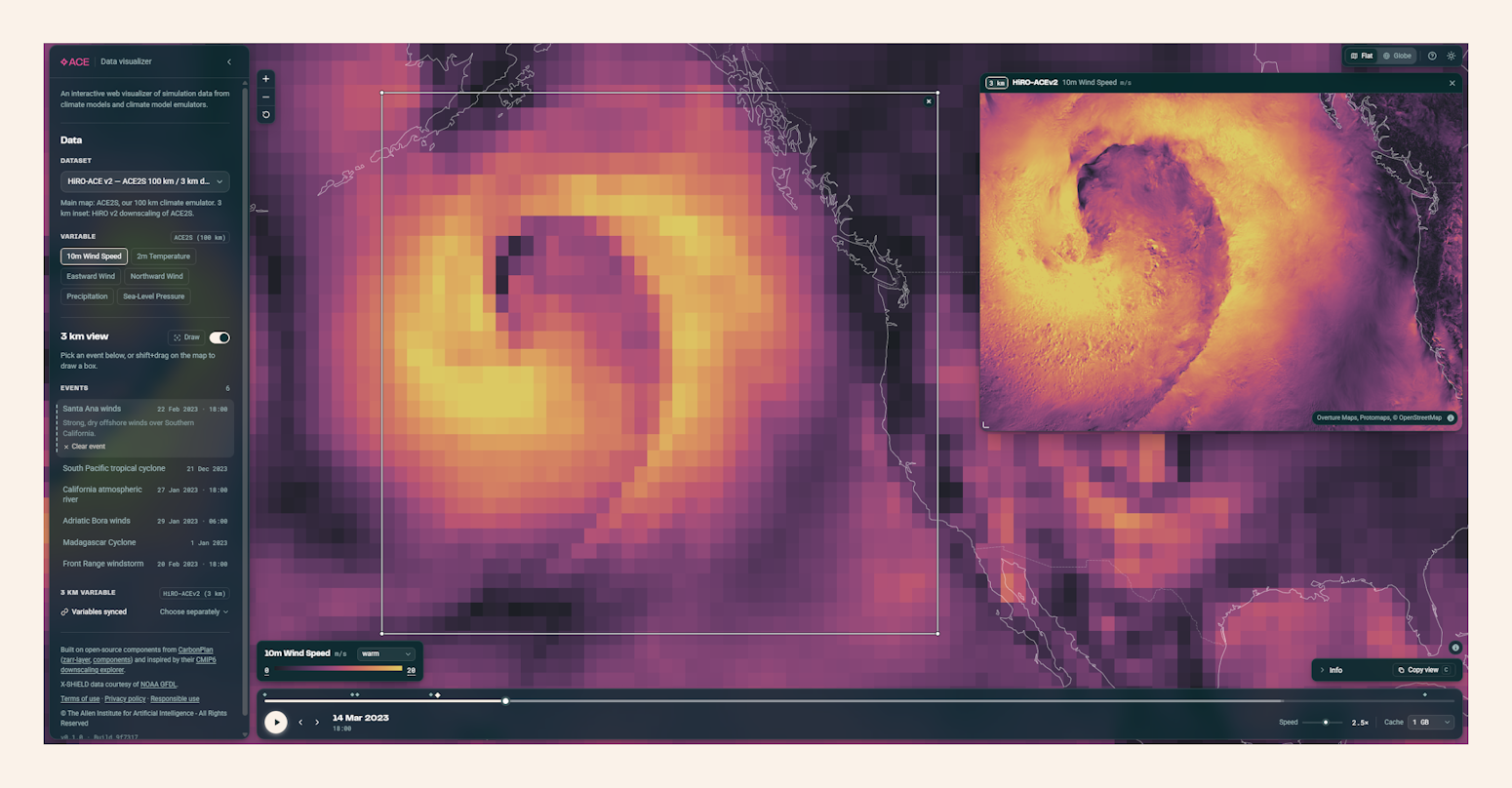
HiRO-ACEv2: Simulating extreme weather at 3 km resolution for a fraction of the cost
Hugging Face's HiRO-ACEv2 model offers unprecedented weather simulation capabilities at a fraction of traditional costs.
Key takeaways
- HiRO-ACEv2 simulates extreme weather at a 3 km resolution.
- The model is significantly cheaper than traditional weather simulation methods.
- Developed by Hugging Face, it aims to enhance accessibility for researchers and local governments.
- It builds upon the previous HiRO-ACE model, improving resolution and performance.
- Open-source availability allows for widespread use and integration into existing systems.
Hugging Face has unveiled its latest innovation, the HiRO-ACEv2 model, which is set to revolutionize the field of weather simulation. This advanced model is capable of simulating extreme weather events at an impressive resolution of 3 kilometers, a feat that was previously only achievable with significantly higher computational resources. By leveraging cutting-edge machine learning techniques, HiRO-ACEv2 not only enhances the accuracy of weather predictions but also does so at a fraction of the cost compared to traditional methods. This breakthrough has the potential to transform how meteorologists and researchers approach weather forecasting and climate modeling, making it more accessible and efficient.
The development of HiRO-ACEv2 comes at a critical time when climate change is leading to increasingly severe weather patterns worldwide. As communities grapple with the impacts of extreme weather, the need for reliable forecasting tools has never been more urgent. Traditional weather simulation models often require extensive computational power and resources, limiting their availability to well-funded institutions. HiRO-ACEv2 aims to democratize access to high-resolution weather simulations, enabling a broader range of users, from academic researchers to local governments, to harness its capabilities for better preparedness and response strategies.
Key facts
| Field | Detail |
|---|---|
| Model Name | HiRO-ACEv2 |
| Resolution | 3 km |
| Cost | Fraction of traditional simulation costs |
| Primary Use | Extreme weather simulation |
| Release Date | October 2023 |
| Developed By | Hugging Face |
| Target Users | Meteorologists, researchers, local governments |
| Key Features | High accuracy, low computational cost |
| Comparison | Improved over previous HiRO-ACE model |
| Accessibility | Open-source availability |
Who's involved
The key player behind HiRO-ACEv2 is Hugging Face, a company renowned for its contributions to the field of artificial intelligence and machine learning. Hugging Face has established itself as a leader in natural language processing and has expanded its focus to include various applications of AI, including weather modeling. The development team behind HiRO-ACEv2 comprises experts in meteorology, machine learning, and software engineering, all working collaboratively to push the boundaries of what is possible in weather simulation.
Background
Weather simulation has long been a cornerstone of meteorological research, enabling scientists to predict weather patterns and understand climate dynamics. Traditionally, these simulations relied on complex mathematical models that required immense computational resources. For instance, the Weather Research and Forecasting (WRF) model, widely used in the field, can demand significant processing power and memory, making it less accessible for smaller institutions or individual researchers.
The introduction of machine learning into weather modeling represents a paradigm shift. Previous iterations of the HiRO model, such as HiRO-ACE, demonstrated the potential of using AI to enhance weather predictions. However, these earlier models still faced limitations in resolution and cost-effectiveness. HiRO-ACEv2 builds upon these foundations, offering a more refined approach that not only increases resolution but also reduces the computational burden, making it feasible for a wider audience to utilize.
How to read the numbers
While specific performance metrics for HiRO-ACEv2 are not disclosed in the initial announcement, the improvements over its predecessor can be inferred from its design goals. The focus on achieving a 3 km resolution suggests a significant enhancement in the model's ability to capture localized weather phenomena, which is critical for accurate forecasting of extreme events such as hurricanes, tornadoes, and heavy rainfall. The reduction in cost also implies that users can run simulations more frequently and at larger scales, which is essential for timely decision-making in disaster response.
What you can do with it
- Access the Model: Users can download HiRO-ACEv2 from Hugging Face's model hub to start running simulations.
- Integrate with Existing Systems: Researchers can incorporate HiRO-ACEv2 into their existing weather forecasting frameworks to enhance accuracy.
- Conduct Localized Studies: With its high resolution, users can focus on specific geographic areas to study localized weather impacts.
- Collaborate with Local Governments: Municipalities can utilize the model for disaster preparedness and response planning.
- Engage in Research: Academics can leverage the model for studies in climate change, urban planning, and environmental science.
What we're watching
As HiRO-ACEv2 gains traction, the next significant milestone will be its adoption by various institutions and researchers. Observing how effectively it integrates into existing meteorological practices will provide insights into its practical utility. Additionally, the community's feedback on its performance and accessibility will be crucial in shaping future iterations and updates of the model.
The potential for HiRO-ACEv2 to reshape the landscape of weather forecasting is immense. As more users begin to explore its capabilities, the model could lead to a new era of climate science where high-resolution simulations are not just the privilege of well-funded organizations. Instead, they could become standard tools for a diverse range of stakeholders, from scientists to policymakers, ultimately enhancing our ability to respond to the challenges posed by climate change and extreme weather events. The implications of this model extend beyond mere simulation; they touch on the very fabric of how societies prepare for and adapt to an increasingly unpredictable climate.
In conclusion, the launch of HiRO-ACEv2 marks a pivotal moment in the intersection of artificial intelligence and meteorology. As the world grapples with the realities of climate change, tools like HiRO-ACEv2 will be essential in providing the insights needed to navigate these challenges effectively. The combination of high resolution and low cost opens doors for innovative applications and collaborations, setting the stage for a more resilient future in weather forecasting and climate adaptation.
Source: Hugging Face Blog · Read original →
Instagram & TikTok: copy the link and paste into a Story, Reel, or caption.
Digest
AI news by email
Weekly Friday briefings plus midweek notes when models or research drop. Sources included — unsubscribe anytime.
Discussion
Comment here after signing in, or share the story to continue the conversation elsewhere.
Instagram & TikTok: copy the link and paste into a Story, Reel, or caption.
Log in or create an account to comment — Google / GitHub / X when those providers are configured.
No comments yet — start the thread.



