

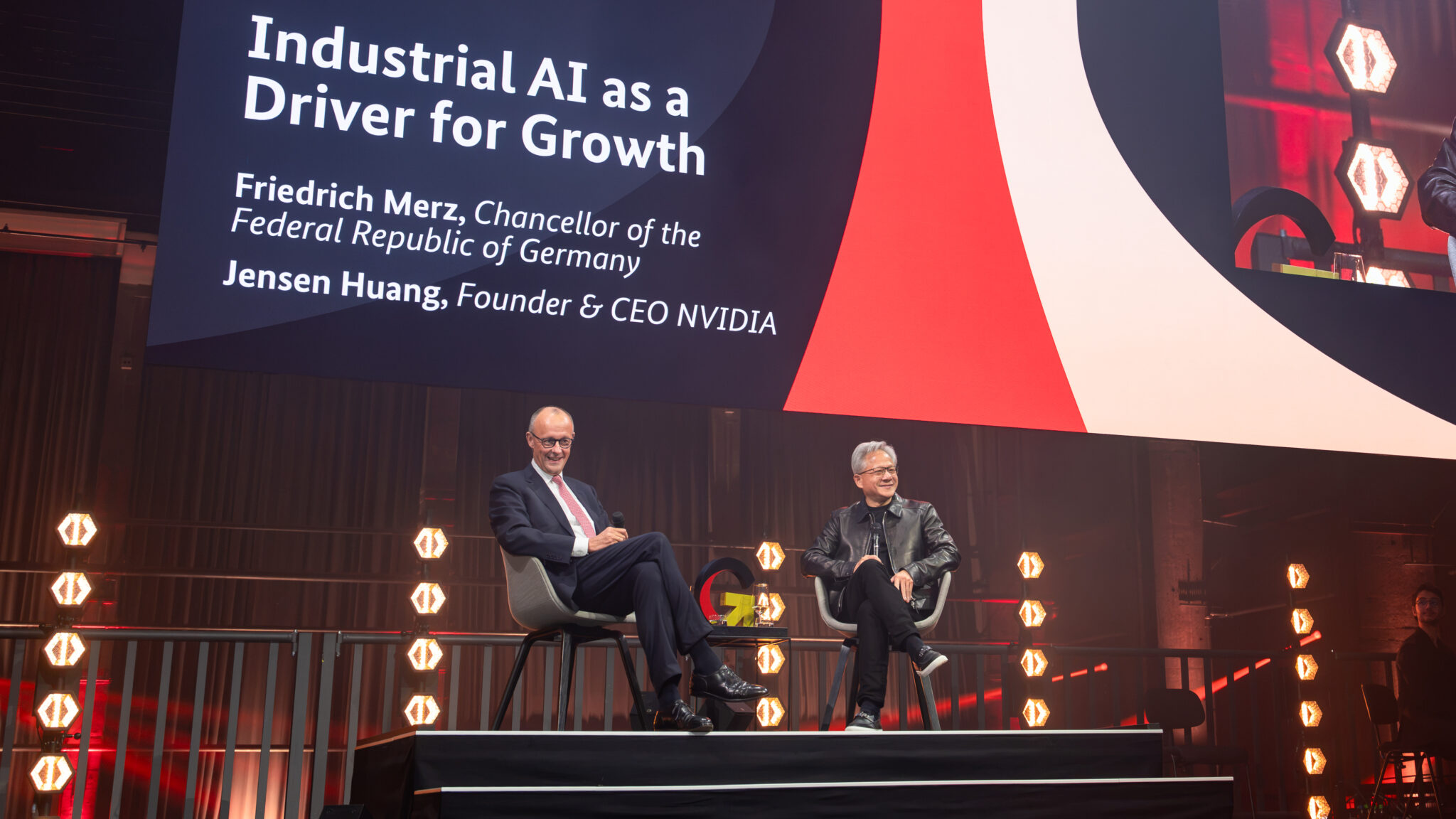
Germany Wants to Lead the World in Industrial AI: How NVIDIA Will Help
Germany aims to become a global leader in industrial AI, with NVIDIA's support shaping its ambitious roadmap.
“As Germany seeks to lead in industrial AI, the challenge lies in transforming its workforce to adapt to this technological revolution.”
Key takeaways
- Germany is positioning itself as a leader in industrial AI with NVIDIA's support.
- The meeting took place at Kraftwerk in Berlin between Chancellor Merz and Jensen Huang.
- NVIDIA aims to provide technology and expertise to enhance German industrial productivity.
- Historical ties between NVIDIA and German industries, particularly in automotive and gaming, are significant.
- Workforce training and adaptation are critical challenges in integrating AI into traditional industries.
In a significant meeting held at the Kraftwerk, a repurposed power station in Berlin, German Chancellor Friedrich Merz and NVIDIA's founder and CEO Jensen Huang engaged in a dialogue about Germany's strategic vision for artificial intelligence. This discussion marks a pivotal moment for Germany as it seeks to harness the potential of AI to bolster its industrial sector, which has long been a cornerstone of the nation's economy. Huang emphasized NVIDIA's commitment to supporting Germany's AI initiatives, highlighting the company's historical ties to various sectors, including gaming, automotive, and enterprise solutions.
The conversation between Merz and Huang underscored the urgency of integrating AI technologies into Germany's industrial framework. As the global landscape for AI continues to evolve rapidly, Germany is positioning itself to not only catch up with but potentially lead in the industrial AI domain. Huang noted that NVIDIA's advanced computing platforms, particularly in graphics processing units (GPUs) and AI software, are essential tools that can empower German industries to innovate and increase productivity. This partnership could redefine how traditional industries operate, making them more efficient and competitive on a global scale.
Key facts
| Field | Detail |
|---|---|
| Event | Meeting between Chancellor Friedrich Merz and Jensen Huang |
| Location | Kraftwerk, Berlin |
| Date | Recent meeting in October 2023 |
| Focus | Germany's AI roadmap and industrial applications |
| NVIDIA's Role | Providing technology and expertise to support AI integration |
| Historical Context | Longstanding relationship between NVIDIA and German industries |
| Key Industries | Gaming, automotive, enterprise solutions |
| Goals | Position Germany as a leader in industrial AI |
| Challenges | Need for infrastructure and skilled workforce |
| Future Outlook | Enhanced productivity and innovation in German industry |
Who's involved
The key players in this initiative include German Chancellor Friedrich Merz, who is advocating for a robust AI strategy, and Jensen Huang, the visionary behind NVIDIA, a company renowned for its contributions to AI and computing technology. Their collaboration signals a strong commitment to advancing Germany's industrial capabilities through AI. Other stakeholders likely include various German industrial leaders and technology firms that will play a role in implementing these AI solutions.
The partnership between NVIDIA and Germany is not new; it has been developing over the years as NVIDIA's technologies have found applications in various sectors. The automotive industry, in particular, has been a significant focus, with NVIDIA's AI solutions being utilized for autonomous driving and smart manufacturing processes. This historical context adds depth to the current discussions, as both parties are building on a foundation of previous collaborations.
As the conversation progressed, Huang pointed out that the integration of AI into industrial processes is not merely about adopting new technologies but also about transforming the workforce. The challenge lies in equipping workers with the necessary skills to leverage AI tools effectively. This aspect of the discussion is crucial, as it addresses the potential disruptions that AI may bring to traditional job roles within the industrial sector.
In the past, Germany has been known for its engineering prowess and manufacturing excellence. However, as global competition intensifies, the need for innovation becomes paramount. The introduction of AI technologies can provide German industries with the tools they need to enhance efficiency, reduce costs, and improve product quality. Huang's insights into NVIDIA's capabilities suggest that the company is well-positioned to assist in this transformation.
How to read the numbers
While specific performance metrics were not disclosed during the meeting, the implications of AI integration can be inferred from industry trends. For instance, companies that have adopted AI technologies have reported significant improvements in operational efficiency and cost savings. The following table outlines some general expectations for AI impact in industrial settings:
| Benchmark | Expected Impact |
|---|---|
| Productivity Increase | 20-30% improvement |
| Cost Reduction | 15-25% savings |
| Time to Market | 25% faster development cycles |
| Quality Improvement | 30% reduction in defects |
| Workforce Efficiency | 40% more effective use of human resources |
These benchmarks reflect the potential benefits that German industries could experience by embracing AI technologies, supported by NVIDIA's expertise and resources. The integration of AI into manufacturing processes, logistics, and supply chain management can lead to a more agile and responsive industrial ecosystem.
What you can do with it
For businesses looking to capitalize on this transformative moment, several practical steps can be taken:
- Invest in Training: Companies should prioritize training programs to equip their workforce with AI skills, ensuring they can effectively utilize new technologies.
- Collaborate with Tech Partners: Engaging with technology providers like NVIDIA can help businesses access cutting-edge AI solutions tailored to their specific needs.
- Pilot AI Projects: Initiating pilot projects can allow companies to test AI applications in controlled environments, assessing their impact before wider implementation.
- Focus on Data Strategy: Developing a robust data strategy is essential for successful AI integration, as data quality and accessibility directly influence AI performance.
- Monitor Industry Trends: Staying informed about advancements in AI technologies and industry best practices can help businesses remain competitive and innovative.
What we're watching
As Germany moves forward with its AI roadmap, the next concrete milestone will be the establishment of partnerships between NVIDIA and various German industries. These collaborations will likely lead to pilot projects and case studies that demonstrate the practical applications of AI in real-world scenarios. Additionally, the ongoing development of infrastructure to support AI technologies will be crucial in determining the pace of adoption.
Looking ahead, the challenge of workforce adaptation remains a significant concern. As AI technologies evolve, so too must the skills of the workforce that operates within these industries. The success of Germany's industrial AI ambitions will depend not only on technological advancements but also on the ability to cultivate a skilled workforce capable of leveraging these innovations effectively. The intersection of technology and human capability will ultimately define the future landscape of German industry in the age of AI.
Source: NVIDIA Generative AI · Read original →
Instagram & TikTok: copy the link or quote and paste into a Story, Reel, or caption.
Digest
AI news by email
Weekly Friday briefings plus midweek notes when models or research drop. Sources included — unsubscribe anytime.
Discussion
Comment here after signing in, or share the story to continue the conversation elsewhere.
Instagram & TikTok: copy the link and paste into a Story, Reel, or caption.
Log in or create an account to comment — Google / GitHub / X when those providers are configured.
No comments yet — start the thread.


