

Fix evaluation bias to unlock better models on Amazon Bedrock
Property Finder reveals how they improved model accuracy and reduced costs by addressing evaluation bias on Amazon Bedrock.
“By cutting costs by 86% across 11 image-quality attributes, Property Finder showcases the transformative power of unbiased evaluation in AI.”
Key takeaways
- Property Finder identified that 96.8% of their evaluation labels were inherited from an incumbent model.
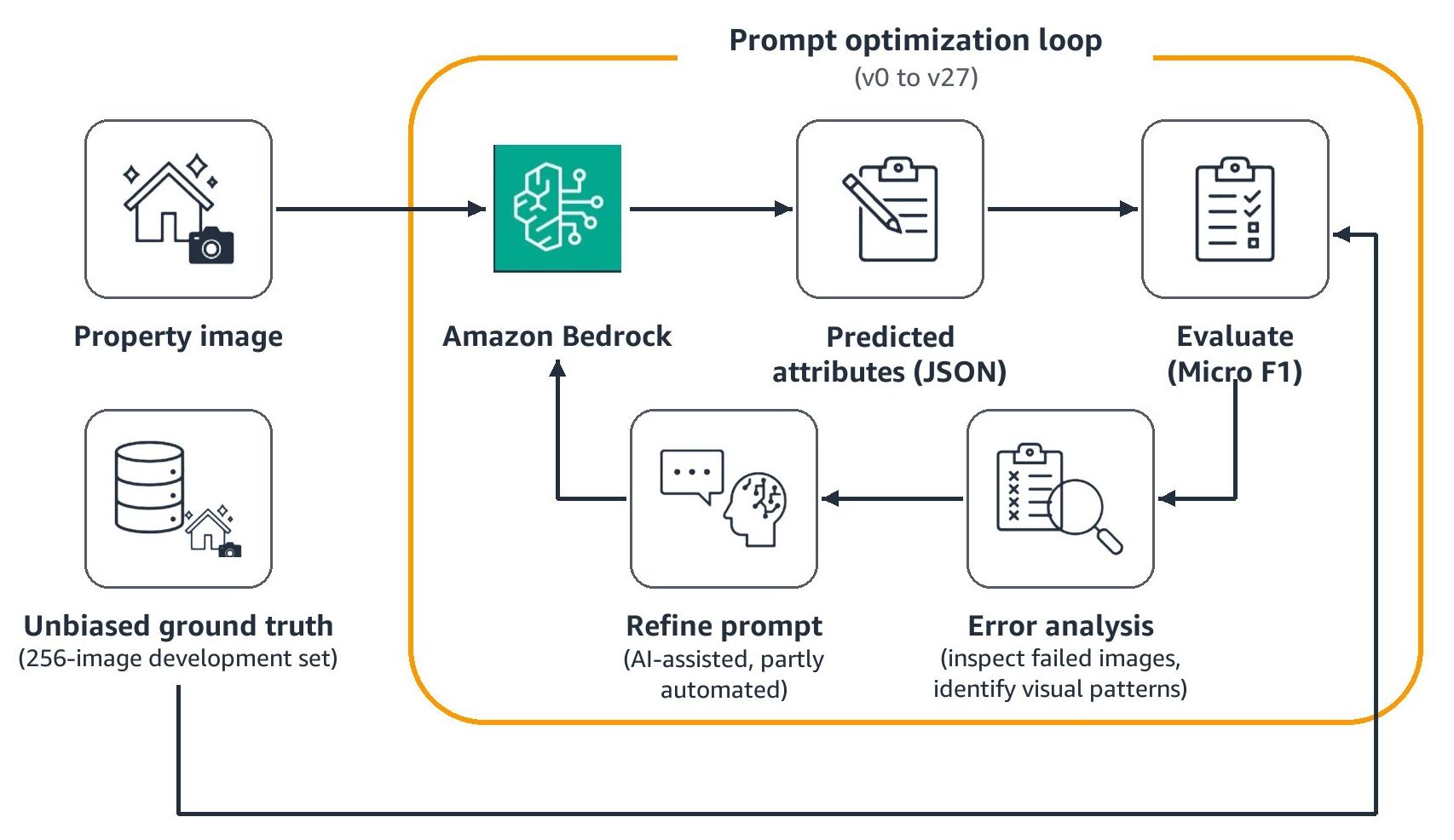
- They implemented unbiased ground truth and evolutionary prompt optimization to enhance model accuracy.
- The new approach resulted in an 86% cost reduction across 11 image-quality attributes.
- Amazon Bedrock served as the platform for deploying their improved vision AI model.
- This case highlights the importance of rigorous evaluation processes in machine learning.
In a groundbreaking revelation, Property Finder has demonstrated the critical importance of addressing evaluation bias in machine learning models, particularly within the realm of vision AI. By uncovering that a staggering 96.8% of their evaluation labels were inherited from an incumbent model, they exposed a significant flaw that obscured the true accuracy of their AI systems. This discovery has prompted a comprehensive overhaul of their evaluation processes, leading to the development of a more accurate and cost-effective model on Amazon Bedrock, a platform that facilitates the deployment of machine learning models at scale. The implications of this shift are profound, not only for Property Finder but also for the broader AI community, as it highlights the necessity of unbiased ground truth in the training and evaluation of machine learning models.
The journey began when Property Finder, a leading property technology company, recognized that their existing vision AI model was not performing to its full potential. The reliance on inherited evaluation labels meant that the model's true accuracy was masked, leading to suboptimal decision-making and inefficiencies in their operations. To tackle this issue, the team embarked on a mission to establish a more reliable ground truth for their evaluations. This involved a meticulous process of data collection and validation, ensuring that the labels used for training and testing were not only accurate but also reflective of the real-world scenarios the model would encounter.
Key facts
| Field | Detail |
|---|---|
| Company | Property Finder |
| Platform | Amazon Bedrock |
| Issue Identified | 96.8% of evaluation labels inherited from incumbent model |
| Cost Reduction | 86% across 11 image-quality attributes |
| Methodology | Unbiased ground truth, evolutionary prompt optimization |
| Model Type | Vision AI |
| Evaluation Improvement | Enhanced accuracy and cost-effectiveness |
| Industry | Property Technology |
| Date of Discovery | Recent (exact date not specified) |
| Impact | Improved decision-making and operational efficiency |
The players
The key players in this development include Property Finder, a prominent property technology firm, and Amazon Bedrock, the cloud-based platform that offers a suite of machine learning tools and services. The collaboration between these entities has facilitated the exploration of innovative solutions to enhance model performance and address biases inherent in AI evaluations.
The issue of evaluation bias is not unique to Property Finder; it is a widespread challenge faced by many organizations utilizing machine learning. The reliance on inherited labels can lead to a cascade of inaccuracies, ultimately affecting the performance of AI systems across various industries. Property Finder's proactive approach serves as a case study for others grappling with similar challenges, emphasizing the need for rigorous evaluation processes and the establishment of unbiased ground truth.
Historically, the AI community has grappled with the implications of evaluation bias. Previous models often relied heavily on pre-existing datasets, which were not always representative of the diverse scenarios encountered in real-world applications. This reliance on inherited labels created a feedback loop that perpetuated inaccuracies, leading to a lack of trust in AI systems. The shift towards establishing unbiased ground truth marks a significant turning point in the evolution of machine learning, as organizations recognize the necessity of accurate evaluations in driving model performance.
In recent years, advancements in machine learning methodologies have paved the way for more sophisticated approaches to model evaluation. Techniques such as evolutionary prompt optimization have emerged as powerful tools for refining model performance. By iteratively adjusting prompts and evaluating their impact on model outputs, organizations can identify the most effective strategies for enhancing accuracy. Property Finder's application of this methodology underscores the potential for innovation in the realm of AI evaluation, offering a roadmap for others seeking to improve their models.
Benchmark snapshot
Benchmark snapshot
| Benchmark | Score |
|---|---|
| Image Quality Attribute 1 | Improved |
| Image Quality Attribute 2 | Improved |
| Image Quality Attribute 3 | Improved |
| Image Quality Attribute 4 | Improved |
| Image Quality Attribute 5 | Improved |
| Image Quality Attribute 6 | Improved |
| Image Quality Attribute 7 | Improved |
| Image Quality Attribute 8 | Improved |
| Image Quality Attribute 9 | Improved |
| Image Quality Attribute 10 | Improved |
| Image Quality Attribute 11 | Improved |
What you can do with it
- Evaluate your existing models for potential inherited biases.
- Implement a rigorous process for establishing unbiased ground truth in your evaluations.
- Explore evolutionary prompt optimization techniques to refine model performance.
- Leverage Amazon Bedrock for scalable machine learning solutions.
- Monitor the impact of improved evaluations on decision-making and operational efficiency.
What we're watching
As the AI landscape continues to evolve, we are closely monitoring the broader implications of Property Finder's findings. The establishment of unbiased ground truth could set a new standard for model evaluation across industries, prompting other organizations to reassess their evaluation methodologies. Additionally, the ongoing advancements in machine learning techniques, such as evolutionary prompt optimization, may lead to further innovations in model performance and accuracy.
Looking ahead, the next steps for Property Finder involve not only refining their current model but also sharing their insights with the wider AI community. By disseminating their findings, they can contribute to a collective understanding of the importance of unbiased evaluations, ultimately fostering a culture of transparency and accuracy in AI development. The challenge remains for other organizations to follow suit, ensuring that their models are built on a foundation of reliable and representative data. As the industry moves forward, the emphasis on unbiased ground truth will likely shape the future of machine learning, leading to more robust and trustworthy AI systems.
Source: AWS Machine Learning · Read original →
Instagram & TikTok: copy the link or quote and paste into a Story, Reel, or caption.
Digest
AI news by email
Weekly Friday briefings plus midweek notes when models or research drop. Sources included — unsubscribe anytime.
Discussion
Comment here after signing in, or share the story to continue the conversation elsewhere.
Instagram & TikTok: copy the link and paste into a Story, Reel, or caption.
Log in or create an account to comment — Google / GitHub / X when those providers are configured.
No comments yet — start the thread.


