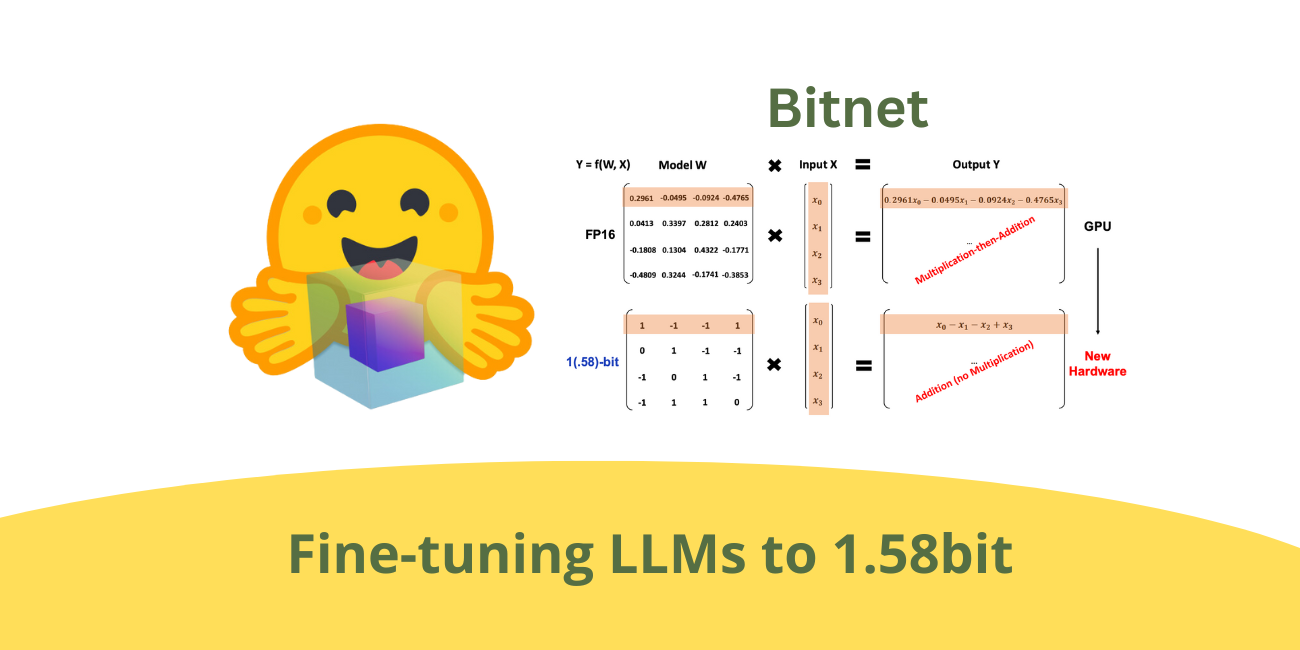
Fine-tuning LLMs to 1.58bit: extreme quantization made easy
Hugging Face simplifies extreme quantization of large language models to 1.58 bits, enhancing accessibility for resource-constrained devices.
Hugging Face has announced a groundbreaking advancement in the field of large language models (LLMs) with the introduction of extreme quantization techniques that allow for model compression down to an astonishing 1.58 bits. This development is significant as it enables developers to deploy powerful AI models on devices that previously lacked the necessary computational resources. The ability to reduce model size while maintaining performance is a game-changer for a variety of applications, particularly in mobile and edge computing environments where memory and processing power are limited.
The new quantization method not only minimizes the storage requirements of LLMs but also streamlines their deployment across a wider range of devices. By achieving this level of compression, Hugging Face is addressing a critical barrier that has historically hindered the accessibility of advanced AI technologies. This initiative opens the door for developers to integrate sophisticated language models into applications that require efficiency and speed, such as chatbots, virtual assistants, and other AI-driven solutions that operate on less powerful hardware.
Key facts
| Field | Detail |
|---|---|
| Quantization Level | 1.58 bits |
| Model Type | Large Language Models (LLMs) |
| Performance Impact | Minor performance loss |
| Target Devices | Resource-constrained devices |
| Developer Platform | Hugging Face |
The implications of this advancement extend beyond mere technical specifications; they represent a shift in how developers can approach AI model deployment. Traditionally, deploying LLMs required substantial computational resources, often relegating their use to high-end servers or cloud-based solutions. However, with Hugging Face's new quantization method, developers can now leverage these models in a variety of environments, including IoT devices and smartphones. This democratization of AI technology is likely to spur innovation in various sectors, from healthcare to education, where access to advanced AI capabilities can lead to improved outcomes.
As the demand for AI applications continues to grow, the ability to run powerful models on less capable hardware becomes increasingly critical. This trend aligns with the broader movement towards edge computing, where processing tasks are handled closer to the source of data generation. By enabling LLMs to function effectively in these constrained environments, Hugging Face is not only enhancing the versatility of AI applications but also paving the way for new use cases that were previously impractical due to hardware limitations. The next steps for developers will involve experimenting with these quantized models to assess their performance in real-world applications, as well as exploring further optimizations that could push the boundaries of what is possible with LLMs on constrained devices.
Source: Hugging Face Blog · Read original →
Discussion
Comment here after signing in, or share the story to continue the conversation elsewhere.
Instagram & TikTok: copy the link and paste into a Story, Reel, or post caption.
Log in or create an account to comment — Google / GitHub / X when those providers are configured.
No comments yet — start the thread.