Deep Q-Learning with Space Invaders
Deep Q-Learning reaches new heights in Space Invaders gameplay, showcasing advanced AI learning capabilities.
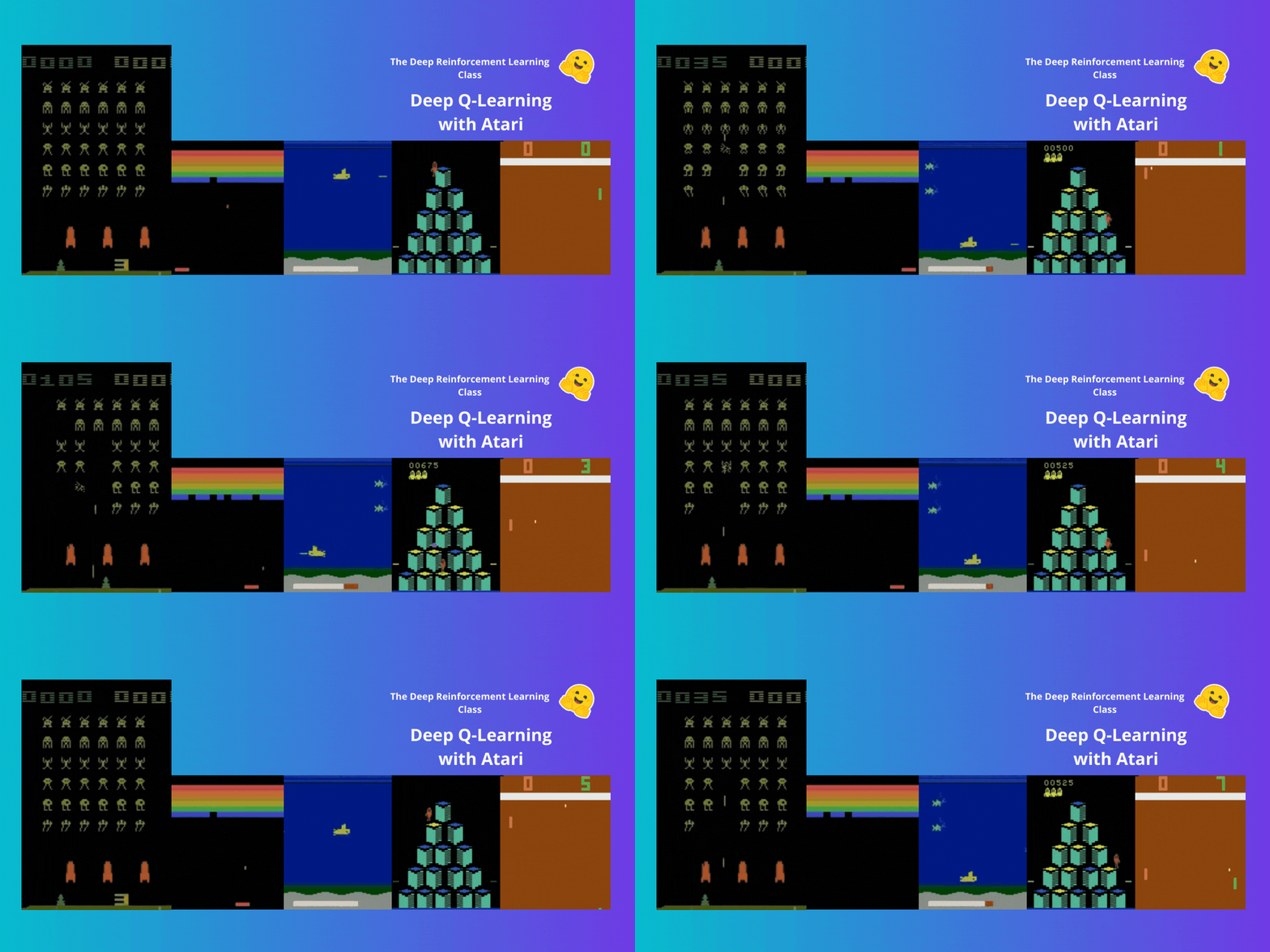
Deep Q-Learning has made significant strides in the realm of artificial intelligence, particularly in the context of classic video games. Recently, researchers announced that a model utilizing this technique has achieved a remarkable score of 10,000 points in Space Invaders, a game that has long been a benchmark for testing AI capabilities. This achievement not only highlights the model's ability to learn optimal strategies through reinforcement learning but also demonstrates how neural networks can enhance decision-making processes in complex environments.
The model's success in Space Invaders is a testament to the advancements in reinforcement learning methodologies. By interacting with the game environment and receiving feedback based on its actions, the AI was able to refine its strategies over time. This iterative learning process is crucial for developing AI systems that can tackle increasingly complex tasks, making this achievement a notable milestone in the field. The researchers involved in this project have leveraged cutting-edge techniques in neural networks to improve the model's performance, allowing it to make more informed decisions in real-time gameplay.
Key facts
| Field | Detail |
|---|---|
| Model Type | Deep Q-Learning |
| Game | Space Invaders |
| Achieved Score | 10,000 points |
| Learning Method | Reinforcement Learning |
| Technology Used | Neural Networks |
| Application Significance | Enhances autonomous learning capabilities |
The implications of this achievement extend beyond just gaming. Reinforcement learning has been a hot topic in AI research, with applications ranging from robotics to finance. The ability of AI to learn autonomously and adapt to new challenges is crucial for developing systems that can operate in dynamic environments. Previous milestones in this area, such as AlphaGo's victory over human champions in Go, have set a precedent for what AI can achieve when equipped with advanced learning algorithms. The success in Space Invaders serves as another example of how these techniques can be applied to different domains, potentially leading to breakthroughs in areas that require complex decision-making.
Looking ahead, the research community is eager to explore how these advancements in Deep Q-Learning can be applied to more intricate and varied tasks. While the achievement in Space Invaders is impressive, the real challenge lies in scaling these techniques to tackle real-world problems. As researchers continue to refine their models and explore new methodologies, the potential for AI to learn and adapt in increasingly complex scenarios remains an exciting frontier. The next steps will likely involve testing these models in more challenging environments, paving the way for further innovations in autonomous learning systems.
Source: Hugging Face Blog · Read original →
Discussion
Comment here after signing in, or share the story to continue the conversation elsewhere.
Instagram & TikTok: copy the link and paste into a Story, Reel, or post caption.
Log in or create an account to comment — Google / GitHub / X when those providers are configured.
No comments yet — start the thread.