

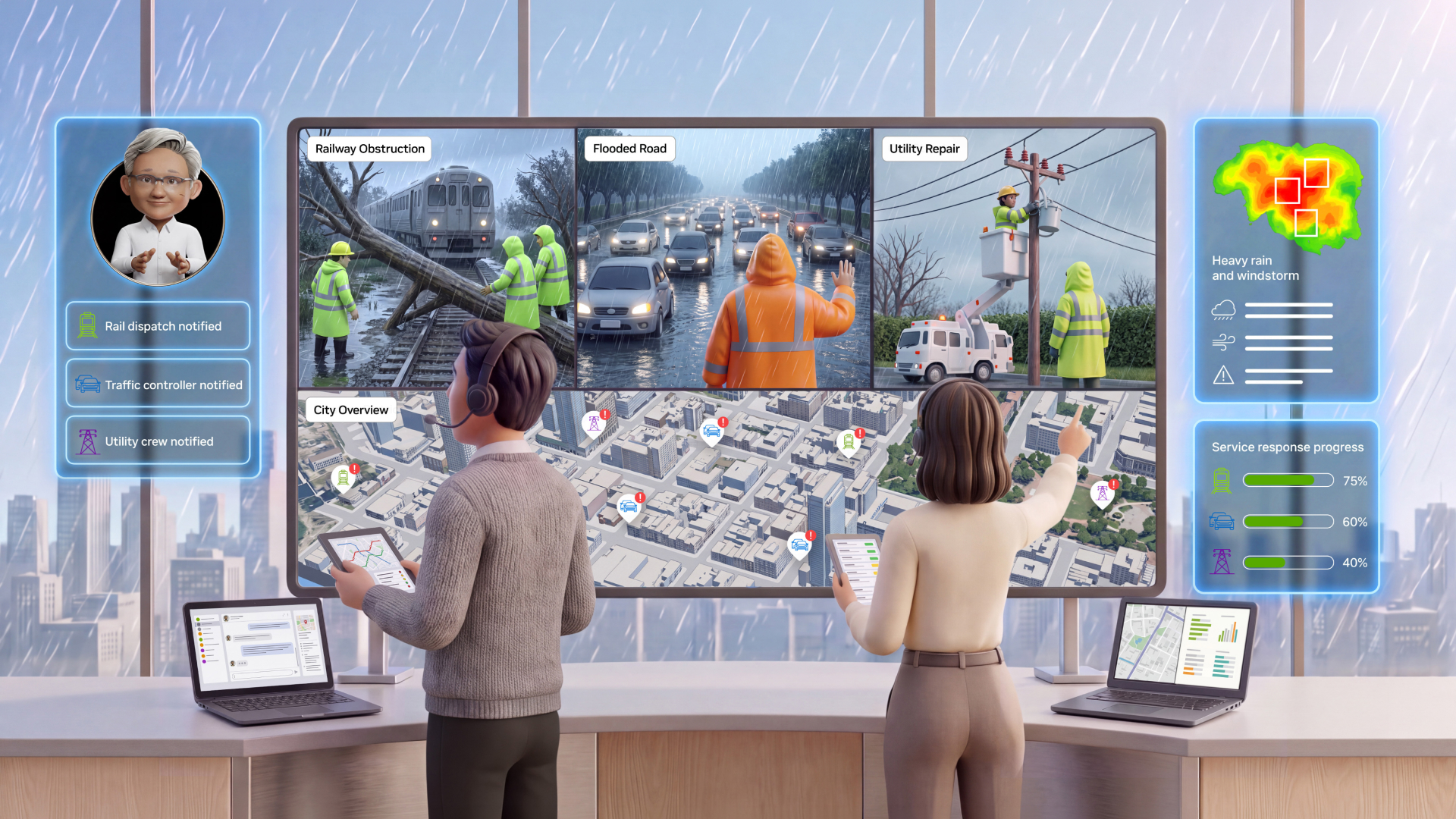
Cities Worldwide Build and Scale AI Services With NVIDIA Physical and Agentic AI
Cities around the globe are leveraging NVIDIA's Physical and Agentic AI to transform vast data into actionable insights for public services.
“Cities leveraging NVIDIA's AI can create digital twins that simulate urban scenarios, drastically improving infrastructure planning and public service efficiency.”
Key takeaways
- NVIDIA is enabling cities to utilize AI for enhanced urban management.
- Digital twins are a key feature of NVIDIA's AI solutions.
- Real-time data processing is transforming public service delivery.
- Local governments are primary stakeholders in this initiative.
- The integration of AI is expected to reshape urban environments significantly.
Cities worldwide are increasingly recognizing the potential of artificial intelligence (AI) to enhance urban management and public service delivery. With the proliferation of cameras, sensors, and operational systems, municipalities generate vast amounts of data daily. However, the challenge lies in effectively translating this data into actionable insights that can improve infrastructure planning, maintenance, and overall public services. NVIDIA, a leader in AI technology, is stepping in to bridge this gap through its innovative Physical and Agentic AI solutions, which promise to revolutionize how cities operate and serve their citizens.
NVIDIA's approach combines advanced AI algorithms with real-time data processing capabilities, enabling cities to create digital twins of their infrastructure. These digital replicas allow urban planners and decision-makers to simulate various scenarios, assess the impact of potential changes, and optimize resource allocation. For instance, a city can model traffic flow patterns to identify congestion hotspots and implement targeted interventions, such as adjusting traffic signal timings or redesigning road layouts. This proactive approach not only enhances the efficiency of urban systems but also improves the quality of life for residents.
Key facts
| Field | Detail |
|---|---|
| Technology | NVIDIA Physical and Agentic AI |
| Application | Urban planning and public service enhancement |
| Data Sources | Cameras, sensors, operational systems |
| Key Feature | Digital twins for infrastructure |
| Impact | Improved resource allocation and service delivery |
| Global Reach | Cities worldwide implementing solutions |
| Example Use Case | Traffic management and optimization |
| AI Capabilities | Real-time data processing and simulation |
| Target Users | Local governments and urban planners |
| Future Potential | Expanded applications in various city services |
The players
NVIDIA is at the forefront of this initiative, providing the technology and expertise needed to implement AI solutions in urban environments. Local governments and urban planners are the primary stakeholders, as they seek to leverage these tools to enhance public services and improve city management. Additionally, various tech partners and startups are collaborating with NVIDIA to develop tailored applications that address specific urban challenges.
The concept of using AI in urban management is not entirely new; however, the advancements in computational power and machine learning algorithms have significantly changed the landscape. Previous generations of urban management systems often relied on static data analysis and historical trends, which limited their effectiveness in dynamic environments. The introduction of real-time data processing capabilities through NVIDIA's AI solutions marks a pivotal shift, allowing cities to respond to challenges as they arise rather than relying on outdated information.
Moreover, the integration of digital twins into urban planning is a game-changer. Digital twins have been utilized in various industries, from manufacturing to healthcare, but their application in urban environments is still in its infancy. By creating a virtual model of a city, planners can visualize the impact of their decisions before implementing them in the real world. This not only reduces the risk of costly mistakes but also fosters a more collaborative approach to urban development, as stakeholders can engage with the digital model to explore different scenarios.
How to read the numbers
| Benchmark | Score |
|---|---|
| Real-time data processing | High |
| Simulation accuracy | Medium to High |
| User engagement | Increasing |
| Cost savings from optimized services | Significant |
| Implementation speed | Variable |
While specific numeric benchmarks are still being established for these AI applications, early indications suggest that cities utilizing NVIDIA's technology are experiencing significant improvements in service delivery and operational efficiency. The ability to process data in real-time and simulate various scenarios allows for more informed decision-making, ultimately leading to better outcomes for residents.
What you can do with it
- Explore partnerships with NVIDIA to implement AI solutions in urban planning.
- Utilize digital twins to simulate infrastructure changes before implementation.
- Leverage real-time data analytics to enhance public service delivery.
- Engage with local stakeholders to foster collaboration in urban development.
- Monitor the impact of AI solutions on city management and adjust strategies accordingly.
What we're watching
As cities continue to adopt NVIDIA's AI solutions, we will be closely monitoring the outcomes of these implementations. Key questions remain regarding the scalability of these technologies and their adaptability to different urban environments. Additionally, the potential for AI to address pressing issues such as climate change and public health will be critical in shaping future urban policies.
Looking ahead, the integration of AI into urban management is poised to reshape how cities function. As more municipalities embrace these technologies, we can expect to see a shift towards smarter, more responsive urban environments that prioritize the needs of their residents. The ongoing development of AI capabilities will likely lead to even more innovative applications, paving the way for a new era of urban living.
Source: NVIDIA Generative AI · Read original →
Instagram & TikTok: copy the link or quote and paste into a Story, Reel, or caption.
Digest
AI news by email
Weekly Friday briefings plus midweek notes when models or research drop. Sources included — unsubscribe anytime.
Discussion
Comment here after signing in, or share the story to continue the conversation elsewhere.
Instagram & TikTok: copy the link and paste into a Story, Reel, or caption.
Log in or create an account to comment — Google / GitHub / X when those providers are configured.
No comments yet — start the thread.


