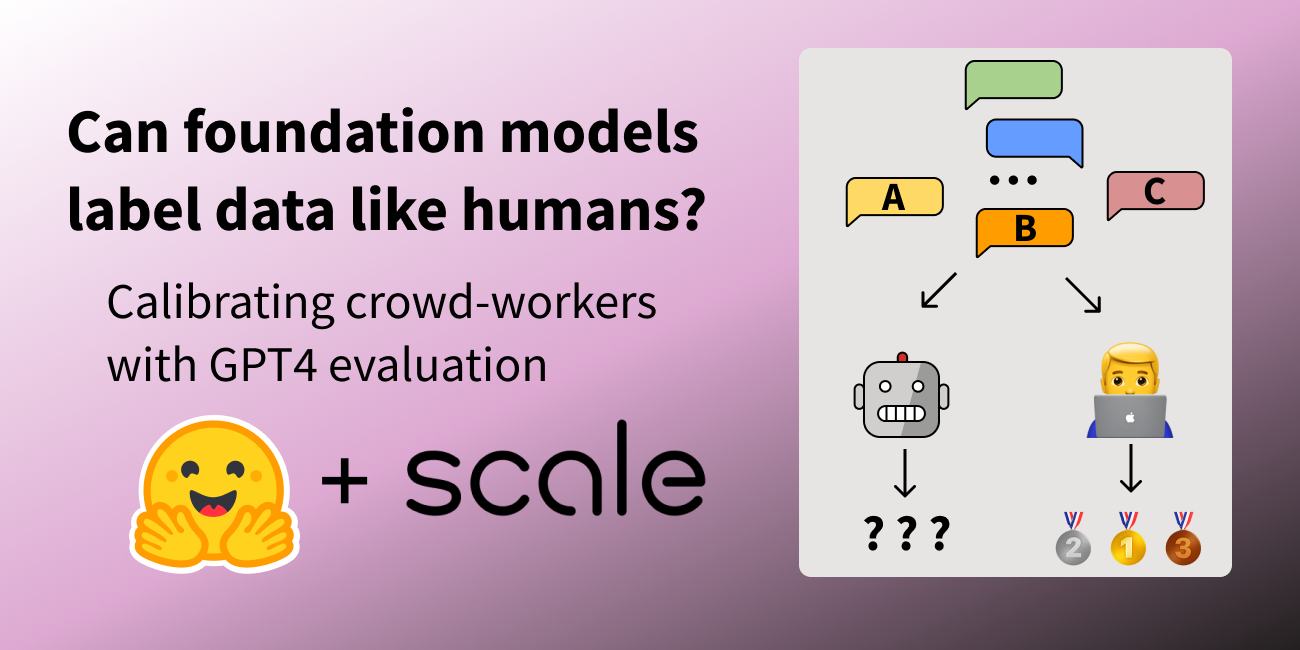
Can foundation models label data like humans?
Foundation models are on the brink of matching human accuracy in data labeling tasks, promising efficiency and cost savings.
Foundation models, a class of AI models that leverage vast amounts of data for training, are undergoing rigorous testing to determine their effectiveness in data labeling tasks. Recent studies indicate that these models are achieving accuracy rates that are comparable to those of human labelers. This development is particularly significant as data labeling is a critical step in the machine learning pipeline, often requiring extensive human resources and time. The ability of foundation models to perform this task could revolutionize how organizations prepare data for AI applications, making the process faster and more cost-effective.
The implications of this research extend beyond mere accuracy; they encompass the potential for substantial efficiency gains in data preparation workflows. Traditionally, human labelers have been the backbone of data annotation, but the increasing demand for labeled datasets in AI projects has strained resources. By employing foundation models for this purpose, organizations can not only reduce the time spent on labeling but also cut costs associated with hiring and training human annotators. As these models continue to improve, the prospect of automating data labeling becomes increasingly viable, allowing teams to focus on higher-level tasks that require human insight.
Key facts
| Field | Detail |
|---|---|
| Testing Phase | Foundation models are currently being tested for data labeling tasks. |
| Accuracy Comparison | Recent studies show promising accuracy rates compared to human labels. |
| Cost Efficiency | Improved efficiency could significantly reduce costs in data preparation. |
| Impact on Workflows | Potential to streamline workflows for AI practitioners. |
| Future Developments | Ongoing research aims to enhance model performance further. |
Understanding the broader context of foundation models is essential for grasping their potential impact on data labeling. These models, such as GPT-3 and BERT, have already demonstrated remarkable capabilities in natural language processing and understanding. Their evolution has paved the way for applications beyond text, expanding into areas like image and audio processing. The ability to label data accurately is a natural extension of their capabilities, and as these models become more adept, they could redefine the standards for data preparation in AI.
Looking ahead, the next steps involve not only refining the accuracy of these models but also addressing the ethical considerations surrounding their deployment. While the promise of reduced reliance on human labelers is enticing, it raises questions about job displacement and the quality of labels produced by AI. Organizations will need to strike a balance between leveraging these advanced tools and ensuring that human oversight remains a part of the data labeling process. As research continues, the AI community will be watching closely to see how foundation models evolve in this critical area.
Source: Hugging Face Blog · Read original →
Discussion
Comment here after signing in, or share the story to continue the conversation elsewhere.
Instagram & TikTok: copy the link and paste into a Story, Reel, or post caption.
Log in or create an account to comment — Google / GitHub / X when those providers are configured.
No comments yet — start the thread.