

Building ultra-low-latency voice AI applications on AWS
Cartesia leverages AWS infrastructure to achieve ultra-low-latency voice AI applications, enabling sub-100ms text-to-speech and speech-to-text capabilities.
Key takeaways
- Cartesia's Sonic model delivers sub-100ms latency for text-to-speech and speech-to-text.
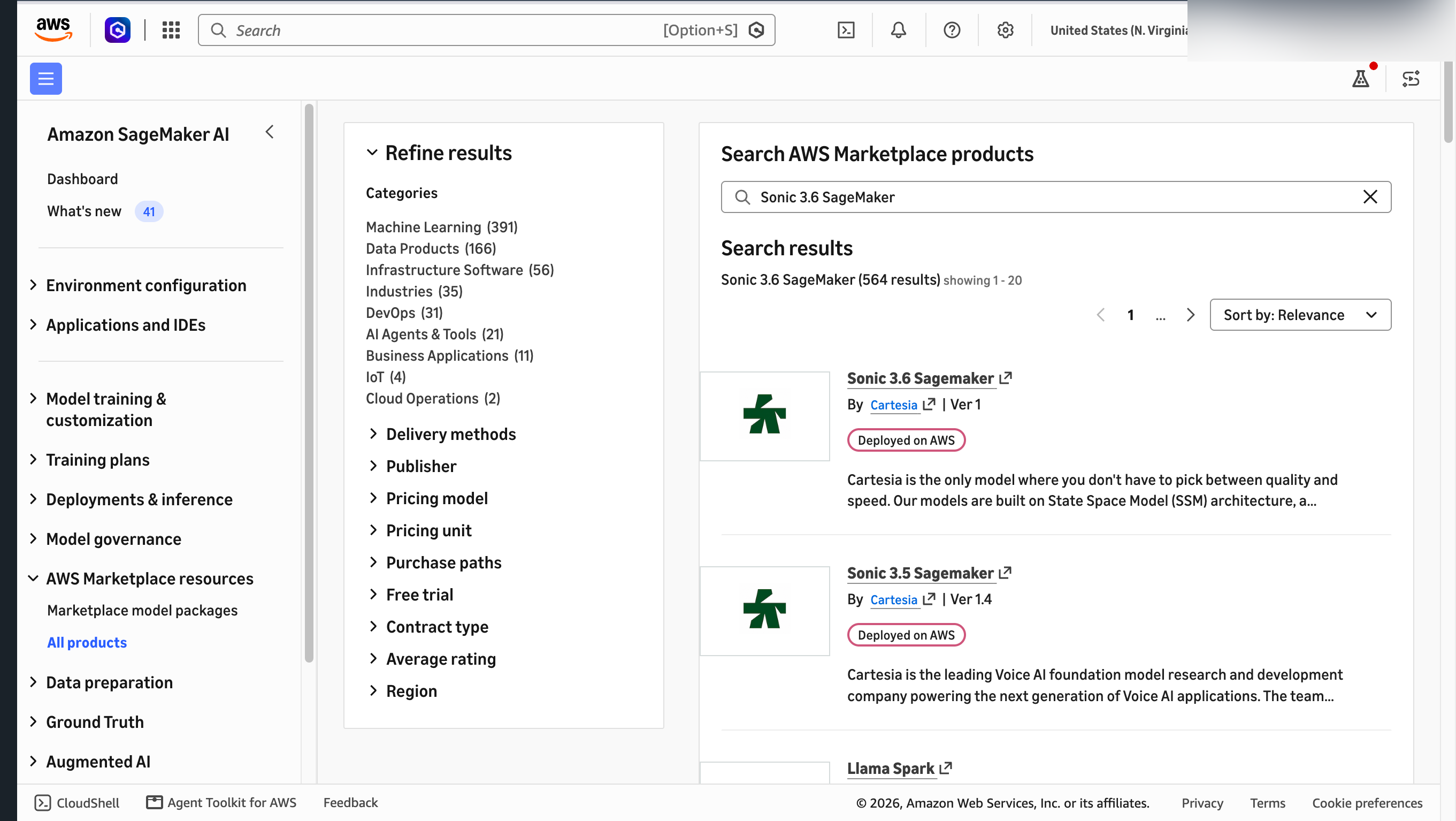
- The model can be deployed on AWS's Amazon SageMaker or self-managed EC2 instances.
- Voice AI applications are increasingly being adopted across various industries.
- State Space Models enhance efficiency and accuracy in voice processing.
- The demand for real-time voice interaction solutions is on the rise.
The landscape of voice AI applications is evolving rapidly, with advancements in technology allowing for unprecedented levels of performance and efficiency. Cartesia, an AWS Partner, is at the forefront of this transformation, utilizing purpose-built State Space Models alongside Amazon Web Services (AWS) infrastructure to deliver voice AI solutions that operate with remarkable speed. Their Sonic model is capable of achieving sub-100ms latency for both text-to-speech (TTS) and speech-to-text (STT) functionalities, a feat that positions them as a leader in the voice AI space. This development is particularly significant as the demand for real-time voice interaction continues to grow across various industries, including customer service, gaming, and personal assistants.
The integration of Cartesia's Sonic model with AWS services allows developers to deploy these advanced voice AI capabilities seamlessly. By utilizing Amazon SageMaker, a fully managed service that enables developers to build, train, and deploy machine learning models, Cartesia is making it easier for businesses to incorporate voice AI into their applications. Additionally, the option to deploy on self-managed Amazon EC2 GPU instances provides flexibility for organizations that require customized environments. This dual approach not only enhances accessibility but also ensures that companies can leverage the power of Cartesia's technology in a way that best suits their operational needs.
Key facts
| Field | Detail |
|---|---|
| Company | Cartesia |
| Partnership | AWS Partner |
| Technology | State Space Models |
| Latency | Sub-100ms for TTS and STT |
| Deployment Options | Amazon SageMaker, Amazon EC2 GPU instances |
| Target Industries | Customer service, gaming, personal assistants |
| Global Reach | Yes |
| Model Name | Sonic |
| AI Type | Voice AI applications |
| Infrastructure | AWS |
Cartesia is not the only player in the voice AI market, but their unique approach sets them apart from competitors. The use of State Space Models is particularly noteworthy, as these models allow for more efficient processing of voice data, leading to faster response times and improved accuracy. This is crucial in applications where real-time interaction is essential, such as virtual assistants that need to understand and respond to user queries without noticeable delays. The ability to achieve sub-100ms latency is a game-changer, as it significantly enhances the user experience by making interactions feel more natural and fluid.
Who's involved
- Cartesia: The company leading the development of ultra-low-latency voice AI applications.
- AWS (Amazon Web Services): The cloud computing platform providing the infrastructure for deploying Cartesia's Sonic model.
- Developers and Businesses: End-users who will implement these voice AI solutions in their applications.
The advancements made by Cartesia come at a time when the demand for voice AI solutions is surging. Companies are increasingly recognizing the value of integrating voice capabilities into their products, as consumers seek more intuitive and efficient ways to interact with technology. This trend is not limited to any single sector; industries ranging from healthcare to finance are exploring the potential of voice AI to enhance customer engagement and streamline operations. As a result, the competitive landscape is becoming more crowded, with various players vying for market share.
Historically, voice AI applications have faced challenges related to latency and accuracy. Early systems often struggled to provide real-time responses, leading to frustrating user experiences. However, advancements in machine learning and natural language processing have paved the way for more sophisticated models that can handle complex tasks with greater efficiency. Cartesia's Sonic model represents a significant leap forward in this regard, as it combines cutting-edge technology with the scalability of AWS infrastructure.
How to read the numbers
| Benchmark | Score |
|---|---|
| Text-to-Speech Latency | <100ms |
| Speech-to-Text Latency | <100ms |
| Deployment Options | 2 (SageMaker, EC2) |
| Global Scalability | Yes |
| Model Efficiency | High |
The ability to deploy voice AI applications with sub-100ms latency opens up a range of possibilities for developers. For instance, in customer service scenarios, agents can respond to inquiries almost instantaneously, leading to improved customer satisfaction. Similarly, in gaming, players can interact with characters and environments in real-time, enhancing immersion and engagement. The Sonic model's efficiency also means that developers can create more complex interactions without sacrificing performance, allowing for richer user experiences.
What you can do with it
- Integrate Voice AI: Use Cartesia's Sonic model to add voice capabilities to applications across various industries.
- Leverage AWS Infrastructure: Deploy models on Amazon SageMaker for ease of use or on EC2 for customized environments.
- Enhance User Experience: Create applications that respond to user input in real-time, improving engagement and satisfaction.
- Experiment with State Space Models: Explore the benefits of using advanced models for voice AI applications, focusing on latency and accuracy.
As the voice AI landscape continues to evolve, Cartesia's advancements are setting new standards for performance and usability. The next milestone to watch will be the broader adoption of their Sonic model across different sectors. As more businesses begin to implement these technologies, it will be interesting to see how they adapt to the unique challenges of their respective industries.
Looking ahead, the potential for voice AI applications is vast. With ongoing improvements in machine learning and natural language processing, we can expect to see even more sophisticated models emerge. Cartesia's commitment to pushing the boundaries of what's possible in voice AI will likely inspire other companies to innovate and compete in this rapidly growing market. As organizations increasingly prioritize real-time interactions, the demand for ultra-low-latency solutions will only continue to rise, shaping the future of voice technology.
Source: AWS Machine Learning · Read original →
Instagram & TikTok: copy the link and paste into a Story, Reel, or caption.
Digest
AI news by email
Weekly Friday briefings plus midweek notes when models or research drop. Sources included — unsubscribe anytime.
Discussion
Comment here after signing in, or share the story to continue the conversation elsewhere.
Instagram & TikTok: copy the link and paste into a Story, Reel, or caption.
Log in or create an account to comment — Google / GitHub / X when those providers are configured.
No comments yet — start the thread.


