Bring structured and unstructured data together with Amazon Quick
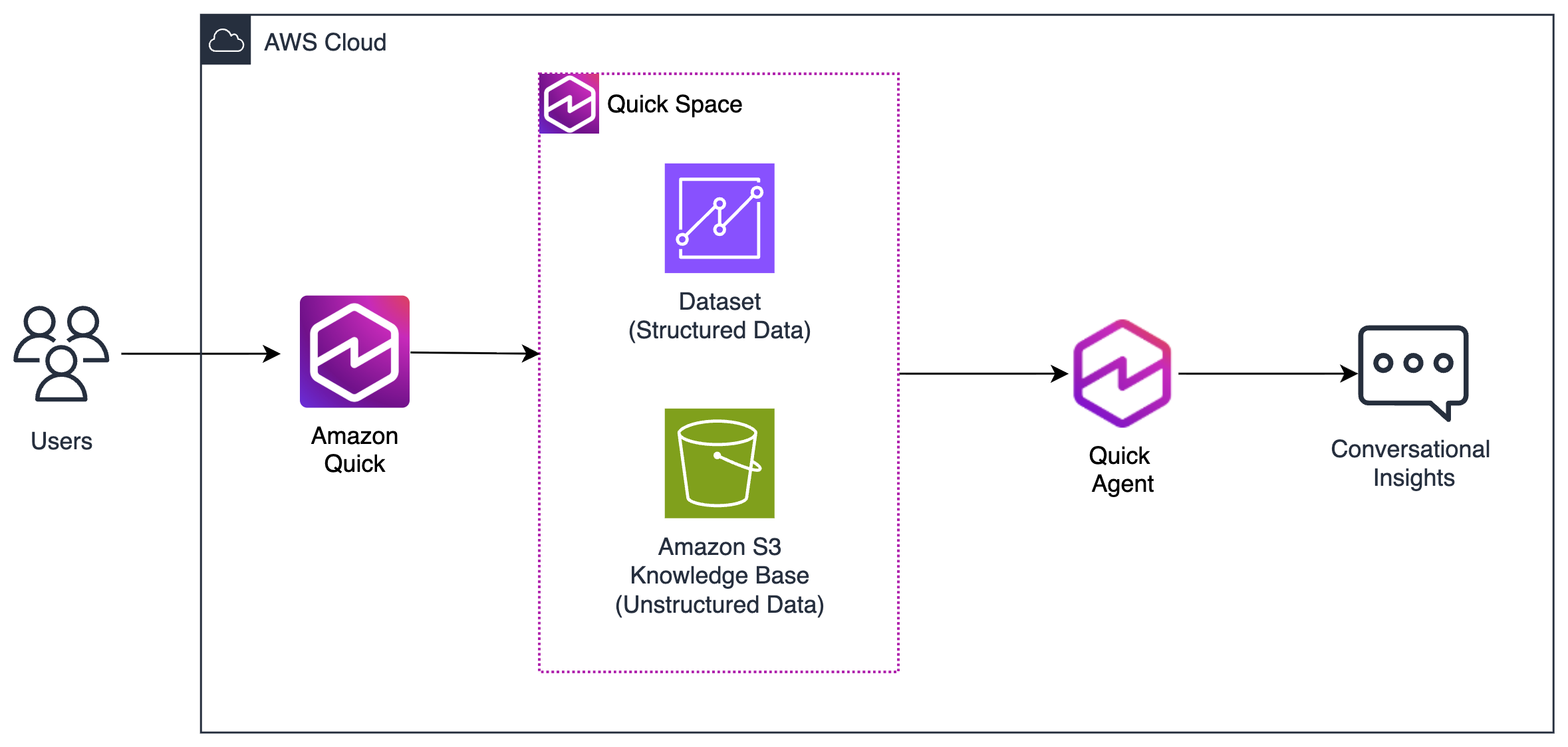
Amazon Quick integrates structured and unstructured data, enabling users to create a unified conversational interface for business insights.
“Amazon Quick's ability to create a custom chat agent that answers business questions across diverse data sets is a game-changer for data interaction.”
Key takeaways
- Amazon Quick integrates structured and unstructured data for enhanced business insights.
- Users can connect Amazon S3 as a knowledge base for data enrichment.
- A custom chat agent can be built to answer specific business queries.
- The service offers a unified conversational interface for intuitive data interaction.
- Adoption rates and user feedback will be critical in assessing its impact.
Amazon has unveiled a new feature within its Amazon Quick service that allows users to seamlessly integrate structured and unstructured data into a single, cohesive experience. This innovative approach aims to enhance data accessibility and usability for businesses by connecting Amazon S3 as a knowledge base. Users can enrich their datasets and build a customized chat agent capable of answering business questions across both data types, all through a unified conversational interface. This development signifies a major step forward in how organizations can leverage their data assets, providing a more streamlined and efficient way to extract insights and make data-driven decisions.
The integration of structured and unstructured data is particularly significant in today’s data-driven landscape, where organizations are inundated with vast amounts of information from various sources. Traditionally, structured data, which is highly organized and easily searchable, has been managed separately from unstructured data, which includes everything from emails and social media posts to images and videos. By bringing these two types of data together, Amazon Quick allows users to create a more holistic view of their information, enabling richer insights and more informed decision-making.
Key facts
| Field | Detail |
|---|---|
| Service Name | Amazon Quick |
| Data Types | Structured and Unstructured |
| Primary Integration | Amazon S3 |
| Key Feature | Custom chat agent for business questions |
| User Experience | Unified conversational interface |
| Use Cases | Data enrichment, knowledge base creation |
| Target Audience | Businesses seeking data insights |
| Release Date | October 2023 |
| Accessibility | Cloud-based service |
| Competitive Edge | Seamless integration of diverse data types |
Who's involved
Amazon Web Services (AWS) is the primary player behind Amazon Quick, a service designed to enhance data management and accessibility. AWS continues to innovate in the machine learning and data processing space, providing tools that empower businesses to harness their data effectively. The development of Amazon Quick is part of AWS's broader strategy to integrate machine learning capabilities into its cloud services, making advanced data analytics more accessible to a wider range of users.
The introduction of Amazon Quick comes at a time when businesses are increasingly looking for ways to leverage their data for competitive advantage. With the rise of artificial intelligence and machine learning, the ability to analyze and interpret both structured and unstructured data has become crucial for organizations aiming to stay ahead in their respective industries.
Historically, the management of structured and unstructured data has posed significant challenges for businesses. Structured data, typically stored in relational databases, is easy to query and analyze, but it often fails to capture the nuances and complexities of unstructured data. Unstructured data, on the other hand, while rich in information, is often difficult to analyze due to its lack of organization. Previous solutions have attempted to bridge this gap, but they often fell short in providing a truly integrated experience. Amazon Quick aims to change this by offering a platform that not only connects these data types but also enhances their usability through a conversational interface.
The evolution of data management tools has been marked by a gradual shift towards more integrated solutions. In the past, businesses relied on separate systems for structured and unstructured data, which often led to inefficiencies and missed opportunities for insights. The introduction of tools that can handle both data types simultaneously represents a significant advancement in the field. Amazon Quick's ability to create a custom chat agent that can respond to business queries across diverse data sets is a game-changer, allowing users to interact with their data in a more intuitive and engaging way.
How to read the numbers
While specific performance metrics for Amazon Quick have yet to be released, the potential impact of this service can be inferred from the capabilities it offers. The ability to integrate structured and unstructured data is expected to enhance data accessibility and usability, leading to more informed decision-making and improved business outcomes. As organizations begin to adopt Amazon Quick, it will be important to monitor user feedback and performance metrics to gauge its effectiveness in real-world applications.
What you can do with it
- Connect Amazon S3: Start by linking your Amazon S3 storage to Amazon Quick to create a centralized knowledge base.
- Enrich Your Datasets: Use the service to enhance your existing datasets with additional information from unstructured sources.
- Build a Custom Chat Agent: Create a tailored chat agent that can answer specific business questions, leveraging both structured and unstructured data.
- Utilize a Unified Interface: Take advantage of the conversational interface to interact with your data more naturally and intuitively.
- Explore Use Cases: Consider various applications, such as customer support, market research, and data analysis, to maximize the benefits of Amazon Quick.
What we're watching
As Amazon Quick gains traction, we will be monitoring its adoption rates among businesses and the feedback from users regarding its functionality and ease of use. Additionally, it will be interesting to see how Amazon positions this service against competitors in the data management space, particularly those that also offer integrated solutions for structured and unstructured data. The next milestone will be the release of performance metrics and case studies that demonstrate the effectiveness of Amazon Quick in real-world scenarios.
Looking ahead, the integration of structured and unstructured data through Amazon Quick could redefine how businesses approach data analytics. As organizations increasingly rely on data to drive their strategies, the ability to seamlessly access and analyze diverse data types will become a critical differentiator. The success of Amazon Quick may pave the way for further innovations in the field, potentially leading to new standards in data management and analytics. As more businesses adopt this technology, the implications for the industry as a whole could be profound, reshaping the landscape of data-driven decision-making.
Source: AWS Machine Learning · Read original →
Instagram & TikTok: copy the link or quote and paste into a Story, Reel, or caption.
Digest
AI news by email
Weekly Friday briefings plus midweek notes when models or research drop. Sources included — unsubscribe anytime.
Discussion
Comment here after signing in, or share the story to continue the conversation elsewhere.
Instagram & TikTok: copy the link and paste into a Story, Reel, or caption.
Log in or create an account to comment — Google / GitHub / X when those providers are configured.
No comments yet — start the thread.