Binary and Scalar Embedding Quantization for Significantly Faster & Cheaper Retrieval
New quantization techniques promise faster and cheaper data retrieval for AI applications.
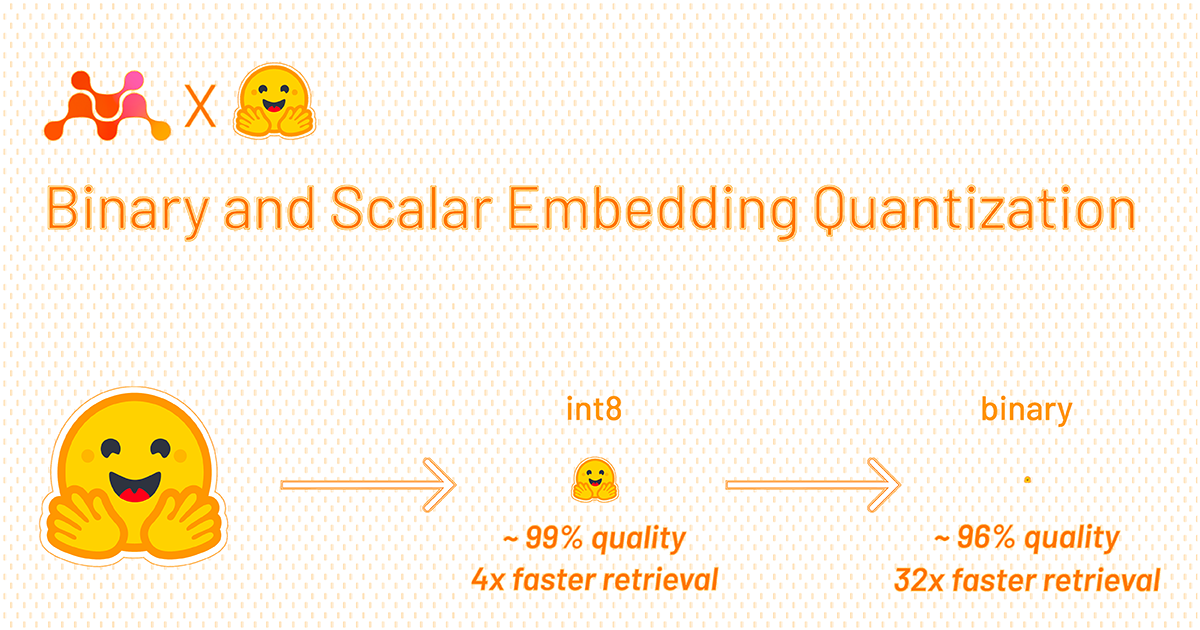
Recent advancements in quantization techniques have emerged from Hugging Face, aiming to enhance the efficiency of data retrieval in AI applications. The introduction of binary and scalar embeddings marks a significant leap forward, as these methods promise to reduce retrieval costs while simultaneously improving the performance of AI models. This is particularly crucial for applications that rely heavily on large datasets, where the speed and cost of data retrieval can be a bottleneck in delivering seamless user experiences.
Hugging Face has been at the forefront of AI and machine learning innovations, and this latest development is no exception. By implementing binary and scalar embeddings, the company is addressing a common challenge faced by developers and businesses: how to retrieve data quickly and affordably without compromising the quality of AI model outputs. The implications of these techniques extend beyond mere cost savings; they also pave the way for more responsive applications that can handle real-time data processing more effectively.
Key facts
| Field | Detail |
|---|---|
| Technique | Binary and scalar embeddings |
| Purpose | Reduce retrieval costs and improve efficiency |
| Impact on AI performance | Enhances model performance and user experience |
| Application areas | AI-driven applications requiring fast data retrieval |
| Company | Hugging Face |
The broader context of these advancements can be understood by looking at the increasing demand for efficient data processing in AI applications. As the volume of data continues to grow exponentially, traditional retrieval methods often struggle to keep pace, leading to delays and increased operational costs. By adopting quantization techniques like those introduced by Hugging Face, developers can optimize their models for faster response times, which is essential for applications in sectors such as e-commerce, healthcare, and real-time analytics. This aligns with a growing trend in the industry towards making AI more accessible and efficient.
Moreover, the introduction of binary and scalar embeddings is reminiscent of previous breakthroughs in model optimization, such as pruning and knowledge distillation, which have also aimed to enhance efficiency without sacrificing performance. These techniques have shown that it is possible to create leaner models that can operate effectively in resource-constrained environments. As businesses increasingly adopt AI technologies, the need for such innovations becomes even more pressing, and Hugging Face's latest offering is a timely response to this demand.
Looking ahead, the real test will be how these quantization techniques are adopted across various industries and integrated into existing AI frameworks. The potential for significant cost savings and improved performance could lead to a paradigm shift in how AI applications are developed and deployed. As developers begin to implement these techniques, the focus will likely shift towards measuring their real-world impact on user experience and operational efficiency, setting the stage for further innovations in AI retrieval systems.
Source: Hugging Face Blog · Read original →
Discussion
Comment here after signing in, or share the story to continue the conversation elsewhere.
Instagram & TikTok: copy the link and paste into a Story, Reel, or post caption.
Log in or create an account to comment — Google / GitHub / X when those providers are configured.
No comments yet — start the thread.


