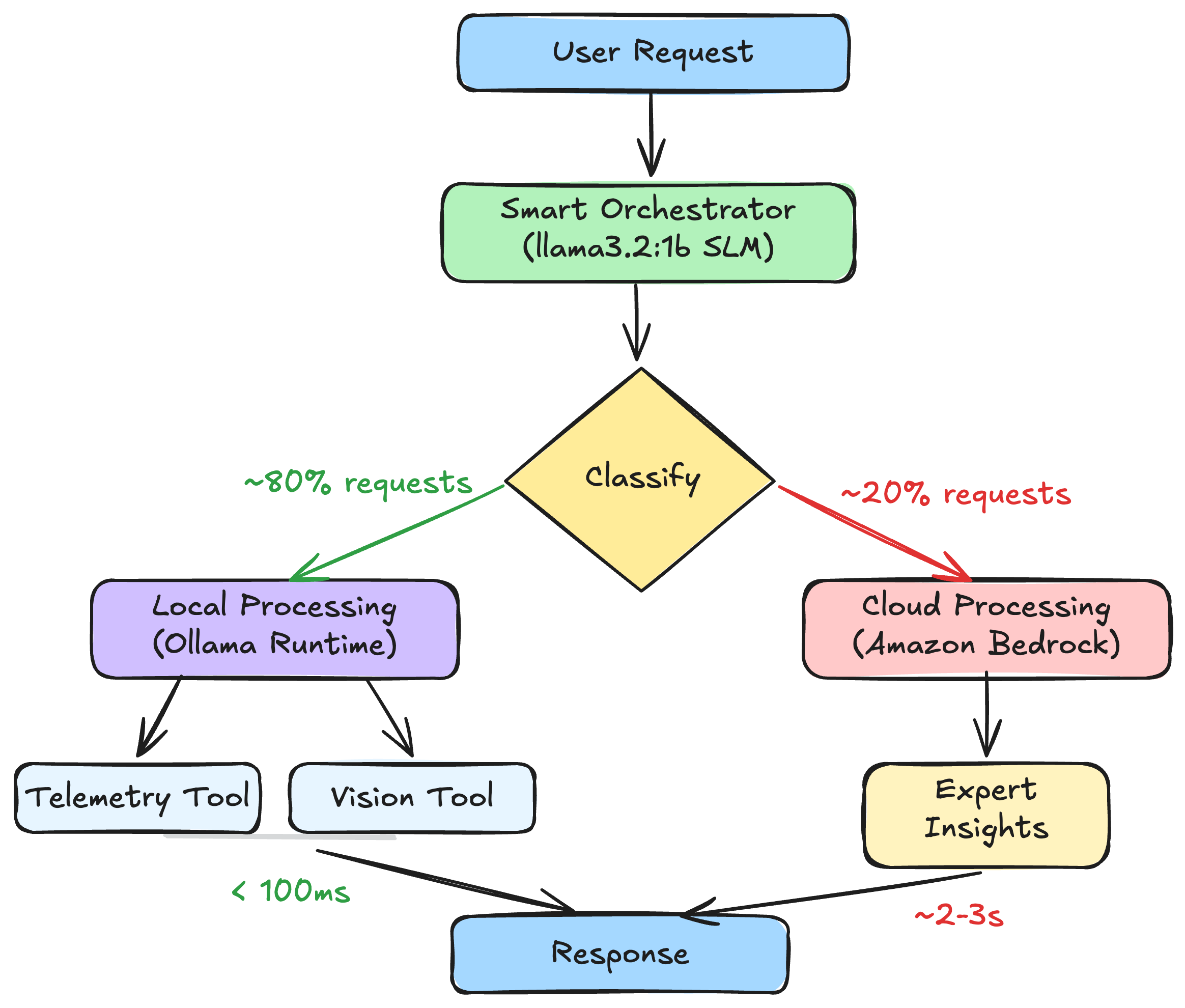
Adaptive agentic intelligence framework using Strands Agents
AWS unveils the Adaptive Agentic Intelligence Framework, integrating local language models with cloud capabilities for enhanced task management.
“By integrating local small language models with cloud capabilities, AAIF minimizes latency and maximizes efficiency in IoT task management.”
Key takeaways
- The Adaptive Agentic Intelligence Framework (AAIF) streamlines task management by using local small language models.
- Complex requests are routed to cloud models via Amazon Bedrock, enhancing processing capabilities.
- Developed by AWS, AAIF targets businesses leveraging IoT technology for improved efficiency.
- The framework represents a significant shift towards hybrid AI solutions, combining local and cloud processing.
- Organizations can expect reduced latency and improved user satisfaction with AAIF's implementation.
Amazon Web Services (AWS) has introduced the Adaptive Agentic Intelligence Framework (AAIF), a groundbreaking approach designed to streamline the management of routine tasks through the use of small language models (SLMs). This innovative framework leverages Strands Agents to operate locally, effectively handling simpler requests while routing more complex queries to advanced cloud models via Amazon Bedrock. By combining local processing with cloud capabilities, AAIF aims to enhance efficiency and responsiveness in various applications, particularly in Internet of Things (IoT) monitoring scenarios. The integration of these technologies marks a significant step forward in the development of intelligent systems capable of adapting to user needs in real-time.
The AAIF represents a shift in how organizations can deploy AI solutions, allowing them to utilize the strengths of both local and cloud-based models. With the rise of IoT devices generating vast amounts of data, the need for intelligent frameworks that can process information quickly and efficiently has never been more pressing. By employing SLMs for local task management, AAIF minimizes latency and bandwidth usage, while still providing access to the more powerful capabilities of cloud models when necessary. This hybrid approach not only optimizes performance but also enhances the user experience by ensuring that responses are timely and relevant.
Key facts
| Field | Detail |
|---|---|
| Framework Name | Adaptive Agentic Intelligence Framework (AAIF) |
| Developed By | Amazon Web Services (AWS) |
| Core Technology | Strands Agents, Small Language Models (SLMs) |
| Cloud Integration | Amazon Bedrock |
| Application Focus | Internet of Things (IoT) monitoring |
| Local Processing | Handles routine tasks |
| Cloud Processing | Routes complex requests |
| Use Case | Enhancing task management efficiency |
| Release Date | October 2023 |
| Target Users | Businesses leveraging IoT technology |
Who's involved
The development of the Adaptive Agentic Intelligence Framework is spearheaded by Amazon Web Services (AWS), a leader in cloud computing and machine learning technologies. The framework utilizes Strands Agents, a technology designed for intelligent task management, and integrates with Amazon Bedrock, AWS's platform for building and deploying machine learning models. This collaboration reflects AWS's commitment to advancing AI capabilities and providing businesses with the tools they need to thrive in a data-driven world.
The AAIF is particularly relevant for organizations that rely on IoT devices, as it addresses the challenges of managing and processing the data generated by these devices. By enabling local processing through SLMs, the framework allows businesses to respond to routine tasks without the delays associated with cloud processing, while still having access to more powerful models for complex queries.
The concept of adaptive agentic intelligence is not entirely new; however, the implementation of such a framework using Strands Agents and SLMs represents a significant advancement. Previous attempts at integrating local and cloud-based AI solutions often faced challenges related to latency, bandwidth, and the complexity of managing multiple systems. The AAIF aims to overcome these obstacles by providing a seamless experience for users, allowing them to interact with intelligent agents that can adapt to their needs in real-time.
Historically, AI systems have relied heavily on cloud-based processing, which, while powerful, can introduce delays and require substantial bandwidth. The introduction of local processing capabilities through SLMs marks a shift towards more efficient AI solutions that can operate independently of cloud resources for routine tasks. This evolution is particularly important as the number of IoT devices continues to grow, generating vast amounts of data that need to be processed quickly and efficiently.
How to read the numbers
While specific performance metrics for the AAIF have not been disclosed, the framework's design suggests a focus on optimizing both local and cloud processing capabilities. As organizations begin to implement AAIF in their operations, it will be crucial to monitor key performance indicators such as response times, accuracy of task completion, and overall user satisfaction. These metrics will provide insights into the effectiveness of the framework in real-world applications.
| Benchmark | Expected Outcome |
|---|---|
| Local Task Response Time | Significantly reduced latency |
| Cloud Task Processing Time | Efficient handling of complex queries |
| User Satisfaction | Increased due to timely responses |
| Bandwidth Usage | Lower for routine tasks |
| Integration Complexity | Streamlined with Strands Agents |
What you can do with it
For businesses looking to leverage the Adaptive Agentic Intelligence Framework, there are several practical steps to consider:
- Evaluate IoT Needs: Assess your organization's IoT deployment and identify routine tasks that can be managed locally with SLMs.
- Integrate with Existing Systems: Explore how AAIF can be integrated into your current infrastructure to enhance task management capabilities.
- Monitor Performance: Establish benchmarks for evaluating the effectiveness of AAIF in your operations, focusing on response times and user satisfaction.
- Train Staff: Ensure that your team is equipped with the knowledge and skills needed to utilize the framework effectively, including understanding how to interact with Strands Agents.
- Experiment with Use Cases: Test various applications of AAIF within your organization to discover new efficiencies and improvements in task management.
What we're watching
As the Adaptive Agentic Intelligence Framework begins to roll out, we will be closely monitoring its adoption across various industries, particularly in sectors heavily reliant on IoT technology. Key questions remain regarding how businesses will integrate AAIF into their existing workflows and the tangible benefits they will experience as a result. Additionally, the performance of local SLMs compared to traditional cloud-based models will be a critical area of focus, as organizations seek to optimize their AI strategies.
Looking ahead, the success of the AAIF could pave the way for further innovations in adaptive intelligence frameworks. As more businesses recognize the value of combining local and cloud processing capabilities, we may see an increase in demand for similar solutions that enhance efficiency and responsiveness in task management. The evolution of AI frameworks like AAIF will undoubtedly shape the future landscape of intelligent systems, driving advancements that can transform how organizations operate in a data-driven world.
Source: AWS Machine Learning · Read original →
Instagram & TikTok: copy the link or quote and paste into a Story, Reel, or caption.
Digest
AI news by email
Weekly Friday briefings plus midweek notes when models or research drop. Sources included — unsubscribe anytime.
Discussion
Comment here after signing in, or share the story to continue the conversation elsewhere.
Instagram & TikTok: copy the link and paste into a Story, Reel, or caption.
Log in or create an account to comment — Google / GitHub / X when those providers are configured.
No comments yet — start the thread.