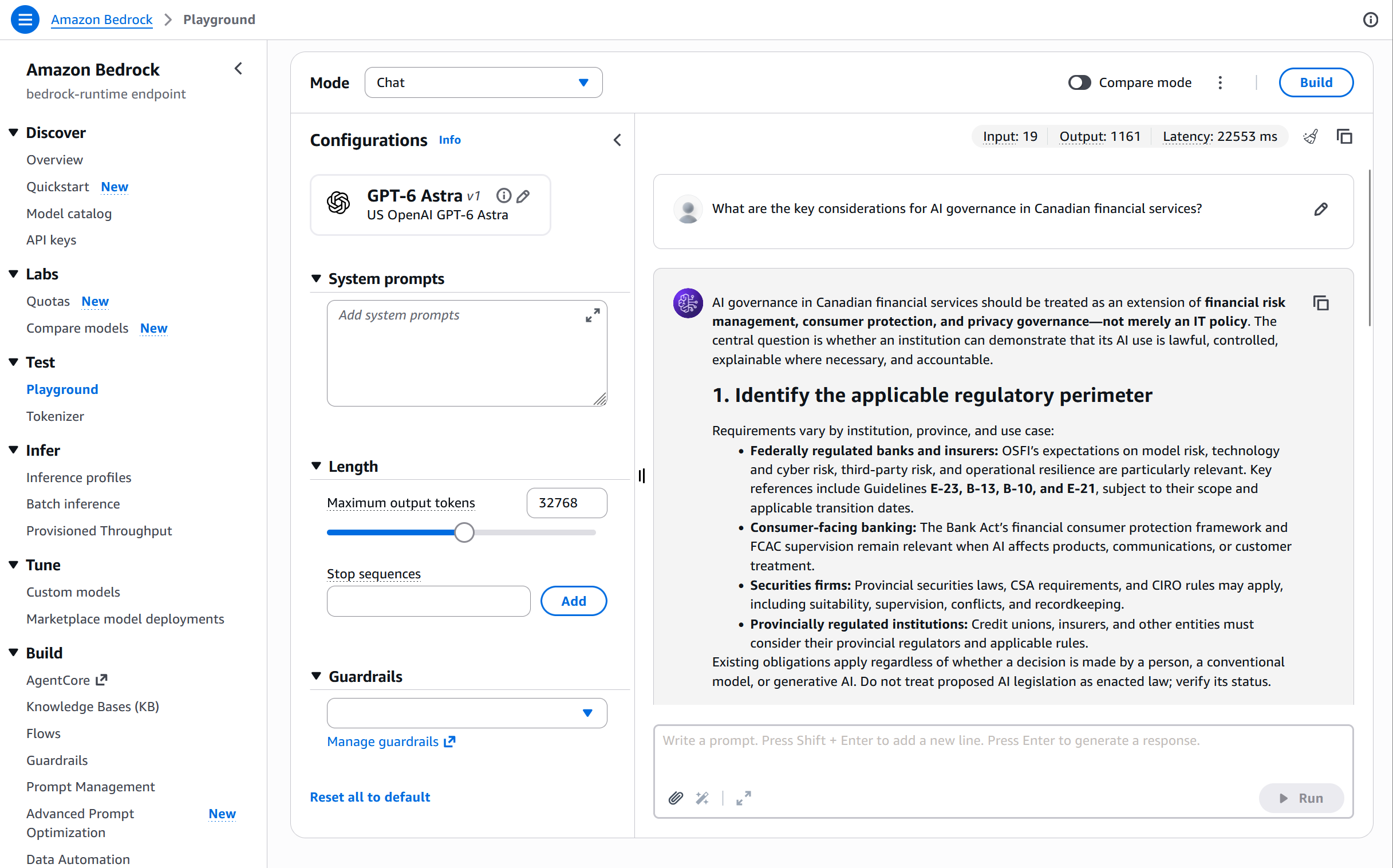
Access OpenAI GPT models on Amazon Bedrock from Canada with cross-Region inference
Canadian organizations can now leverage OpenAI's latest GPT models via Amazon Bedrock, enhancing AI capabilities across the region.
Key takeaways
- Canadian organizations can now access OpenAI's GPT models via AWS Bedrock.
- The models include GPT-5.6, GPT-6, and GPT-6.1.
- Cross-Region inference allows compliance with local data residency regulations.
- The integration supports various applications, including customer interactions and content generation.
- This move is expected to accelerate AI adoption across Canadian industries.
Amazon Web Services (AWS) has announced that Canadian organizations can now access OpenAI's advanced GPT models, including GPT-5.6, GPT-6, and GPT-6.1, through Amazon Bedrock. This development marks a significant step for businesses in Canada, allowing them to utilize state-of-the-art language models directly from the Canada (Central) and Canada West (Calgary) Regions. The introduction of cross-Region inference enables these organizations to harness the power of OpenAI's models while maintaining compliance with local data residency regulations, which is crucial for many sectors, including finance, healthcare, and government.
The integration of OpenAI's models into AWS Bedrock provides Canadian businesses with the ability to implement sophisticated natural language processing (NLP) capabilities without the need for extensive infrastructure investments. By leveraging AWS's scalable cloud services, organizations can now deploy AI solutions that enhance customer interactions, automate content generation, and improve data analysis. This accessibility is expected to accelerate the adoption of AI technologies across various industries in Canada, fostering innovation and enhancing competitive advantage.
Key facts
| Field | Detail |
|---|---|
| Models Available | GPT-5.6, GPT-6, GPT-6.1 |
| Regions | Canada (Central), Canada West (Calgary) |
| Service | Amazon Bedrock |
| Inference Type | Cross-Region inference |
| API Types | Responses, Chat Completions, Converse APIs |
| Target Audience | Canadian organizations |
| Compliance | Local data residency regulations |
| Launch Date | October 2023 |
| Expected Impact | Accelerated AI adoption in Canada |
| Use Cases | Customer interactions, content generation, data analysis |
Who's involved
The key players in this development include Amazon Web Services (AWS), which is the cloud computing arm of Amazon, and OpenAI, the organization behind the GPT models. This partnership allows AWS to offer OpenAI's cutting-edge technology to its customers, expanding the capabilities of its cloud services. Additionally, Canadian businesses across various sectors are poised to benefit from this integration, particularly those in industries that rely heavily on data processing and customer engagement.
OpenAI has been at the forefront of AI research and development, with its GPT models being widely recognized for their ability to generate human-like text and understand complex queries. By making these models available through AWS Bedrock, OpenAI is not only enhancing its reach but also enabling organizations to leverage AI in a more accessible and compliant manner. This collaboration is indicative of a broader trend where cloud service providers are partnering with AI developers to deliver advanced capabilities to their customers.
The introduction of OpenAI's models on AWS Bedrock is a significant milestone, especially considering the previous limitations faced by Canadian organizations in accessing such advanced AI technologies. Prior to this, many businesses had to rely on international cloud services, which posed challenges related to data sovereignty and compliance with Canadian regulations. The ability to access these models locally is a game-changer, allowing organizations to innovate without compromising on regulatory requirements.
Historically, the landscape of AI accessibility in Canada has been evolving. While many organizations have been eager to adopt AI technologies, concerns over data privacy and compliance have often hindered progress. The launch of OpenAI's models on AWS Bedrock represents a shift towards more localized AI solutions, enabling businesses to harness the power of AI while adhering to local laws and regulations. This change is particularly relevant in light of recent discussions around data sovereignty and the importance of keeping sensitive information within national borders.
How to read the numbers
While specific performance metrics for the GPT models on AWS Bedrock have not been disclosed, users can expect significant improvements in various NLP tasks compared to previous iterations. The models are designed to handle complex queries, generate coherent text, and engage in meaningful conversations, making them suitable for a wide range of applications. The following table outlines the expected capabilities of the new models:
| Benchmark | Expected Capability |
|---|---|
| Text Generation | High-quality, coherent text generation |
| Conversational AI | Natural and engaging interactions |
| Context Understanding | Improved comprehension of complex queries |
| Customization | Ability to fine-tune for specific applications |
| Scalability | Supports large-scale deployments |
What you can do with it
Organizations looking to leverage OpenAI's models on AWS Bedrock can take several practical steps to integrate these capabilities into their operations:
- Explore Use Cases: Identify specific applications where AI can enhance business processes, such as customer support, content creation, or data analysis.
- Set Up AWS Bedrock: Follow AWS documentation to set up an account and access the Bedrock service, ensuring compliance with local regulations.
- Utilize APIs: Experiment with the Responses, Chat Completions, and Converse APIs to understand how they can be applied to real-world scenarios.
- Train Custom Models: Consider fine-tuning the GPT models for specific industry needs, enhancing their relevance and effectiveness in targeted applications.
- Monitor Performance: Regularly assess the performance of the deployed models and make adjustments as necessary to optimize outcomes.
What we're watching
As Canadian organizations begin to adopt OpenAI's models through AWS Bedrock, it will be crucial to monitor the impact on various industries. Key questions include how quickly businesses will integrate these technologies and whether they will lead to measurable improvements in efficiency and customer satisfaction. Additionally, the response from regulatory bodies regarding data compliance and privacy will be closely observed, as any changes could influence the future landscape of AI deployment in Canada.
Looking ahead, the collaboration between AWS and OpenAI is expected to evolve, potentially leading to further enhancements in model capabilities and additional features tailored for Canadian users. As organizations gain access to more advanced AI tools, the competitive landscape may shift, prompting businesses to innovate rapidly to stay ahead. The implications of this partnership extend beyond immediate access to technology; they signal a broader commitment to fostering a robust AI ecosystem in Canada that prioritizes compliance and local innovation. The next steps for AWS and OpenAI will likely involve expanding their offerings and refining their models based on user feedback and emerging industry needs.
Source: AWS Machine Learning · Read original →
Instagram & TikTok: copy the link and paste into a Story, Reel, or caption.
Digest
AI news by email
Weekly Friday briefings plus midweek notes when models or research drop. Sources included — unsubscribe anytime.
Discussion
Comment here after signing in, or share the story to continue the conversation elsewhere.
Instagram & TikTok: copy the link and paste into a Story, Reel, or caption.
Log in or create an account to comment — Google / GitHub / X when those providers are configured.
No comments yet — start the thread.