Accelerating Transformers Fine-Tuning with NVIDIA NeMo AutoModel
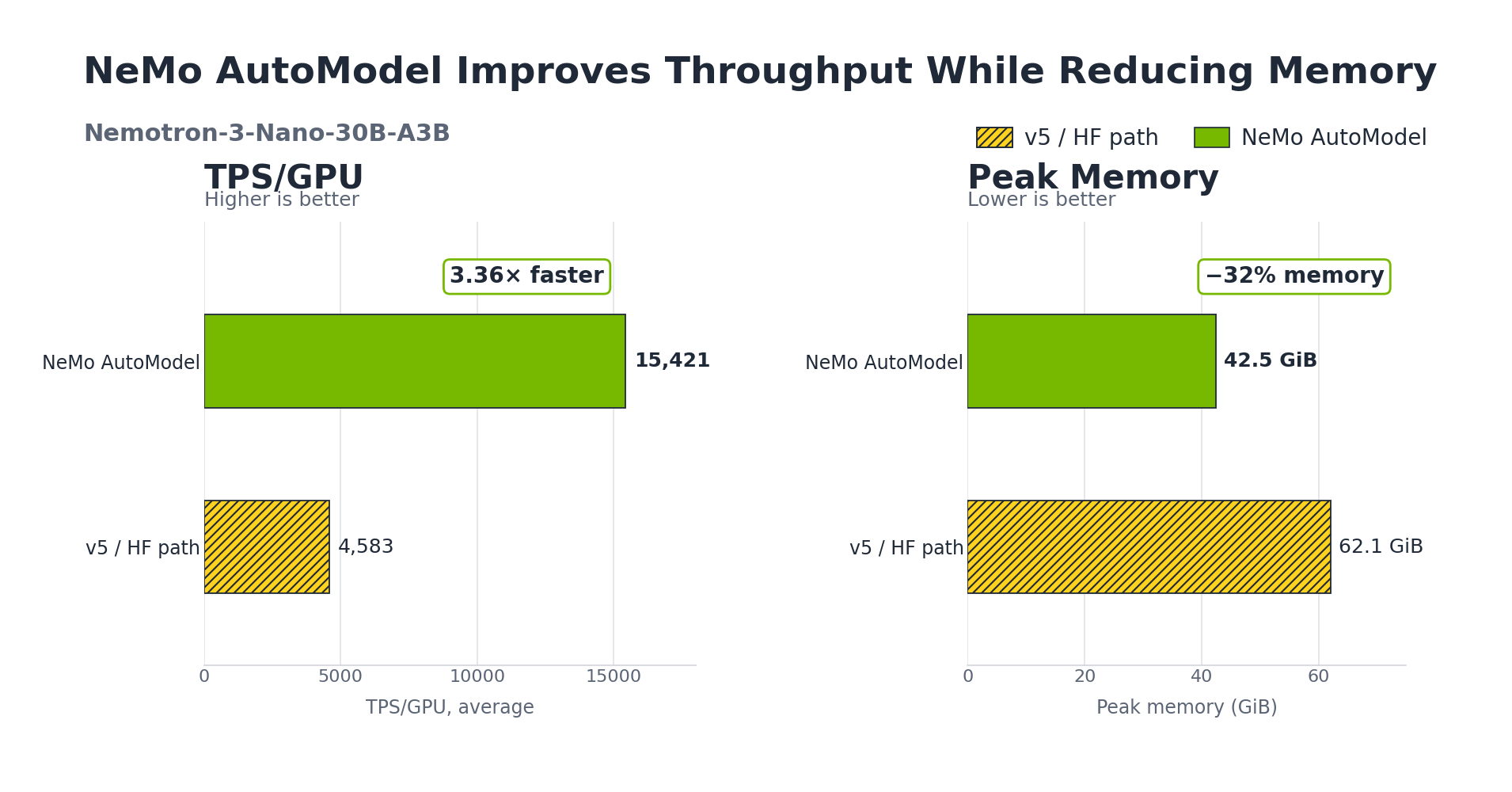
NVIDIA's NeMo AutoModel accelerates Transformers fine-tuning, achieving speeds twice as fast as conventional methods.
NVIDIA has unveiled its NeMo AutoModel, a groundbreaking tool designed to significantly enhance the fine-tuning process of Transformer models. This new offering promises to double the speed of traditional fine-tuning methods, which has long been a bottleneck in the deployment of AI models. With the increasing demand for efficient model training, this innovation is poised to streamline workflows for developers and researchers alike, allowing them to focus on building and refining their applications rather than getting bogged down in lengthy training times.
The NeMo AutoModel leverages advanced techniques in model optimization and parallel processing, enabling faster convergence during the fine-tuning phase. This is particularly crucial in the context of large-scale language models, where the computational resources required can be substantial. By reducing the time needed to fine-tune these models, NVIDIA aims to make sophisticated AI capabilities more accessible to a broader audience, including smaller companies and individual developers who may not have the same resources as larger organizations.
Key facts
| Field | Detail |
|---|---|
| Product Name | NVIDIA NeMo AutoModel |
| Purpose | Accelerate Transformers fine-tuning |
| Speed Improvement | Twice as fast as traditional methods |
| Target Users | Developers and researchers |
| Key Technology | Model optimization and parallel processing |
| Industry Impact | Streamlined workflows for AI applications |
The introduction of NeMo AutoModel comes at a time when the AI landscape is rapidly evolving, with Transformer models becoming the backbone of many applications in natural language processing, computer vision, and beyond. The ability to fine-tune these models efficiently is critical, as it allows organizations to adapt pre-trained models to their specific needs without incurring prohibitive costs in time and resources. NVIDIA's innovation aligns with the broader trend of making AI more user-friendly and efficient, a goal that many companies in the sector are pursuing.
Historically, fine-tuning large models has often been a tedious and resource-intensive process. For instance, the advent of transfer learning marked a significant shift in how models could be adapted for specific tasks, but the fine-tuning process still required considerable time and computational power. NVIDIA's NeMo AutoModel builds on this foundation, offering a solution that not only accelerates the process but also enhances the overall efficiency of model training. This could lead to more rapid iterations and improvements in AI applications, as developers can test and deploy models more quickly.
Looking ahead, the implications of NeMo AutoModel extend beyond just speed. As more developers adopt this tool, we may see an increase in the diversity of applications built on Transformer architectures, as the barrier to entry lowers. Furthermore, NVIDIA's commitment to optimizing AI workflows may inspire other companies to innovate in similar ways, potentially leading to a new wave of tools that prioritize efficiency and accessibility in AI development.
Source: Hugging Face Blog · Read original →
Discussion
Comment here after signing in, or share the story to continue the conversation elsewhere.
Instagram & TikTok: copy the link and paste into a Story, Reel, or post caption.
Log in or create an account to comment — Google / GitHub / X when those providers are configured.
No comments yet — start the thread.
