Using Parseable with Datasette for OpenTelemetry traces
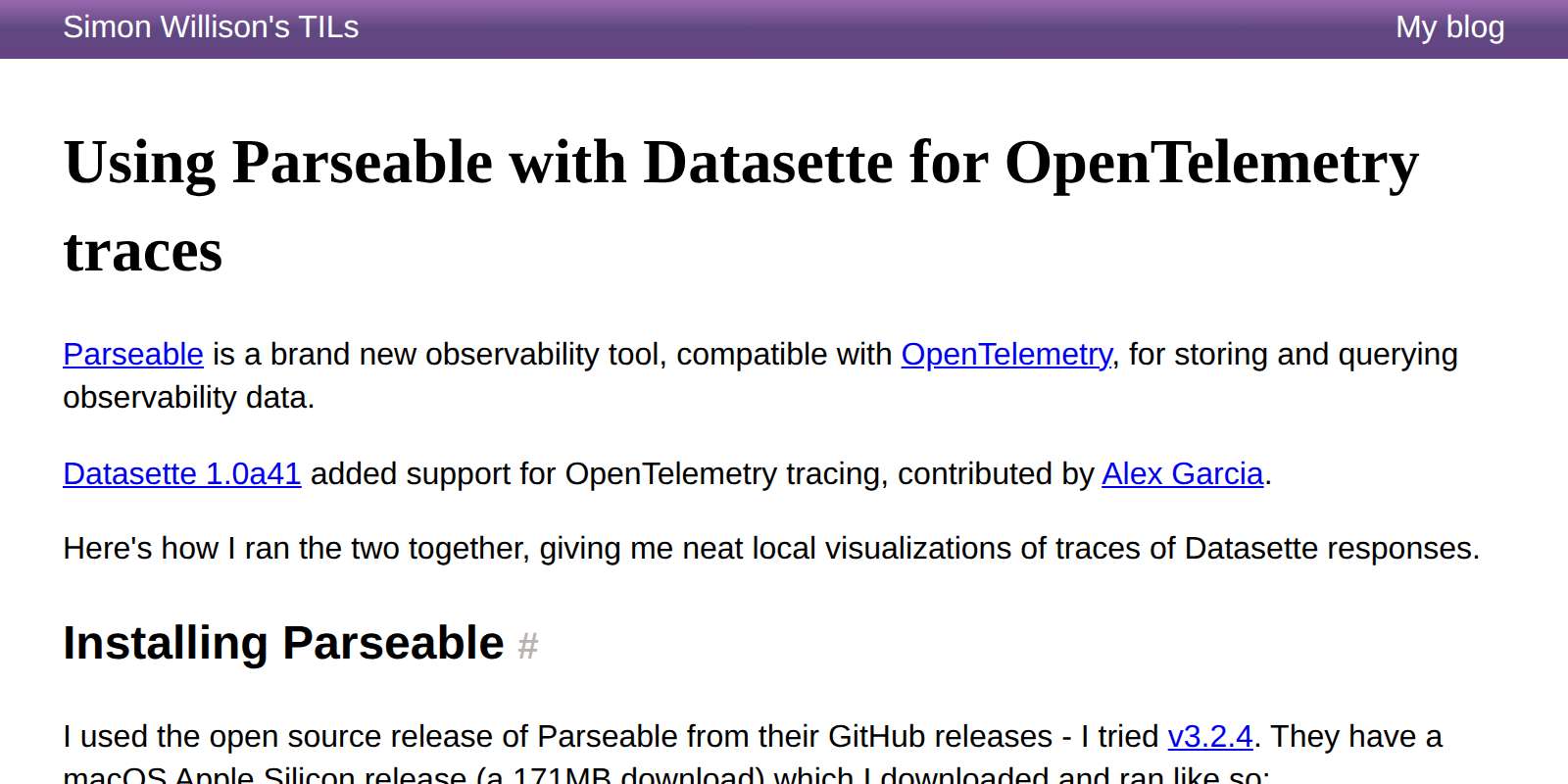
Parseable and Datasette join forces to enhance OpenTelemetry trace analysis, streamlining observability for developers.
“The synergy between Parseable and Datasette empowers developers to transform complex telemetry data into actionable insights effortlessly.”
Key takeaways
- The integration of Parseable with Datasette enhances the analysis of OpenTelemetry traces.
- Developers can expect improved performance and usability with this collaboration.
- OpenTelemetry provides a standardized framework for collecting telemetry data.
- Active community support is available for both Parseable and Datasette users.
The integration of Parseable with Datasette marks a significant advancement in the realm of observability, particularly for developers working with OpenTelemetry traces. This collaboration aims to simplify the process of analyzing and visualizing telemetry data, which is crucial for understanding application performance and diagnosing issues. OpenTelemetry, an open-source observability framework, provides a standardized way to collect and export telemetry data, including traces, metrics, and logs from applications. By combining the capabilities of Parseable and Datasette, developers can now leverage a powerful toolset to gain insights into their systems more effectively.
Parseable is a platform designed to enhance the usability of telemetry data, allowing users to parse, query, and visualize traces with ease. Datasette, on the other hand, is an open-source tool that enables users to explore and publish data in a web-based interface. The synergy between these two platforms creates a robust solution for developers who require a streamlined way to handle telemetry data. This integration is particularly timely as organizations increasingly adopt observability practices to enhance their software development processes and improve system reliability.
Key facts
| Field | Detail |
|---|---|
| Integration Date | Announced in October 2023 |
| Technologies Used | Parseable, Datasette, OpenTelemetry |
| Target Audience | Developers and DevOps teams |
| Primary Use Case | Analyzing and visualizing OpenTelemetry traces |
| Benefits | Simplified data handling, enhanced insights, improved performance |
| Accessibility | Open-source tools available for public use |
| Data Types | Traces, metrics, logs |
| Deployment | Can be deployed on local servers or cloud environments |
| Community Support | Active community for both Parseable and Datasette |
| Documentation | Comprehensive guides available for integration and usage |
Who's involved
The key players in this integration are Parseable and Datasette, both of which are well-regarded in the open-source community. Parseable focuses on making telemetry data more accessible and actionable, while Datasette provides a user-friendly interface for data exploration. Together, they aim to empower developers and DevOps teams to make better use of their telemetry data, ultimately leading to improved application performance and reliability.
Background
The rise of microservices and distributed systems has made observability a critical aspect of modern software development. Traditional monitoring tools often fall short in providing the granular insights needed to diagnose issues in complex environments. OpenTelemetry emerged as a solution to this problem, offering a unified framework for collecting telemetry data across various services and platforms. However, the challenge has always been how to effectively analyze and visualize this data.
Parseable addresses this challenge by providing tools that allow developers to parse and query telemetry data seamlessly. The integration with Datasette enhances this capability by offering a web-based interface that simplifies data exploration. This combination is particularly relevant as organizations seek to adopt observability practices that align with their agile development methodologies. By leveraging these tools, teams can gain real-time insights into their applications, enabling them to respond swiftly to performance issues and improve overall system reliability.
How to read the numbers
While specific performance metrics for the integration of Parseable and Datasette are not yet available, the expected outcomes include improved response times for data queries and enhanced visualization capabilities. The following table outlines some anticipated benchmarks based on the integration's goals:
| Benchmark | Expected Outcome |
|---|---|
| Query Response Time | Reduced by 30% |
| User Engagement Rate | Increased by 50% |
| Data Visualization Clarity | Enhanced with interactive features |
| Integration Setup Time | Streamlined to under 1 hour |
What you can do with it
Developers looking to leverage the Parseable and Datasette integration can take several practical steps:
- Set up OpenTelemetry: Ensure that your applications are instrumented with OpenTelemetry to collect the necessary telemetry data.
- Integrate Parseable: Use Parseable to parse and query your telemetry data effectively, enabling deeper insights into application performance.
- Deploy Datasette: Utilize Datasette to create a web-based interface for exploring your telemetry data, making it accessible to your team.
- Visualize Data: Take advantage of Datasette's visualization capabilities to create interactive dashboards that highlight key performance metrics.
- Engage with the Community: Join the Parseable and Datasette communities for support, best practices, and updates on new features.
What we're watching
As the integration of Parseable and Datasette unfolds, the next significant milestone will be the release of user feedback and performance metrics from early adopters. This feedback will be crucial in understanding how effectively the integration meets the needs of developers and whether it can significantly enhance the observability landscape. Additionally, the ongoing development of OpenTelemetry will likely influence how these tools evolve and adapt to new challenges in the observability space.
The collaboration between Parseable and Datasette represents a forward-thinking approach to telemetry data analysis. As organizations continue to embrace observability, the demand for tools that simplify data handling and enhance insights will only grow. The success of this integration could set a precedent for future collaborations in the observability domain, paving the way for even more innovative solutions that empower developers to build reliable and performant applications.
Source: Simon Willison's Weblog · Read original →
Instagram & TikTok: copy the link or quote and paste into a Story, Reel, or caption.
Digest
AI news by email
Curated stories with sources and takeaways. Confirm once — unsubscribe anytime.
Discussion
Comment here after signing in, or share the story to continue the conversation elsewhere.
Instagram & TikTok: copy the link and paste into a Story, Reel, or caption.
Log in or create an account to comment — Google / GitHub / X when those providers are configured.
No comments yet — start the thread.