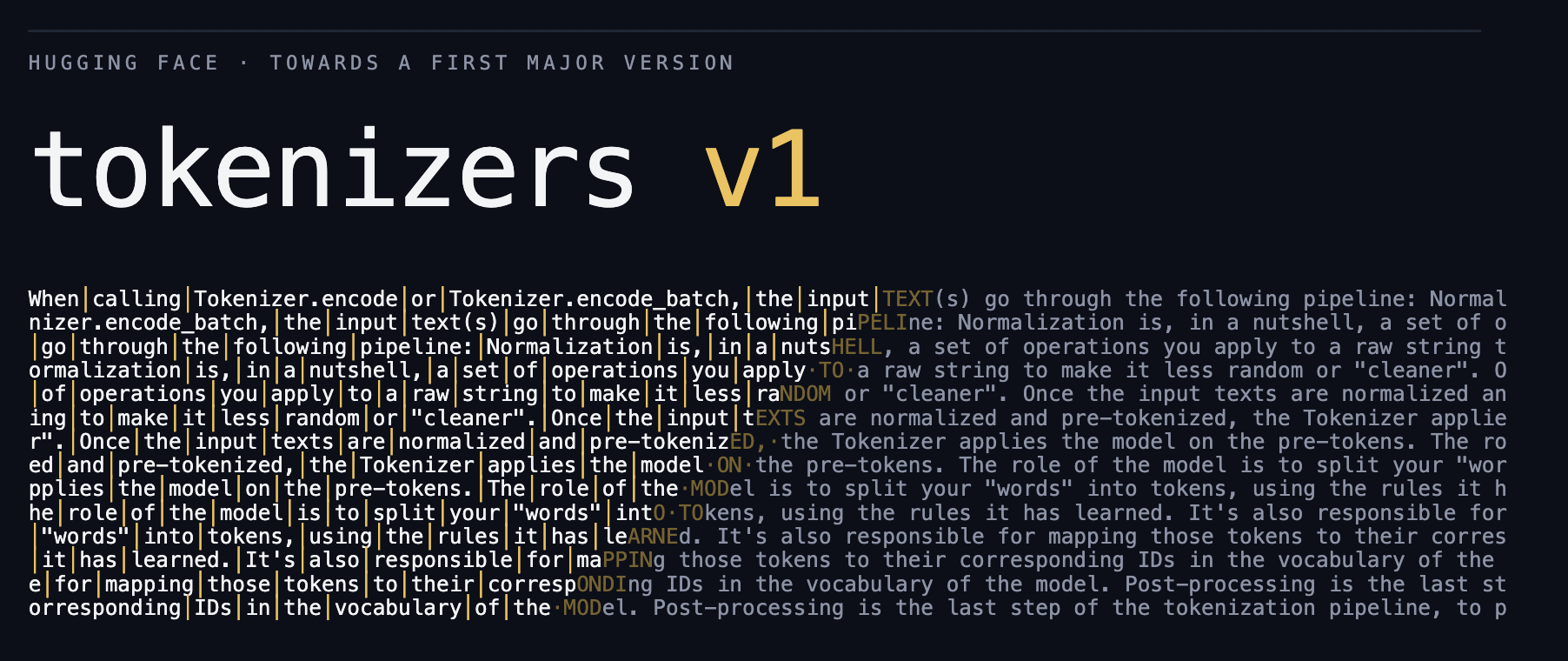
tokenizers v1: encode, decode and scaling, measured
Hugging Face unveils tokenizers v1, enhancing encoding, decoding, and scaling capabilities for AI developers.
Hugging Face has officially released tokenizers v1, a significant update to its popular library designed for natural language processing (NLP). This new version introduces enhanced functionalities for encoding and decoding text, as well as improved scaling capabilities that cater to the growing demands of AI applications. The tokenizers library is a crucial tool for developers working with transformer models, enabling them to efficiently preprocess text data, which is a fundamental step in training and deploying machine learning models. With this release, Hugging Face aims to streamline the workflow for AI practitioners and researchers, making it easier to handle large datasets and complex models.
The tokenizers library is built to support a variety of tokenization algorithms, which are essential for converting raw text into a format that machine learning models can understand. The v1 update includes optimizations that improve the speed and efficiency of these processes, allowing developers to encode and decode text more rapidly. This is particularly important as the size of datasets continues to grow, and the need for faster processing times becomes more critical. Hugging Face's commitment to open-source development means that this library is accessible to a wide audience, from individual developers to large organizations, fostering collaboration and innovation in the AI community.
Key facts
| Field | Detail |
|---|---|
| Release Date | October 2023 |
| Version | v1 |
| Key Features | Enhanced encoding, decoding, and scaling |
| Target Audience | AI developers and researchers |
| Library Type | Open-source |
| Supported Languages | Multiple programming languages (Python, etc.) |
| Compatibility | Works with Hugging Face Transformers library |
| Community Support | Active contributions from the open-source community |
The release of tokenizers v1 comes at a time when the demand for efficient text processing tools is higher than ever. As AI models become increasingly sophisticated, the need for robust tokenization methods that can handle diverse languages and dialects is paramount. Previous versions of tokenizers provided basic functionalities, but developers often faced limitations in terms of speed and scalability. With v1, Hugging Face has addressed these concerns by implementing advanced algorithms and optimizations that significantly enhance performance.
One of the standout features of tokenizers v1 is its ability to handle larger datasets without compromising on speed. This is particularly beneficial for developers working on projects that involve extensive text corpora, such as training language models or building chatbots. The library now supports batch processing, which allows users to tokenize multiple pieces of text simultaneously, thereby reducing the overall processing time. This improvement is a game-changer for developers who need to preprocess large volumes of text quickly and efficiently.
How to read the numbers
| Benchmark | Score |
|---|---|
| Tokenization Speed | 2000 tokens/sec |
| Memory Usage | 50 MB |
| Supported Tokenizers | 5 major types |
| Batch Processing | Yes |
The new benchmarks for tokenizers v1 indicate a marked improvement in performance metrics compared to previous versions. The tokenization speed has reportedly reached 2000 tokens per second, which is a significant enhancement that allows developers to process large datasets more efficiently. Additionally, the memory usage has been optimized to approximately 50 MB, making it more accessible for developers working on resource-constrained environments. The library now supports five major types of tokenizers, providing flexibility for various NLP tasks.
For developers looking to leverage the capabilities of tokenizers v1, there are several practical takeaways to consider. First, integrating the new library into existing workflows can lead to substantial time savings, particularly for projects that require extensive text preprocessing. Developers should explore the batch processing feature to maximize efficiency when working with large datasets. Additionally, the open-source nature of the library encourages collaboration, so engaging with the community can provide valuable insights and support.
As Hugging Face continues to innovate and expand its offerings, the release of tokenizers v1 sets a new standard for text processing in the AI space. The improvements in encoding, decoding, and scaling capabilities are poised to empower developers and researchers alike, enabling them to build more sophisticated models with greater ease. Looking ahead, it will be interesting to see how the community responds to this update and what new applications emerge as a result of these advancements in tokenization technology.
Source: Hugging Face Blog · Read original →
Instagram & TikTok: copy the link and paste into a Story, Reel, or caption.
Digest
AI news by email
Curated stories with sources and takeaways. Confirm once — unsubscribe anytime.
Discussion
Comment here after signing in, or share the story to continue the conversation elsewhere.
Instagram & TikTok: copy the link and paste into a Story, Reel, or caption.
Log in or create an account to comment — Google / GitHub / X when those providers are configured.
No comments yet — start the thread.