Rethinking access control for RAG with Amazon Quick and Amazon Bedrock
Amazon Quick and Amazon Bedrock enhance document-level access controls for enterprise RAG, ensuring secure insights from complex knowledge sources.
“Amazon Quick and Amazon Bedrock enhance document-level access controls for enterprise RAG, ensuring secure insights from complex knowledge sources.”
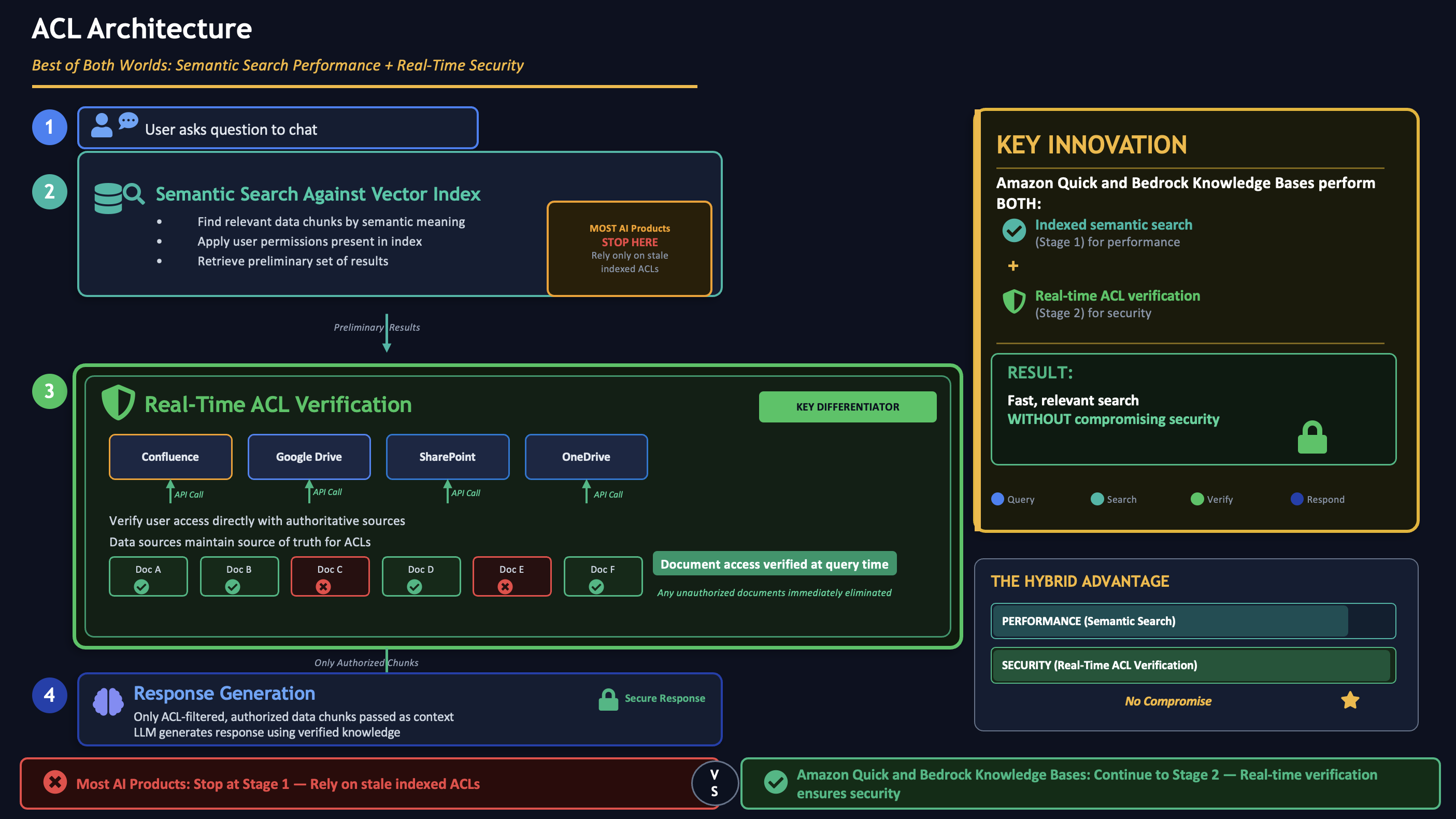
In a notable advancement for enterprise-level machine learning applications, Amazon has introduced enhanced access control mechanisms for Retrieval-Augmented Generation (RAG) through its services, Amazon Quick and Amazon Bedrock. This development is particularly significant as organizations increasingly rely on diverse knowledge sources such as SharePoint, Google Drive, and Confluence to derive insights and drive decision-making. However, these platforms often come with intricate permission structures that can complicate the retrieval of information. Amazon's new approach aims to streamline this process by enforcing document-level access controls in real-time, thus ensuring that users can only access information they are authorized to view.
The integration of Amazon Quick and Amazon Bedrock allows for dynamic verification of permissions directly with authoritative sources at the time of query. This means that when a user attempts to access specific documents or data, the system checks their permissions in real-time, ensuring compliance with organizational policies and security protocols. This capability not only enhances security but also optimizes the user experience by reducing the friction often associated with accessing critical information. By addressing these challenges head-on, Amazon is positioning itself as a leader in the enterprise AI space, particularly in the realm of secure data access and management.
Key facts
| Field | Detail |
|---|---|
| Companies involved | Amazon, with services Amazon Quick and Amazon Bedrock |
| Technology focus | Retrieval-Augmented Generation (RAG) |
| Key features | Document-level access controls, real-time permission verification |
| Knowledge sources | SharePoint, Google Drive, Confluence |
| Use case | Enterprise data retrieval and insights generation |
| Security enhancement | Dynamic verification of user permissions at query time |
| Target audience | Enterprises utilizing AI for data-driven decision making |
| Release date | Announced in October 2023 |
| Compliance focus | Ensures adherence to organizational security policies |
| User experience | Streamlined access to authorized documents |
The players
The key players in this development are Amazon Web Services (AWS), which provides the underlying infrastructure and services, and the various enterprise clients that utilize these tools for their data management needs. Amazon Quick serves as a user-friendly interface for accessing and managing data, while Amazon Bedrock acts as the foundational AI model that powers the RAG capabilities. Together, they form a cohesive solution aimed at simplifying access control in complex enterprise environments.
The introduction of these tools comes at a time when organizations are increasingly adopting AI technologies to enhance their operational efficiencies. By integrating advanced access control mechanisms, Amazon is addressing a critical pain point that many enterprises face: the challenge of securely accessing and utilizing data from multiple sources while adhering to strict compliance requirements.
To understand the significance of this development, it is essential to consider the broader context of data management in enterprises. Traditionally, organizations have struggled with balancing the need for data accessibility with the imperative of data security. As businesses have evolved, the volume and variety of data they handle have grown exponentially, leading to more complex permission structures across various platforms. This complexity often results in delays and inefficiencies when employees seek to access necessary information, which can hinder productivity and decision-making.
Amazon's approach to RAG with document-level access controls marks a shift in how enterprises can manage their data. Previous iterations of data retrieval systems often relied on static permissions that did not account for real-time changes in user roles or access rights. This meant that even if an employee's role changed, their access to certain documents might not be updated immediately, leading to potential security risks or data silos. By implementing real-time verification of permissions, Amazon Quick and Bedrock ensure that users have access only to the information they are entitled to, thus reducing the risk of unauthorized access and enhancing overall data governance.
How to read the numbers
While specific performance metrics for Amazon Quick and Amazon Bedrock's new access control features have not been disclosed, understanding the potential impact of these enhancements can be inferred from the broader trends in enterprise data management. The following table outlines key considerations that organizations might evaluate when assessing the effectiveness of these tools:
| Metric | Expected Impact |
|---|---|
| User access speed | Improved due to real-time permission checks |
| Compliance adherence rate | Increased as a result of dynamic controls |
| User satisfaction | Higher due to streamlined access processes |
| Data security incidents | Decreased with enhanced access controls |
| Operational efficiency | Enhanced through reduced retrieval times |
What you can do with it
For organizations looking to leverage the new capabilities of Amazon Quick and Amazon Bedrock, here are some practical takeaways:
- Implement real-time access controls: Begin integrating the new document-level access control features to ensure that users can only retrieve data they are authorized to access.
- Train employees on new protocols: Educate staff on how to effectively use the new tools and understand the importance of data security and compliance.
- Monitor access patterns: Utilize analytics to track how data is accessed and used, allowing for adjustments to permissions as necessary.
- Integrate with existing systems: Ensure that the new access control mechanisms work seamlessly with current data sources like SharePoint and Google Drive.
- Regularly review permissions: Establish a routine for auditing user permissions to keep access rights aligned with organizational changes.
What we're watching
As Amazon continues to roll out these features, the next critical milestone will be the feedback from enterprise users regarding the effectiveness of the new access controls. Additionally, it will be important to monitor how these tools perform under varying workloads and in different organizational contexts. There is also an open question regarding how quickly other cloud service providers will respond with similar or enhanced capabilities, which could further shape the competitive landscape in enterprise AI solutions.
Looking ahead, the integration of document-level access controls into RAG systems represents a significant step forward in the evolution of enterprise data management. As organizations increasingly rely on AI to drive insights from their data, the ability to securely and efficiently access information will become paramount. With Amazon leading the charge in this area, it will be interesting to see how other players in the market adapt and innovate in response to these advancements.
Source: AWS Machine Learning · Read original →
Instagram & TikTok: copy the link or quote and paste into a Story, Reel, or caption.
Digest
AI news by email
Curated stories with sources and takeaways. Confirm once — unsubscribe anytime.
Discussion
Comment here after signing in, or share the story to continue the conversation elsewhere.
Instagram & TikTok: copy the link and paste into a Story, Reel, or caption.
Log in or create an account to comment — Google / GitHub / X when those providers are configured.
No comments yet — start the thread.