

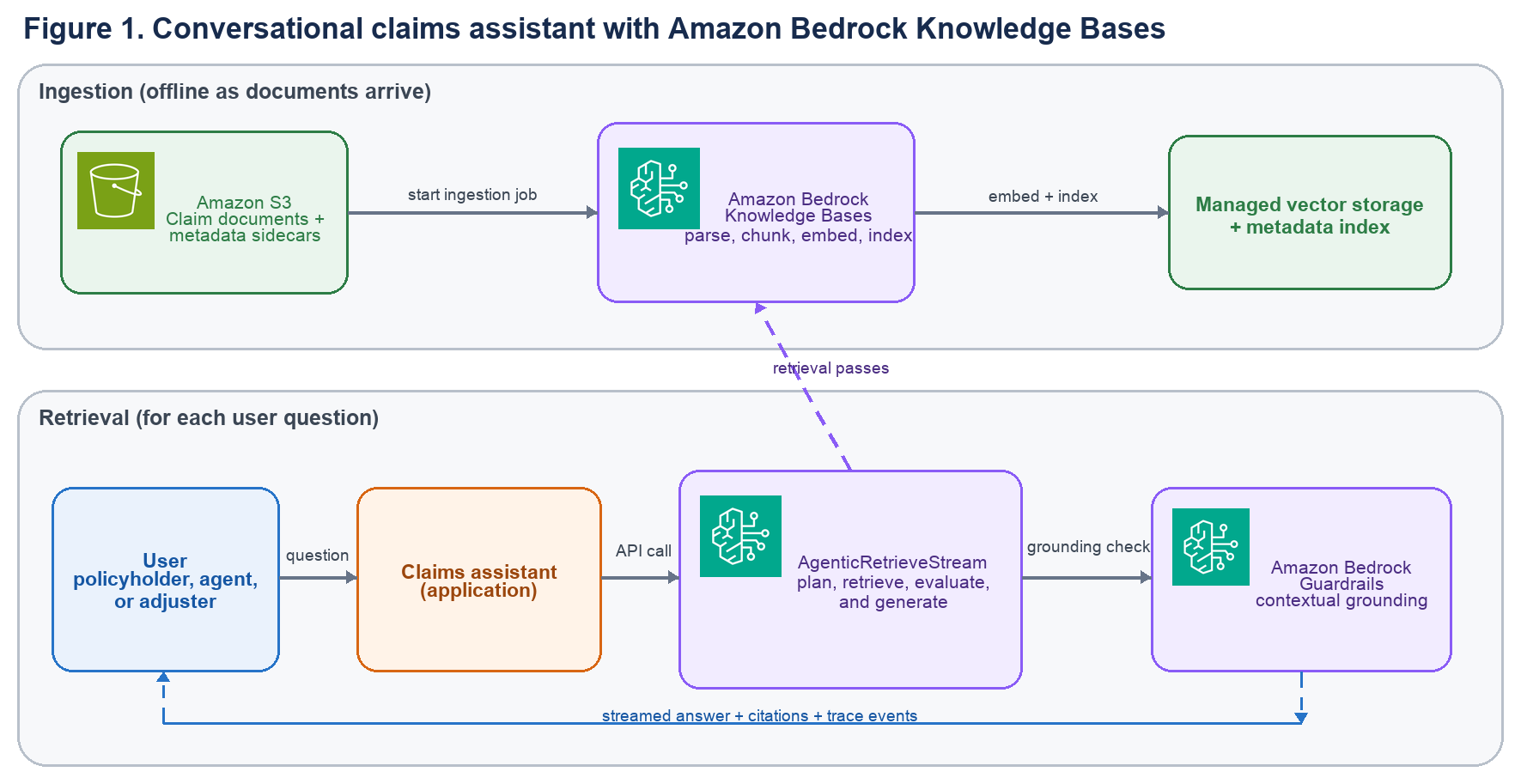
Query claims in natural language with Amazon Bedrock Knowledge Bases
Amazon Bedrock Knowledge Bases introduces a powerful tool for querying claims in natural language, enhancing accessibility and usability for users.
“Amazon Bedrock Knowledge Bases transforms claims processing by enabling natural language queries, making data interaction more intuitive and accessible.”
Key takeaways
- Amazon Bedrock Knowledge Bases allows users to query claims in natural language.
- The AgenticRetrieveStream API facilitates the creation of conversational claims assistants.
- Multi-turn follow-ups and contextual grounding enhance user interaction.
- Integration with Amazon S3 streamlines document ingestion and access.
- This feature is particularly beneficial for industries like insurance, healthcare, and legal sectors.
Amazon has unveiled a new feature within its Bedrock platform that allows users to query claims in natural language using the AgenticRetrieveStream API. This innovation is designed to facilitate the creation of a conversational claims assistant, which can effectively respond to user inquiries while providing relevant citations from claim documents. By leveraging Amazon S3 for document ingestion, this tool aims to streamline the process of accessing and understanding complex information, making it easier for users to interact with data in a more intuitive manner.
The introduction of this feature marks a significant step forward in the realm of natural language processing (NLP) and machine learning. Amazon Bedrock, a fully managed service that provides access to foundation models, is now equipped with capabilities that allow users to build applications that can understand and respond to queries in a conversational manner. This is particularly relevant in industries where claims processing and information retrieval are critical, such as insurance, healthcare, and legal sectors. The ability to ask questions in natural language and receive accurate, contextually relevant answers can greatly enhance user experience and operational efficiency.
Key facts
| Field | Detail |
|---|---|
| Feature | Natural language querying with Amazon Bedrock Knowledge Bases |
| API | AgenticRetrieveStream API |
| Document Source | Claims documents ingested from Amazon S3 |
| Use Case | Building a conversational claims assistant |
| Industries Benefited | Insurance, healthcare, legal sectors |
| Capabilities | Multi-turn follow-ups, metadata filters, contextual grounding guardrails |
| Release Date | October 2023 |
| Target Audience | Developers and businesses seeking to enhance information retrieval capabilities |
| Accessibility | Designed for users with varying levels of technical expertise |
| Documentation Availability | Comprehensive technical how-to guides provided by AWS |
The players involved in this development include Amazon Web Services (AWS), the cloud computing arm of Amazon, which has been at the forefront of machine learning and AI advancements. AWS has consistently rolled out features that enhance the capabilities of its cloud services, and the introduction of the Bedrock Knowledge Bases is no exception. This feature is part of a broader trend where cloud providers are integrating advanced AI functionalities into their platforms to cater to the growing demand for intelligent applications.
The Bedrock platform itself is built on a foundation of various AI models that can be utilized for different tasks, ranging from text generation to image recognition. By incorporating natural language querying capabilities, AWS is not only enhancing the usability of its platform but also positioning itself as a leader in the AI space. The ability to create a conversational claims assistant is a game-changer for businesses that rely on processing large volumes of claims and data.
Historically, the process of querying data has been cumbersome, often requiring users to have a deep understanding of the underlying data structures and query languages. Traditional databases and information retrieval systems often necessitate users to formulate complex queries, which can be a barrier to entry for many. The introduction of natural language processing capabilities aims to dismantle these barriers, allowing users to interact with data in a more natural and intuitive way. This shift is reminiscent of the early days of search engines, where users transitioned from needing to know specific keywords to simply asking questions in plain language.
As organizations increasingly adopt AI technologies, the demand for tools that can facilitate seamless interactions with data is growing. The Bedrock Knowledge Bases feature is designed to meet this demand by providing a user-friendly interface that allows for multi-turn conversations. This means that users can engage in back-and-forth dialogue with the system, refining their queries based on previous responses. Such capabilities are essential for complex inquiries where follow-up questions are necessary to drill down into specific details.
The players
- Amazon Web Services (AWS): The cloud computing platform responsible for the development of Bedrock Knowledge Bases.
- Developers and Businesses: The primary users of this technology, particularly in sectors like insurance, healthcare, and legal.
- Data Scientists and AI Engineers: Professionals who will leverage these tools to build sophisticated applications that utilize natural language processing.
How to read the numbers
While specific performance metrics for the AgenticRetrieveStream API and the Bedrock Knowledge Bases have not been disclosed, the focus on natural language processing indicates a shift towards more user-friendly interfaces. The effectiveness of such systems can often be gauged by user satisfaction and the accuracy of responses, rather than traditional numerical benchmarks. However, as more users adopt this technology, we can expect to see emerging metrics around response times, accuracy rates, and user engagement levels.
What you can do with it
- Build Conversational Interfaces: Utilize the AgenticRetrieveStream API to create applications that can answer user queries in natural language.
- Enhance User Experience: Implement multi-turn follow-ups to allow users to refine their questions and receive more accurate answers.
- Integrate with Existing Systems: Use Amazon S3 for document ingestion to streamline the process of accessing claims and other relevant data.
- Utilize Metadata Filters: Apply metadata filters to improve the relevance of responses based on user context.
What we're watching
As this feature rolls out, we will be monitoring how businesses integrate the Bedrock Knowledge Bases into their existing workflows. An open question remains regarding the adaptability of the technology across different industries and the potential for customization to meet specific business needs. Additionally, the effectiveness of the contextual grounding guardrails will be crucial in ensuring that the responses generated are not only accurate but also relevant to the user's intent.
Looking ahead, the next milestone for Amazon Bedrock Knowledge Bases will likely involve user feedback and iterative improvements based on real-world applications. As more organizations adopt this technology, we can expect to see a growing body of case studies demonstrating its impact on efficiency and user satisfaction. The ongoing development of AI capabilities within cloud platforms like AWS will continue to shape the future of how businesses interact with data, making it essential for developers to stay informed about these advancements.
Source: AWS Machine Learning · Read original →
Instagram & TikTok: copy the link or quote and paste into a Story, Reel, or caption.
Digest
AI news by email
Curated stories with sources and takeaways. Confirm once — unsubscribe anytime.
Discussion
Comment here after signing in, or share the story to continue the conversation elsewhere.
Instagram & TikTok: copy the link and paste into a Story, Reel, or caption.
Log in or create an account to comment — Google / GitHub / X when those providers are configured.
No comments yet — start the thread.


