

Open TTS Leaderboard: Scalable Evaluation for Multilingual Text-to-Speech and Voice Cloning
Hugging Face launches an Open TTS Leaderboard to enhance evaluation standards for multilingual text-to-speech and voice cloning technologies.
“The Open TTS Leaderboard aims to revolutionize multilingual text-to-speech evaluation, fostering innovation and collaboration within the voice synthesis community.”
Key takeaways
- Hugging Face launched the Open TTS Leaderboard for multilingual TTS evaluation.
- The leaderboard establishes standardized metrics for assessing voice synthesis quality.
- Developers can benchmark their models against industry standards.
- Community contributions are encouraged to enhance the platform's effectiveness.
- The initiative aims to improve accessibility and quality in TTS technologies.
The landscape of text-to-speech (TTS) technology is undergoing a significant transformation with the introduction of the Open TTS Leaderboard by Hugging Face. This innovative platform aims to provide a comprehensive evaluation framework for multilingual TTS and voice cloning systems, allowing developers and researchers to benchmark their models against industry standards. By offering a centralized location for performance metrics, the Open TTS Leaderboard seeks to foster competition and collaboration within the TTS community, ultimately leading to advancements in the quality and accessibility of voice synthesis technologies.
Hugging Face, a prominent player in the AI and machine learning space, has been at the forefront of developing tools and platforms that democratize access to cutting-edge technologies. The Open TTS Leaderboard is a natural extension of their mission to support open-source initiatives and promote transparency in AI development. With the increasing demand for high-quality, multilingual voice synthesis solutions across various applications—from virtual assistants to audiobooks—the need for standardized evaluation metrics has never been more critical. The Open TTS Leaderboard addresses this gap by providing a structured approach to assess the performance of different TTS models.
Key facts
| Field | Detail |
|---|---|
| Launch Date | October 2023 |
| Organization | Hugging Face |
| Focus Area | Multilingual text-to-speech and voice cloning |
| Evaluation Criteria | Quality, intelligibility, naturalness, and language diversity |
| Community Involvement | Open to contributions from developers and researchers worldwide |
| Accessibility | Free access to the leaderboard and evaluation tools for all users |
| Target Audience | Developers, researchers, and businesses in the TTS space |
| Future Plans | Continuous updates and expansion of evaluation metrics and models |
| Collaboration | Encourages partnerships between academia and industry for improved TTS solutions |
| Impact | Aims to enhance the quality and accessibility of TTS technologies across languages |
Who's involved
The Open TTS Leaderboard is spearheaded by Hugging Face, a company renowned for its contributions to the AI community, particularly in natural language processing and machine learning. The initiative involves collaboration with various researchers and developers who are actively working on TTS technologies. Additionally, the platform invites participation from academic institutions and industry players, fostering a collaborative environment to push the boundaries of voice synthesis.
Background
Text-to-speech technology has evolved significantly over the past decade, transitioning from basic robotic voices to highly sophisticated systems capable of producing natural-sounding speech. This evolution has been driven by advancements in deep learning and neural networks, which have enabled models to learn from vast datasets and generate more realistic voice outputs. However, despite these advancements, the lack of standardized evaluation metrics has posed challenges in comparing different TTS systems.
Historically, TTS evaluations have been conducted in an ad-hoc manner, relying on subjective assessments rather than objective metrics. This has led to inconsistencies in performance reporting and made it difficult for developers to identify the strengths and weaknesses of their models. The Open TTS Leaderboard addresses these issues by establishing clear evaluation criteria that focus on quality, intelligibility, and naturalness, ensuring that developers have a reliable framework to assess their systems.
How to read the numbers
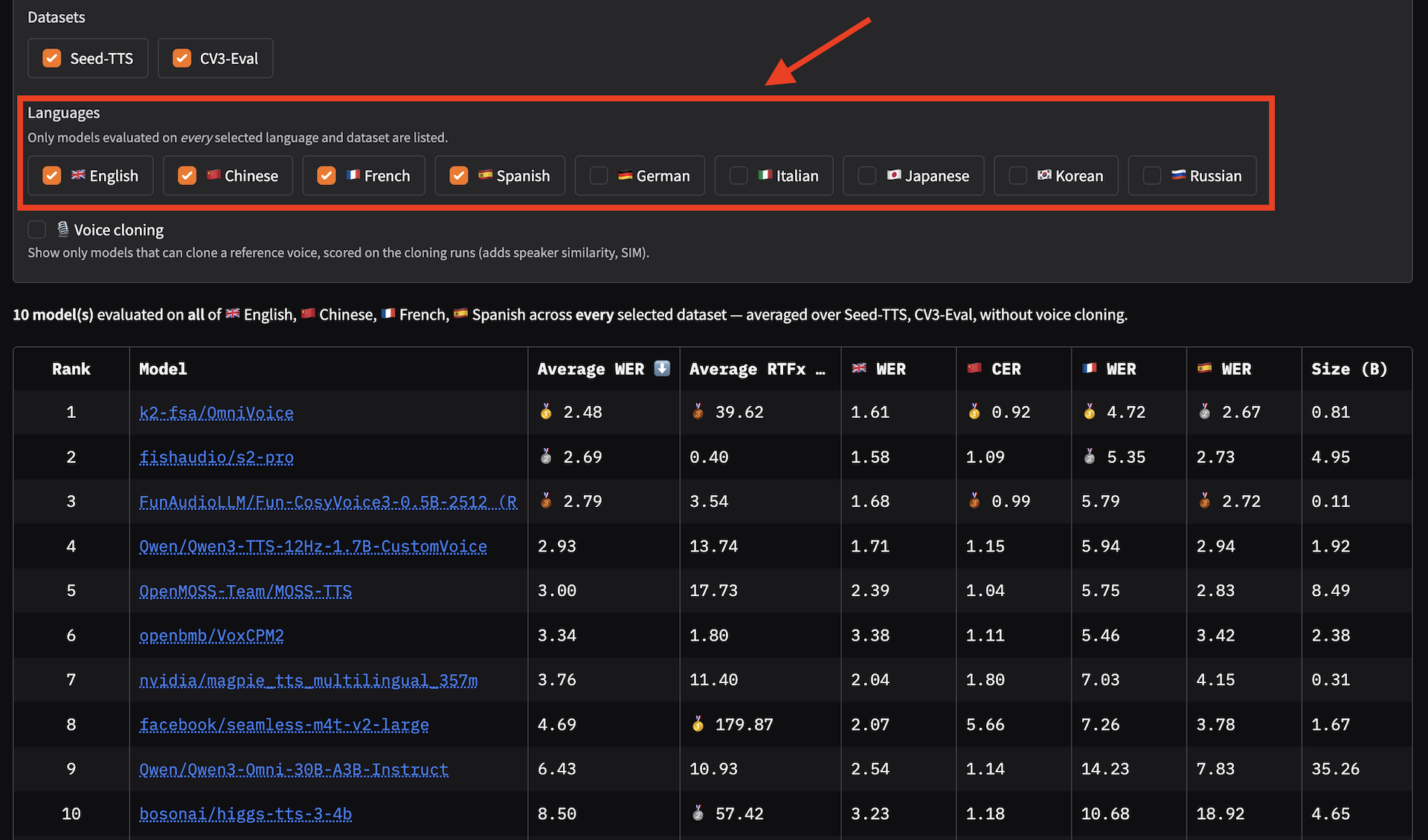
While the Open TTS Leaderboard does not yet provide specific numerical scores for models, it emphasizes qualitative assessments based on user feedback and expert evaluations. The leaderboard will categorize models based on their performance across various languages and use cases, allowing users to gauge which systems excel in specific areas. As more models are submitted and evaluated, users can expect to see a clearer picture of the competitive landscape in TTS technology.
What you can do with it
- Benchmark your models: Use the Open TTS Leaderboard to compare your TTS models against industry standards and identify areas for improvement.
- Contribute to the community: Participate in the leaderboard by submitting your models and sharing insights with other developers and researchers.
- Stay informed: Keep track of the latest advancements in TTS technology and learn from the best-performing models in the leaderboard.
- Collaborate with peers: Engage with other TTS developers and researchers to share knowledge and foster innovation in voice synthesis.
What we're watching
As the Open TTS Leaderboard gains traction, the next critical milestone will be the influx of models submitted for evaluation. It will be interesting to observe how quickly the community embraces this platform and whether it leads to significant improvements in TTS quality across different languages. Additionally, the potential for partnerships between academia and industry could drive further advancements in TTS technologies, making it essential to monitor these developments closely.
Looking ahead, the Open TTS Leaderboard is poised to become a pivotal resource for the TTS community. By establishing a standardized framework for evaluation, it not only enhances the quality of voice synthesis technologies but also promotes collaboration among developers and researchers. As more models are evaluated and compared, the leaderboard will serve as a valuable tool for identifying best practices and driving innovation in the field of multilingual text-to-speech and voice cloning. The ongoing evolution of this platform will undoubtedly shape the future of TTS technology, making it an exciting space to watch in the coming months and years.
Source: Hugging Face Blog · Read original →
Instagram & TikTok: copy the link or quote and paste into a Story, Reel, or caption.
Digest
AI news by email
Curated stories with sources and takeaways. Confirm once — unsubscribe anytime.
Discussion
Comment here after signing in, or share the story to continue the conversation elsewhere.
Instagram & TikTok: copy the link and paste into a Story, Reel, or caption.
Log in or create an account to comment — Google / GitHub / X when those providers are configured.
No comments yet — start the thread.


