

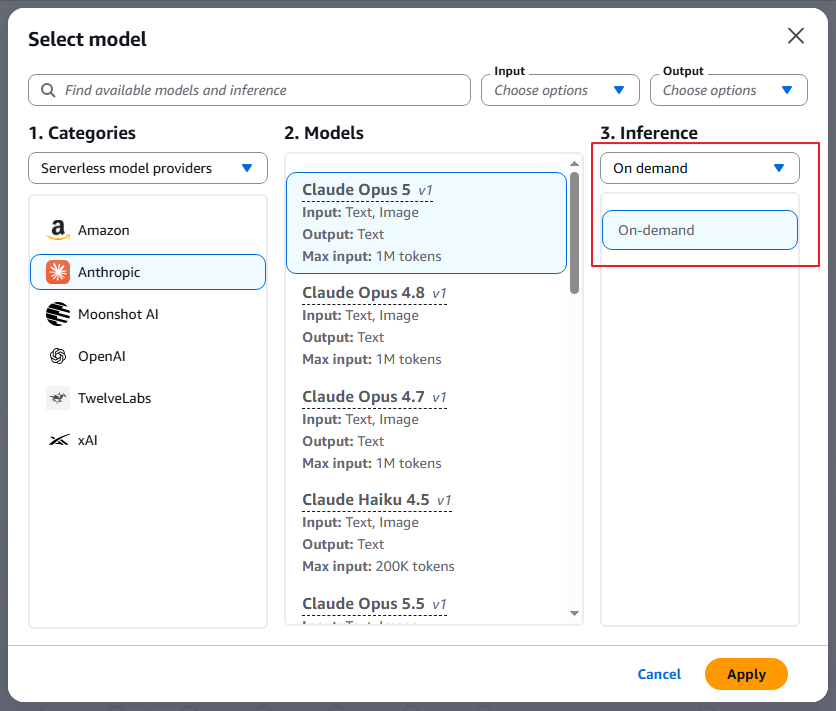
Introducing Anthropic models on Amazon Bedrock for in-region inference in Seoul and Singapore
Amazon Bedrock now enables in-region inference for Anthropic's Claude models in Seoul and Singapore, enhancing local data processing capabilities.
“AWS's integration of Anthropic's Claude models enables businesses in Asia to process sensitive data locally, enhancing privacy and performance.”
Key takeaways
- AWS now supports Anthropic's Claude Opus 5 and Sonnet 5 models for in-region inference.
- Local data processing in Seoul and Singapore enhances compliance with privacy regulations.
- Businesses can expect reduced latency and improved performance in AI applications.
- This move positions AWS as a leader in the Asia-Pacific AI market.
- The success of this initiative may influence other cloud providers to enhance their AI offerings.
Amazon Web Services (AWS) has made a significant move by integrating Anthropic's advanced AI models, Claude Opus 5 and Claude Sonnet 5, into its Amazon Bedrock platform. This integration allows users in South Korea and Singapore to perform in-region inference, which means that data processing can occur locally rather than being routed to distant servers. This is particularly crucial for businesses and organizations that have stringent data privacy and compliance requirements, as it ensures that sensitive information remains within the geographic boundaries of these regions. With this development, AWS is not only expanding its service offerings but also responding to the growing demand for localized AI solutions in Asia.
The announcement comes at a time when businesses are increasingly prioritizing data sovereignty and privacy. By enabling in-region inference, AWS is addressing the concerns of companies that handle sensitive data, such as financial institutions and healthcare providers. The ability to process data locally can significantly reduce latency, improve performance, and enhance the overall user experience. Furthermore, this move positions AWS as a leader in the cloud services market, particularly in the Asia-Pacific region, where the demand for AI and machine learning capabilities is rapidly increasing.
Key facts
| Field | Detail |
|---|---|
| Models Supported | Claude Opus 5, Claude Sonnet 5 |
| Regions Available | Seoul, Singapore |
| Service | Amazon Bedrock |
| Inference Type | In-region |
| Target Users | Businesses with local data processing needs |
| Compliance Focus | Data privacy and sovereignty |
| Performance Benefit | Reduced latency and improved user experience |
| Launch Date | October 2023 |
| Company | Amazon Web Services (AWS) |
| Partner | Anthropic |
Who's involved
The key players in this development are Amazon Web Services (AWS) and Anthropic, a prominent AI research company known for its focus on developing safe and interpretable AI systems. AWS is a leading cloud service provider, offering a wide range of services, including machine learning and AI capabilities. Anthropic, on the other hand, has gained recognition for its Claude models, which are designed to be more aligned with human intentions and values, making them suitable for various applications across industries.
Background
The integration of Anthropic's models into AWS Bedrock marks a significant step in the evolution of cloud-based AI services. Previously, many organizations faced challenges related to data privacy and compliance when using AI models that required data to be processed outside their home countries. This often led to delays in deployment and concerns over data security. With the introduction of in-region inference, AWS is addressing these issues head-on, allowing companies to leverage advanced AI capabilities without compromising on data privacy.
In recent years, the demand for AI solutions has surged, particularly in sectors such as finance, healthcare, and e-commerce. Companies are increasingly looking for ways to harness the power of AI while ensuring that they comply with local regulations regarding data handling and storage. The ability to process data locally not only meets these regulatory requirements but also enhances the performance of AI applications by reducing latency and improving response times.
How to read the numbers
While specific performance metrics for the Claude models have not been disclosed in this announcement, the emphasis on reduced latency and improved user experience suggests that users can expect significant enhancements in their AI applications. The integration of these models into AWS Bedrock is likely to lead to better performance outcomes for businesses that rely on AI for critical operations.
What you can do with it
- Leverage Claude Opus 5 and Claude Sonnet 5 for natural language processing tasks, such as chatbots and customer support systems.
- Utilize in-region inference to comply with local data privacy regulations while still benefiting from advanced AI capabilities.
- Enhance user experience by reducing latency in AI-driven applications, leading to faster response times and improved customer satisfaction.
- Explore new use cases for AI in your organization, particularly in sectors that require stringent data handling practices.
What we're watching
As AWS continues to expand its AI offerings, it will be interesting to see how other cloud service providers respond to this move. The integration of Anthropic's models into Amazon Bedrock may prompt competitors to enhance their own AI capabilities or form partnerships with other AI research organizations. Additionally, the success of in-region inference in Seoul and Singapore could lead to similar offerings in other regions, further shaping the landscape of AI services globally.
The next milestone to watch will be the adoption rates of these models among businesses in South Korea and Singapore. As organizations begin to implement in-region inference, it will be crucial to monitor how this impacts their operations and the overall effectiveness of AI applications. Furthermore, the ongoing development of Anthropic's models may lead to new features and improvements that could enhance their utility in various industries.
In conclusion, the introduction of Anthropic models on Amazon Bedrock for in-region inference represents a significant advancement in the cloud AI landscape. By enabling local data processing in Seoul and Singapore, AWS is not only addressing the pressing needs of businesses for data privacy and compliance but also enhancing the performance of AI applications. As organizations increasingly turn to AI to drive innovation and efficiency, the ability to leverage advanced models like Claude Opus 5 and Claude Sonnet 5 will be a game-changer for many. The future of AI in the Asia-Pacific region looks promising, and AWS's strategic move may set the stage for further developments in the industry.
Source: AWS Machine Learning · Read original →
Instagram & TikTok: copy the link or quote and paste into a Story, Reel, or caption.
Digest
AI news by email
Curated stories with sources and takeaways. Confirm once — unsubscribe anytime.
Discussion
Comment here after signing in, or share the story to continue the conversation elsewhere.
Instagram & TikTok: copy the link and paste into a Story, Reel, or caption.
Log in or create an account to comment — Google / GitHub / X when those providers are configured.
No comments yet — start the thread.


