Google announces Gemini 4 Argon AI model, but you can't use it yet
Google's latest AI model, Gemini 4 Argon, promises advanced capabilities but remains unavailable for public use.
“With Gemini 4 Argon, Google aims to set a new benchmark in AI capabilities, but access remains a tantalizing prospect for developers.”
Key takeaways
- Google has announced the Gemini 4 Argon AI model, which is not yet available for public use.
- The model promises enhanced reasoning and contextual understanding compared to its predecessor, Gemini 3.5 Pro.
- Developers should prepare for the eventual release by exploring existing Gemini models and engaging with the AI community.
- The competitive landscape in AI continues to evolve, with companies racing to develop more sophisticated models.
- The timeline for Gemini 4 Argon's public release remains unclear, raising questions about its positioning in the market.
Google has unveiled its latest AI model, Gemini 4 Argon, which is touted to surpass its predecessor, Gemini 3.5 Pro, in various capabilities. This announcement comes amidst a competitive landscape where tech giants are racing to develop more sophisticated AI models that can handle complex tasks across diverse applications. However, despite the excitement surrounding Gemini 4 Argon, Google has made it clear that this model will not be accessible to the public just yet, leaving many developers and businesses eager to see what it can do in limbo.
The announcement of Gemini 4 Argon marks a significant step in Google's ongoing efforts to enhance its AI offerings. The company has been investing heavily in AI research and development, aiming to create models that can not only understand and generate human-like text but also perform advanced reasoning, coding, and other tasks. Gemini 4 Argon is expected to incorporate improvements in natural language processing, machine learning efficiency, and contextual understanding, setting a new benchmark for AI capabilities. However, the lack of immediate access raises questions about the model's deployment strategy and how it fits into Google's broader AI ecosystem.
Key facts
| Field | Detail |
|---|---|
| Model Name | Gemini 4 Argon |
| Predecessor | Gemini 3.5 Pro |
| Announcement Date | October 2023 |
| Availability | Not yet available for public use |
| Key Improvements | Enhanced reasoning and contextual understanding |
| Target Applications | Natural language processing, coding, and more |
| Developer | |
| Industry Context | Competitive AI landscape |
| Future Plans | Expected public release timeline unclear |
| Research Focus | AI efficiency and advanced capabilities |
Who's involved
The key player in this announcement is Google, a tech giant known for its extensive work in AI and machine learning. The Gemini model family represents a significant investment in AI research, with a focus on creating models that can outperform existing solutions in various tasks. Other competitors in the AI space include OpenAI, Microsoft, and Meta, all of which are also developing advanced AI models to capture market share.
The Gemini 4 Argon model is part of a broader trend in the tech industry where companies are racing to develop AI systems that can handle increasingly complex tasks. This competition has led to rapid advancements in AI capabilities, with each new model promising to deliver better performance and more sophisticated features.
To understand the significance of Gemini 4 Argon, it's essential to look at the evolution of AI models over the past few years. The Gemini series follows in the footsteps of other successful models like OpenAI's GPT-3 and GPT-4, which have set high standards for natural language understanding and generation. Each iteration of these models has introduced new features and improvements, pushing the boundaries of what AI can achieve. With Gemini 4 Argon, Google aims to build on the successes of its predecessors while addressing some of the limitations that users have encountered.
Historically, AI models have faced challenges related to contextual understanding and reasoning capabilities. Previous models often struggled with tasks that required a deeper understanding of nuances in language or complex problem-solving. Gemini 4 Argon is expected to tackle these issues head-on, leveraging advancements in machine learning techniques and data processing to enhance its performance. This focus on improving reasoning and contextual understanding is crucial as businesses increasingly rely on AI for tasks that require a high level of accuracy and comprehension.
How to read the numbers
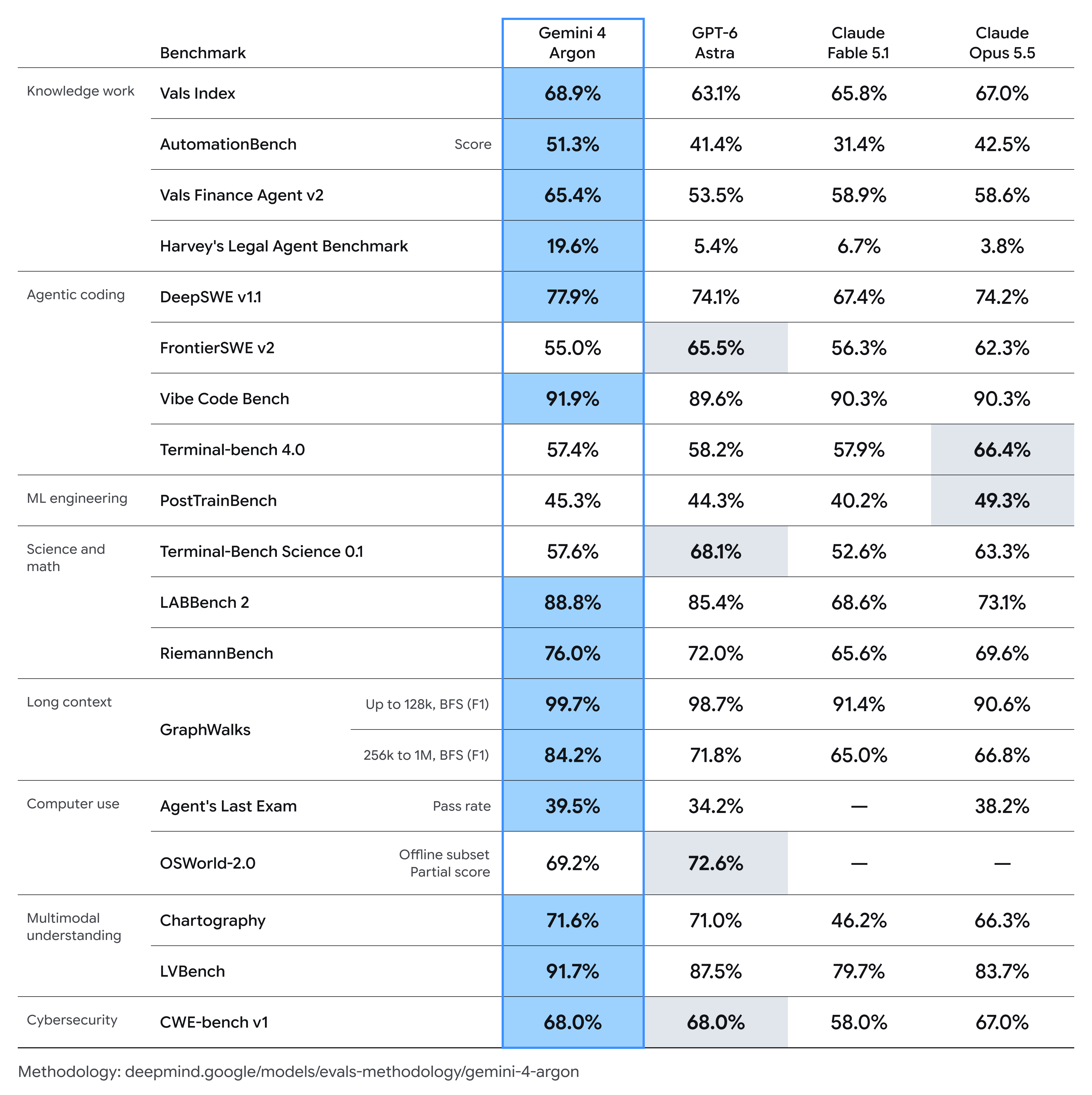
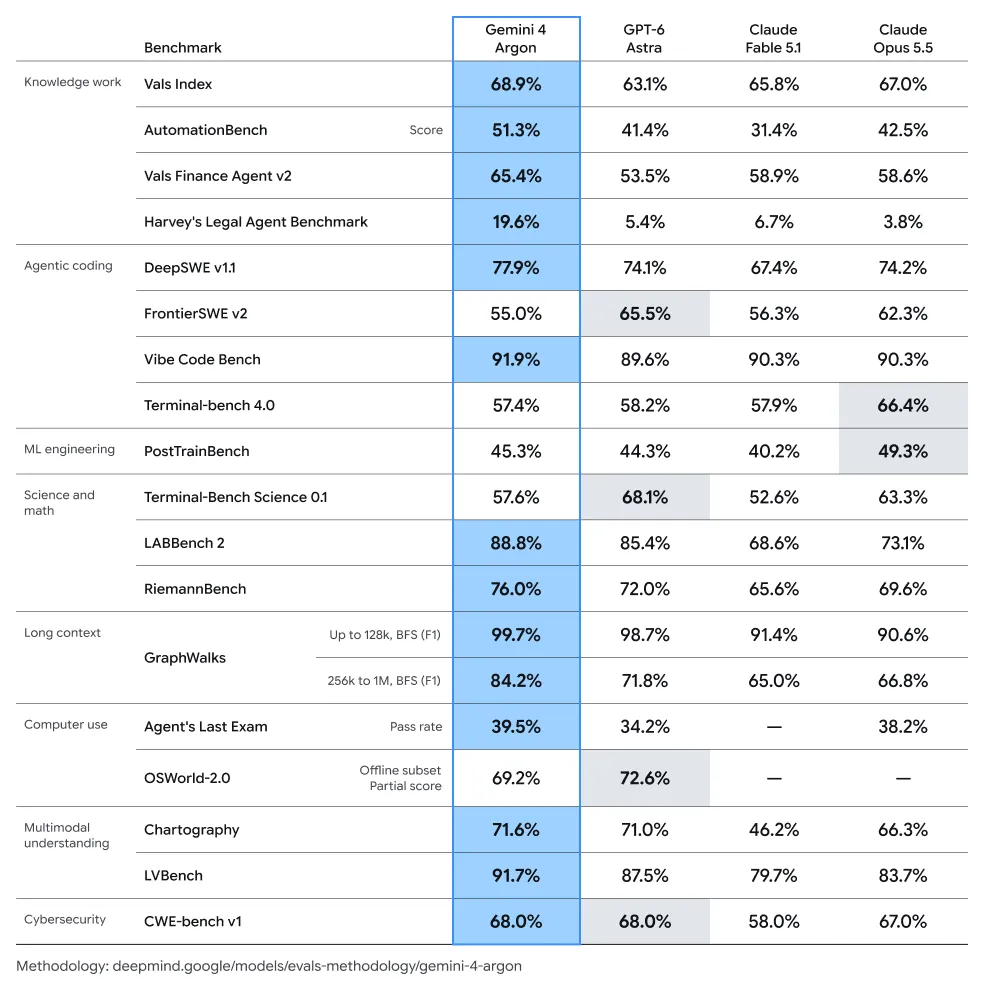
While specific performance metrics for Gemini 4 Argon have not been disclosed, understanding the benchmarks used in the AI community can provide insight into what to expect from this new model. Here’s a snapshot of relevant benchmarks from previous models that can serve as a reference point:
| Benchmark | Score |
|---|---|
| Natural Language Processing | TBD |
| Reasoning Tasks | TBD |
| Coding Capabilities | TBD |
| Contextual Understanding | TBD |
| Efficiency Metrics | TBD |
These benchmarks are critical for evaluating the performance of AI models. As Google prepares to release Gemini 4 Argon, many in the AI community will be closely monitoring how it performs against these established metrics.
What you can do with it
While Gemini 4 Argon is not yet available for public use, developers and businesses can prepare for its eventual release by considering the following steps:
- Stay informed about updates from Google regarding the model's availability and features.
- Explore existing Gemini models to understand their capabilities and limitations, which may provide insights into what to expect from the new version.
- Begin developing applications that could leverage advanced AI capabilities, focusing on areas like natural language processing and coding tasks.
- Engage with the AI community to share insights and gather feedback on potential use cases for Gemini 4 Argon once it becomes available.
What we're watching
As Google moves forward with the development of Gemini 4 Argon, the tech community is keenly observing the timeline for public release and any additional features that may be announced. There is also an open question regarding how Google will position this model in relation to its competitors, particularly as other companies continue to release their own advanced AI models. The anticipation surrounding Gemini 4 Argon reflects a broader trend in the industry, where the demand for powerful AI solutions continues to grow.
Looking ahead, the next milestone will be the official launch of Gemini 4 Argon, which many expect to set new standards in AI performance. The model's capabilities could redefine how businesses approach AI integration, particularly in sectors that rely heavily on natural language processing and complex reasoning tasks. As Google prepares for this launch, the excitement and speculation surrounding Gemini 4 Argon will likely intensify, making it a focal point in the ongoing AI arms race.
Source: Ars Technica - AI · Read original →
Instagram & TikTok: copy the link or quote and paste into a Story, Reel, or caption.
Digest
AI news by email
Curated stories with sources and takeaways. Confirm once — unsubscribe anytime.
Discussion
Comment here after signing in, or share the story to continue the conversation elsewhere.
Instagram & TikTok: copy the link and paste into a Story, Reel, or caption.
Log in or create an account to comment — Google / GitHub / X when those providers are configured.
No comments yet — start the thread.