

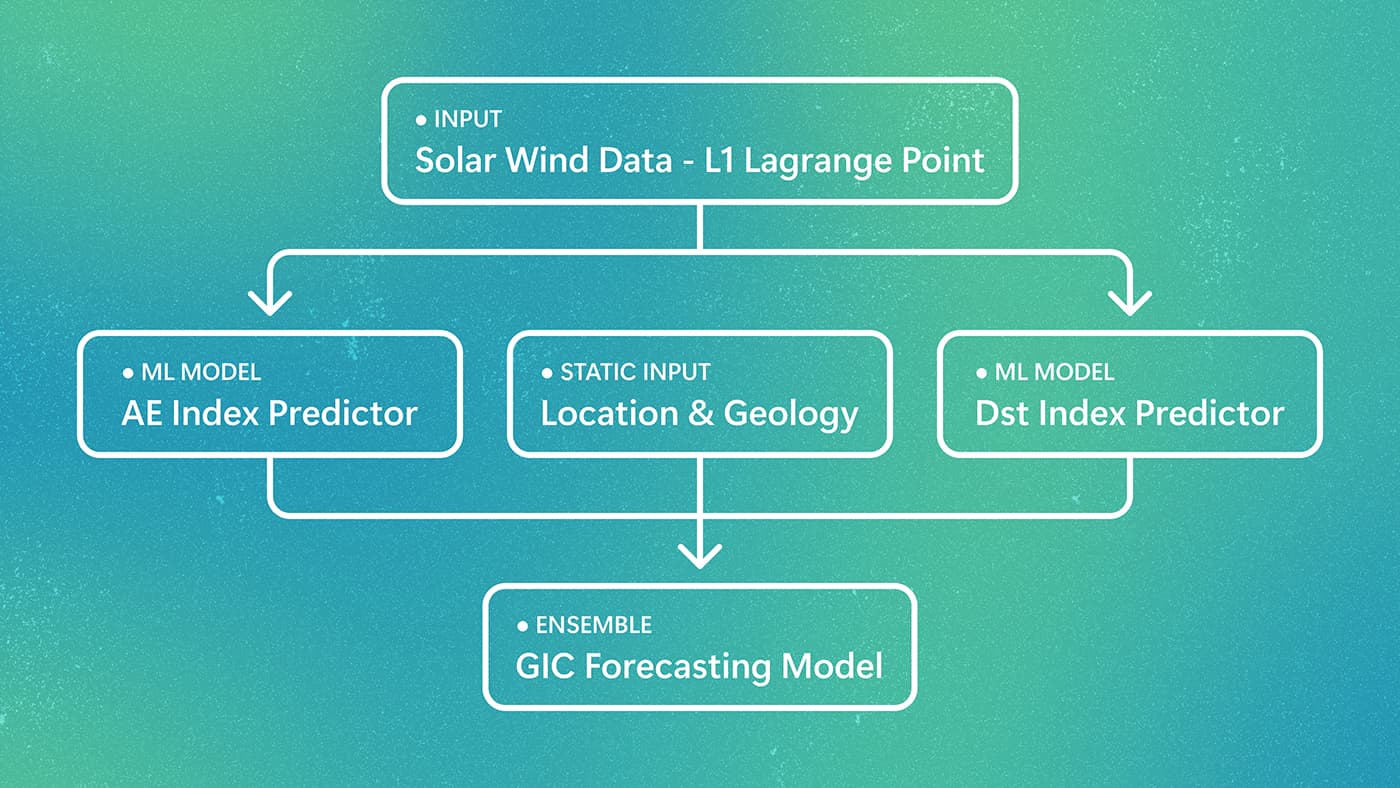
Forecasting space weather risks on power grids
A new machine learning system predicts space weather risks, providing critical insights for power grids and satellite operations ahead of storms.
“With a 30-60 minute lead time, this machine learning system transforms how we prepare for and respond to space weather events.”
Key takeaways
- Microsoft Research has developed a machine learning system for predicting space weather risks.
- The system provides 30-60 minutes of advance warning for potential damage.
- Early warnings can significantly enhance the resilience of power grids and satellite operations.
- Integration into existing infrastructure is crucial for maximizing the system's effectiveness.
- Ongoing research and collaboration will drive further advancements in space weather forecasting.
Extreme space weather events pose significant risks to modern infrastructure, particularly power grids and satellite operations. These events, which can include solar flares and coronal mass ejections, have the potential to disrupt electrical systems on Earth, leading to widespread outages and damage. In response to this growing concern, researchers at Microsoft have developed a machine learning system capable of forecasting these risks with remarkable precision. This innovative approach allows for predictions of potential damage locations 30 to 60 minutes before a storm arrives, providing essential lead time for operators to take preventive measures.
The implications of this technology are profound. Power grid operators can utilize these forecasts to prepare for potential disruptions, ensuring that they have the necessary resources and protocols in place to mitigate damage. Similarly, satellite operators can adjust their systems in anticipation of adverse conditions, improving the reliability of GPS services and other satellite-dependent technologies. As our reliance on these systems continues to grow, the ability to predict and respond to space weather events becomes increasingly critical.
Key facts
| Field | Detail |
|---|---|
| Technology | Machine learning system for space weather forecasting |
| Developed by | Microsoft Research |
| Prediction time frame | 30-60 minutes before storm arrival |
| Impacted systems | Power grids, GPS accuracy, satellite operations |
| Key benefit | Early warning for damage mitigation |
| Application | Real-time monitoring and forecasting |
| Research publication | Microsoft Research Blog |
| Date of announcement | October 2023 |
| Collaboration | Not specified |
| Future potential | Broader applications in infrastructure resilience |
Who's involved
The primary player in this development is Microsoft Research, a division of Microsoft dedicated to advancing technology through innovative research. Their work in machine learning and artificial intelligence has positioned them at the forefront of numerous technological advancements, including this latest initiative aimed at enhancing our ability to predict and respond to space weather events. While specific collaborators or partners in this project have not been disclosed, the implications of this research extend to various sectors reliant on stable power and satellite operations.
Understanding the nature of space weather is crucial for anyone involved in infrastructure management. Historically, significant solar events have caused power outages and disruptions. For instance, the 1989 geomagnetic storm led to a nine-hour outage for the entire province of Quebec, Canada, affecting millions. As technology has advanced, so too has our understanding of these phenomena, but the need for real-time predictive capabilities has become more pressing. The development of machine learning models to forecast space weather risks represents a significant leap forward in our ability to protect critical infrastructure.
Machine learning has been increasingly applied in various fields, from healthcare to finance, but its application in space weather forecasting is relatively novel. Traditional forecasting methods often rely on historical data and physical models that can take time to analyze. In contrast, machine learning systems can process vast amounts of data in real-time, identifying patterns and making predictions with unprecedented speed and accuracy. This shift not only enhances our predictive capabilities but also allows for a more proactive approach to managing the risks associated with space weather.
How to read the numbers
While this announcement does not provide specific performance metrics for the machine learning system, understanding its potential impact can be framed in terms of operational readiness and risk mitigation. The following table outlines key aspects of the system's capabilities:
| Capability | Description |
|---|---|
| Data processing speed | Real-time analysis of incoming data |
| Prediction accuracy | Enhanced through machine learning algorithms |
| Response time | 30-60 minutes lead time for operators |
| Integration potential | Can be integrated with existing monitoring systems |
| User accessibility | Designed for use by power grid and satellite operators |
What you can do with it
For those in the fields of power management and satellite operations, the introduction of this machine learning system offers several actionable steps:
- Integrate predictive models: Begin discussions with technology providers to incorporate machine learning forecasting into existing systems.
- Develop response protocols: Establish clear protocols for responding to predictions of space weather events, ensuring that teams are prepared to act quickly.
- Invest in training: Provide training for staff on interpreting forecasts and implementing necessary precautions based on predictions.
- Collaborate with researchers: Engage with research institutions to stay updated on advancements in space weather forecasting and machine learning applications.
- Monitor developments: Keep an eye on ongoing research and updates from Microsoft and other organizations involved in this field to leverage new insights and technologies.
What we're watching
As this technology continues to develop, one key area to monitor is the integration of these predictive capabilities into existing infrastructure systems. The effectiveness of the machine learning model will largely depend on how well it can be incorporated into the operational frameworks of power grids and satellite systems. Additionally, the response of these sectors to the forecasts will be critical in determining the overall impact of this innovation.
Looking ahead, the next major milestone will be the real-world application of this forecasting system in operational settings. The ability to test and refine the model in live conditions will provide valuable insights into its performance and reliability. Furthermore, as more data becomes available, the model's accuracy and predictive capabilities are likely to improve, potentially leading to even longer lead times for damage mitigation.
In conclusion, the development of a machine learning system for forecasting space weather risks marks a significant advancement in our ability to protect critical infrastructure from the impacts of extreme space weather events. As reliance on technology continues to grow, the need for proactive measures to safeguard power grids and satellite operations becomes increasingly essential. The integration of this system into operational protocols could redefine how industries prepare for and respond to space weather, ultimately enhancing resilience and reliability in the face of natural phenomena.
Source: Microsoft Research Blog · Read original →
Instagram & TikTok: copy the link or quote and paste into a Story, Reel, or caption.
Digest
AI news by email
Curated stories with sources and takeaways. Confirm once — unsubscribe anytime.
Discussion
Comment here after signing in, or share the story to continue the conversation elsewhere.
Instagram & TikTok: copy the link and paste into a Story, Reel, or caption.
Log in or create an account to comment — Google / GitHub / X when those providers are configured.
No comments yet — start the thread.


