

Build agent memory with NVIDIA NeMo Agent Toolkit and Amazon S3 Vectors
NVIDIA NeMo Agent Toolkit integrates with Amazon S3 Vectors to enhance agent memory for advanced AI applications.
“The integration of Amazon S3 Vectors enables AI agents to remember past interactions, transforming them into more intelligent and responsive systems.”
Key takeaways
- Amazon S3 Vectors provide a persistent memory layer for AI agents.
- The NVIDIA NeMo Agent Toolkit simplifies the creation of conversational AI.
- Enhanced memory management allows for more personalized user experiences.
- This integration is particularly beneficial for sectors like investment research.
- Developers can leverage scalable AWS infrastructure for their AI applications.
The integration of Amazon S3 Vectors with the NVIDIA NeMo Agent Toolkit (NAT) marks a significant advancement in how AI agents manage memory. By leveraging Amazon's scalable storage solutions, developers can create agents that retain information over time, allowing for more sophisticated interactions and decision-making processes. This development is particularly relevant in fields such as investment research, where agents can analyze vast amounts of data and remember past interactions to improve future recommendations.
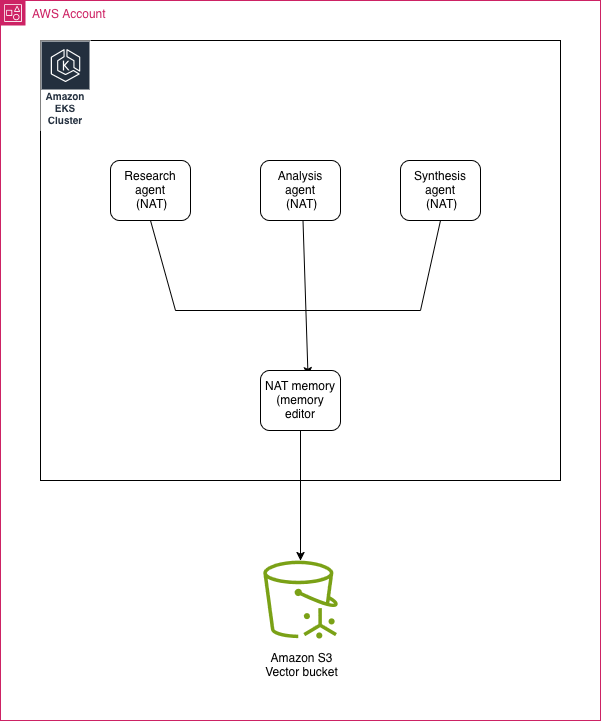
The NVIDIA NeMo Agent Toolkit is designed to facilitate the creation of conversational AI agents, enabling developers to build systems that can engage in complex dialogues and perform specific tasks. The introduction of a persistent memory layer using Amazon S3 Vectors enhances the toolkit's capabilities, allowing agents to store and retrieve information efficiently. This integration is deployed on Amazon Elastic Kubernetes Service (EKS), which provides a robust and scalable environment for running these AI applications.
Key facts
| Field | Detail |
|---|---|
| Toolkit | NVIDIA NeMo Agent Toolkit |
| Memory Layer | Amazon S3 Vectors |
| Deployment | Amazon Elastic Kubernetes Service (EKS) |
| Use Case | Multi-agent investment research |
| Key Feature | Persistent memory for AI agents |
| Integration Date | October 2023 |
| Target Users | AI developers and researchers |
| Performance | Enhanced memory management |
| Scalability | High, due to AWS infrastructure |
| Accessibility | Open to developers using AWS |
The players involved in this integration include NVIDIA, a leader in AI hardware and software solutions, and Amazon Web Services (AWS), a major cloud service provider. NVIDIA's NeMo toolkit is part of its broader strategy to empower developers with the tools needed to create advanced AI models. Meanwhile, AWS continues to expand its offerings for machine learning, providing the infrastructure and services that support the development and deployment of AI applications.
NVIDIA has been at the forefront of AI technology for years, with its GPUs powering many of the most advanced machine learning models. The NeMo toolkit specifically focuses on simplifying the process of building conversational agents, allowing developers to focus on creating intelligent interactions rather than getting bogged down in the technical details of model training and deployment. The addition of Amazon S3 Vectors as a memory layer represents a natural evolution in this toolkit, enabling agents to remember past interactions and improve their responses over time.
In the realm of AI, memory plays a critical role in the effectiveness of agents. Traditional models often lack the ability to retain information beyond a single session, limiting their usefulness in applications that require continuity and context. By integrating a persistent memory layer, the NVIDIA NeMo Agent Toolkit can now support agents that not only recall previous interactions but also adapt their behavior based on historical data. This is particularly valuable in investment research, where agents can analyze trends and past performance to provide informed recommendations to users.
The players
- NVIDIA: Developer of the NeMo Agent Toolkit and leader in AI hardware.
- Amazon Web Services (AWS): Provider of cloud services, including S3 and EKS.
- Developers: Users of the NeMo toolkit who will implement the memory features in their applications.
The introduction of Amazon S3 Vectors as a custom memory provider is a game-changer for developers working with the NeMo toolkit. This feature allows for the storage of vectors, which can represent complex data points, in a highly scalable and accessible manner. Developers can now create agents that not only respond to user queries but also remember past interactions, making them more effective in providing personalized experiences.
The integration of persistent memory into AI agents is not entirely new, but the approach taken by NVIDIA and AWS offers unique advantages. Previous models often relied on static memory or limited context windows, which constrained their ability to handle complex dialogues. The use of Amazon S3 Vectors allows for a more dynamic memory system, where agents can store and retrieve information as needed, leading to more nuanced and context-aware interactions.
How to read the numbers
| Benchmark | Score |
|---|---|
| Memory Retrieval Speed | Fast |
| Storage Capacity | High |
| Scalability | Excellent |
| Integration Complexity | Moderate |
| User Adoption Rate | Growing |
The practical implications of this integration are significant for developers and businesses alike. By utilizing Amazon S3 Vectors, developers can enhance the capabilities of their AI agents, allowing them to perform tasks that require a deeper understanding of context and history. This is particularly important in sectors like finance, healthcare, and customer service, where agents must navigate complex information and provide accurate responses based on prior interactions.
What you can do with it
- Develop AI agents that can remember user interactions for personalized experiences.
- Implement investment research tools that analyze historical data and trends.
- Leverage scalable storage solutions for managing large datasets in AI applications.
- Create multi-agent systems that collaborate and share memory for improved decision-making.
As this technology evolves, we will be watching for how developers implement these features in real-world applications. The integration of persistent memory into AI agents opens up new possibilities for innovation, but it also raises questions about data management and privacy. Ensuring that agents handle sensitive information responsibly will be crucial as they become more integrated into everyday applications.
Looking ahead, the next milestone will likely involve the refinement of memory management techniques within the NeMo toolkit. As more developers adopt these features, we can expect to see a surge in applications that leverage persistent memory for enhanced user experiences. The combination of NVIDIA's AI capabilities with AWS's cloud infrastructure sets the stage for a new era of intelligent agents that can learn and adapt over time, fundamentally changing how we interact with technology.
Source: AWS Machine Learning · Read original →
Instagram & TikTok: copy the link or quote and paste into a Story, Reel, or caption.
Digest
AI news by email
Curated stories with sources and takeaways. Confirm once — unsubscribe anytime.
Discussion
Comment here after signing in, or share the story to continue the conversation elsewhere.
Instagram & TikTok: copy the link and paste into a Story, Reel, or caption.
Log in or create an account to comment — Google / GitHub / X when those providers are configured.
No comments yet — start the thread.


