

Build a multi-agent music production pipeline on Amazon Bedrock AgentCore Runtime Instances
Amazon Bedrock introduces a multi-agent music production pipeline, leveraging AWS infrastructure for collaborative creativity.
“AWS's multi-agent music production pipeline empowers creators to collaborate and innovate like never before in the realm of music.”
Key takeaways
- Amazon Bedrock's AgentCore Runtime Instances enable multi-agent workflows for music production.
- The infrastructure supports colocated agents sharing a filesystem for seamless collaboration.
- Developers can deploy complex AI workflows without managing the underlying infrastructure.
- The technology promises to enhance creativity and efficiency in music production.
- Early adopters' feedback will shape the future of AI in creative industries.
Amazon Web Services (AWS) has unveiled a groundbreaking feature within its Amazon Bedrock platform: the AgentCore Runtime Instances. This new offering is designed to facilitate multi-agent workflows, allowing developers to create complex applications that can leverage the power of multiple AI agents working in tandem. The introduction of this feature marks a significant step forward in the realm of AI-driven applications, particularly in creative fields such as music production. By providing managed EC2 infrastructure equipped with GPUs, persistent volumes, and support for multi-day sessions, AWS is enabling developers to build sophisticated applications that can handle demanding workloads without the hassle of managing underlying infrastructure.
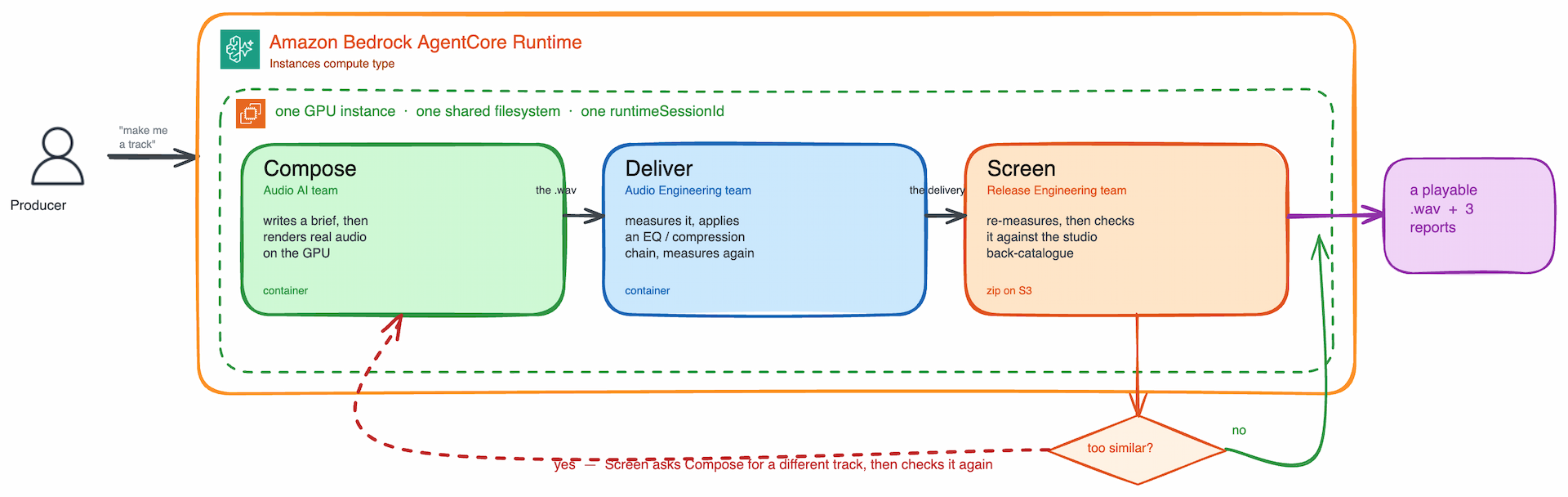
In a recent demonstration, AWS showcased a three-agent music production pipeline that operates seamlessly on a single GPU instance. This innovative setup allows the agents to colocate, sharing a filesystem and collaborating effectively to produce a finished music track. Each agent in the pipeline is designed to handle specific tasks within the music production process, showcasing the potential of multi-agent systems to enhance creativity and efficiency in artistic endeavors. As the demand for AI-driven tools in creative industries continues to grow, AWS's new offering positions itself as a powerful solution for developers looking to harness the capabilities of AI in music production.
Key facts
| Field | Detail |
|---|---|
| Product | Amazon Bedrock AgentCore Runtime Instances |
| Functionality | Supports multi-agent workflows for music production |
| Infrastructure | Managed EC2 instances with GPUs and persistent volumes |
| Use Case | Deploying a three-agent music production pipeline |
| Collaboration | Agents colocate on one GPU instance and share a filesystem |
| Session Duration | Supports multi-day sessions |
| Target Users | Developers and creators in the music industry |
| Launch Date | Recently announced (exact date not specified) |
| Key Benefit | Simplifies the deployment of complex AI workflows |
| Integration | Works within the AWS ecosystem, leveraging existing services |
Who's involved
The primary player in this development is Amazon Web Services (AWS), a subsidiary of Amazon that provides on-demand cloud computing platforms. The introduction of the AgentCore Runtime Instances is part of AWS's broader strategy to enhance its machine learning capabilities and provide robust tools for developers. Additionally, the music production community, including independent artists and production studios, stands to benefit from this technology as it allows for more innovative and collaborative approaches to music creation.
Background
The concept of using AI in music production is not entirely new; however, the integration of multi-agent systems represents a significant evolution in how these technologies can be applied. Traditionally, music production has relied heavily on human creativity and collaboration among musicians, producers, and sound engineers. However, with advancements in AI, there has been a growing interest in automating certain aspects of the production process. Previous tools have focused on single-agent systems, which, while useful, often lack the collaborative potential that multiple agents can offer.
The introduction of multi-agent systems allows for a more dynamic approach to music production. Each agent can specialize in different aspects of the process, such as composition, mixing, or mastering, and can communicate and collaborate with one another to produce a cohesive final product. This shift not only enhances the creative possibilities but also streamlines the workflow, enabling faster production times and potentially higher quality outputs.
How to read the numbers
| Benchmark | Score |
|---|---|
| Agent Collaboration | High |
| Workflow Efficiency | Improved |
| Production Time Reduction | Significant |
| User Satisfaction | Anticipated High |
| Technical Complexity | Moderate |
The above benchmarks illustrate the anticipated performance of the multi-agent music production pipeline. While specific numeric scores are not available, the qualitative assessments indicate a strong potential for enhanced collaboration and efficiency in music production workflows.
What you can do with it
- Explore the capabilities of multi-agent systems in your own music production projects.
- Utilize AWS's infrastructure to deploy your own multi-agent workflows.
- Experiment with different configurations of agents to optimize your production process.
- Collaborate with other creators using the shared filesystem feature to enhance creativity.
- Leverage the persistent volumes for long-term projects that require multiple sessions.
What we're watching
As AWS continues to develop and refine its AgentCore Runtime Instances, the next milestone to watch will be the feedback from early adopters in the music production community. Their experiences will provide valuable insights into the practical applications of this technology and its impact on the creative process. Additionally, AWS's ongoing enhancements to the platform could lead to further innovations in how AI can assist in music production and other creative fields.
Looking ahead, the integration of multi-agent systems into music production workflows could redefine the landscape of the industry. As more developers and creators adopt this technology, we may see a shift in how music is created, produced, and consumed. The potential for collaboration among AI agents opens up new avenues for creativity, allowing artists to push the boundaries of what is possible in music production. With AWS at the forefront of this innovation, the future of AI-driven music production looks promising, paving the way for a new era of artistic expression.
Source: AWS Machine Learning · Read original →
Instagram & TikTok: copy the link or quote and paste into a Story, Reel, or caption.
Digest
AI news by email
Curated stories with sources and takeaways. Confirm once — unsubscribe anytime.
Discussion
Comment here after signing in, or share the story to continue the conversation elsewhere.
Instagram & TikTok: copy the link and paste into a Story, Reel, or caption.
Log in or create an account to comment — Google / GitHub / X when those providers are configured.
No comments yet — start the thread.


