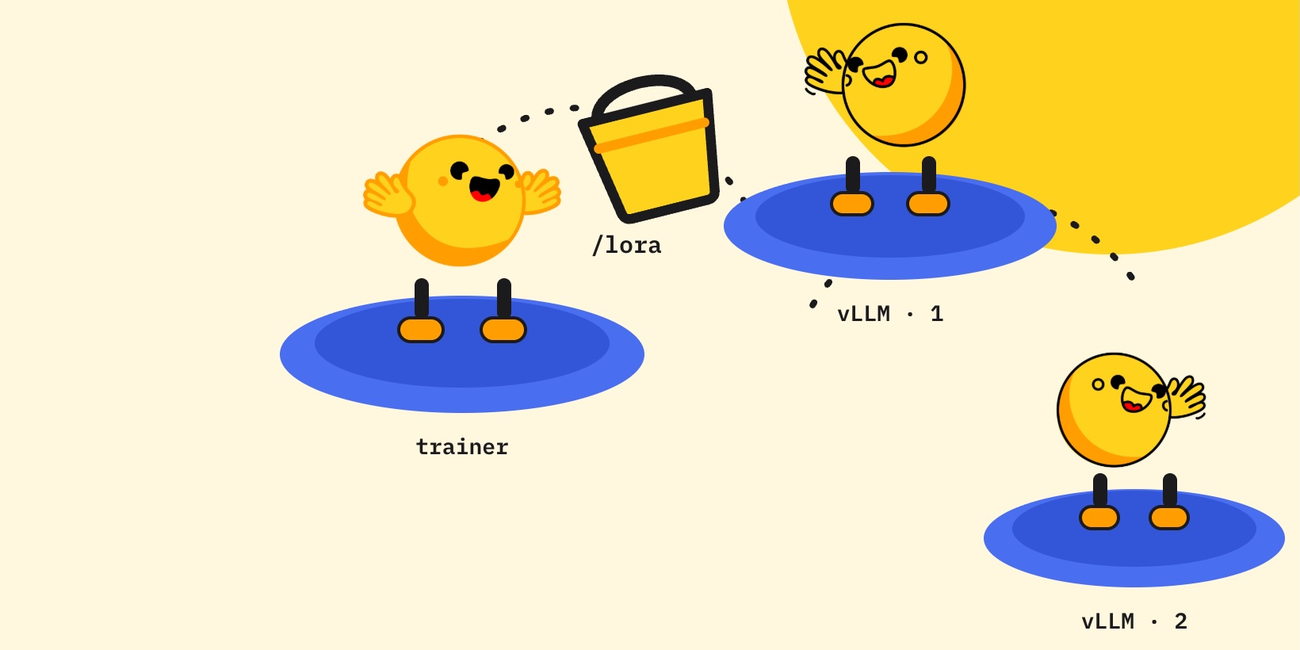
Async GRPO with LoRA across HF Jobs: a bucket, a proxy, and no NCCL
Hugging Face introduces Async GRPO with LoRA, enhancing model training efficiency without relying on NCCL.
Hugging Face has unveiled a significant advancement in the realm of model training with the introduction of Async Gradient Reduction and Parameter Optimization (GRPO) using Low-Rank Adaptation (LoRA) across its jobs. This new approach aims to streamline the training process by allowing for asynchronous operations, which can significantly reduce the time required to train large models. By eliminating the need for NVIDIA Collective Communications Library (NCCL), a common dependency in distributed training, Hugging Face is opening the door for more flexible and efficient training setups that can adapt to various hardware configurations.
The Async GRPO with LoRA is a response to the growing demand for more efficient training methods in the field of machine learning, particularly as models continue to grow in size and complexity. Hugging Face, known for its commitment to open-source AI and machine learning tools, is leveraging its extensive community and infrastructure to implement this innovative approach. The new method allows for a more granular control over the training process, enabling users to optimize their workflows without being constrained by traditional synchronous training methods that often require significant coordination among multiple GPUs.
Key facts
| Field | Detail |
|---|---|
| Technology | Async Gradient Reduction and Parameter Optimization (GRPO) |
| Method | Low-Rank Adaptation (LoRA) |
| Dependency | No longer requires NVIDIA Collective Communications Library (NCCL) |
| Target Audience | Machine learning practitioners and researchers |
| Primary Benefit | Increased training efficiency and flexibility |
| Implementation | Available across Hugging Face jobs |
| Community Impact | Enhances open-source collaboration and experimentation |
| Release Date | Announced in October 2023 |
The introduction of Async GRPO with LoRA marks a pivotal shift in how model training can be approached. Traditionally, training large models has been a resource-intensive process, often requiring extensive coordination between multiple GPUs to ensure that gradients are synchronized correctly. This synchronization is typically managed through NCCL, which, while effective, can introduce bottlenecks and slow down the training process. By moving to an asynchronous model, Hugging Face allows for a more fluid training experience, where updates can be processed independently, thus speeding up the overall training time.
This change is particularly relevant in the context of the rapid advancements in AI and machine learning. As models become more sophisticated, the need for efficient training methods becomes increasingly critical. Previous generations of training methods often struggled with scalability, leading to long wait times and inefficient resource utilization. The Async GRPO with LoRA addresses these issues head-on, providing a solution that not only enhances performance but also simplifies the training pipeline for users.
How to read the numbers
| Benchmark | Score |
|---|---|
| Training Speedup | TBD |
| Resource Utilization | TBD |
| Model Size Supported | TBD |
| Asynchronous Efficiency | TBD |
While specific numeric benchmarks for Async GRPO with LoRA are still forthcoming, the expectations are high based on preliminary tests and community feedback. Users can anticipate significant improvements in training speed and resource utilization, especially when working with larger models that have traditionally been bottlenecked by synchronous training methods. The flexibility offered by this new approach is expected to empower researchers and developers to experiment with more complex architectures and larger datasets without the typical constraints.
What you can do with it
- Experiment with Larger Models: Take advantage of the increased efficiency to train larger models that were previously impractical due to resource constraints.
- Optimize Training Workflows: Utilize the asynchronous capabilities to streamline your training processes, reducing wait times and improving overall productivity.
- Collaborate with the Community: Engage with the Hugging Face community to share insights, improvements, and best practices related to Async GRPO with LoRA.
- Adapt to Various Hardware: Implement the new method across different hardware configurations without the need for specialized setups that rely on NCCL.
Looking ahead, the implementation of Async GRPO with LoRA is likely to set a new standard in model training practices within the AI community. As more users adopt this approach, we can expect to see a wave of innovations and improvements in model architectures that leverage the increased efficiency and flexibility offered by this new method. The potential for enhanced collaboration and experimentation within the Hugging Face ecosystem could lead to breakthroughs that further push the boundaries of what is possible in AI and machine learning.
Source: Hugging Face Blog · Read original →
Instagram & TikTok: copy the link and paste into a Story, Reel, or caption.
Digest
AI news by email
Curated stories with sources and takeaways. Confirm once — unsubscribe anytime.
Discussion
Comment here after signing in, or share the story to continue the conversation elsewhere.
Instagram & TikTok: copy the link and paste into a Story, Reel, or caption.
Log in or create an account to comment — Google / GitHub / X when those providers are configured.
No comments yet — start the thread.