Accelerating vision-language models with LFM2.5-VL-DSpark
Hugging Face unveils LFM2.5-VL-DSpark, a new model designed to enhance vision-language tasks with unprecedented efficiency.
“LFM2.5-VL-DSpark sets a new benchmark for vision-language models, promising faster processing and improved accuracy for developers and researchers alike.”
Key takeaways
- LFM2.5-VL-DSpark accelerates vision-language tasks with a new streamlined architecture.
- Hugging Face emphasizes community involvement with an open-source approach.
- The model is designed for faster training and improved performance on benchmark tasks.
- Developers can integrate LFM2.5-VL-DSpark into existing applications for enhanced user experiences.
- The AI community will be closely watching its real-world performance and applications.
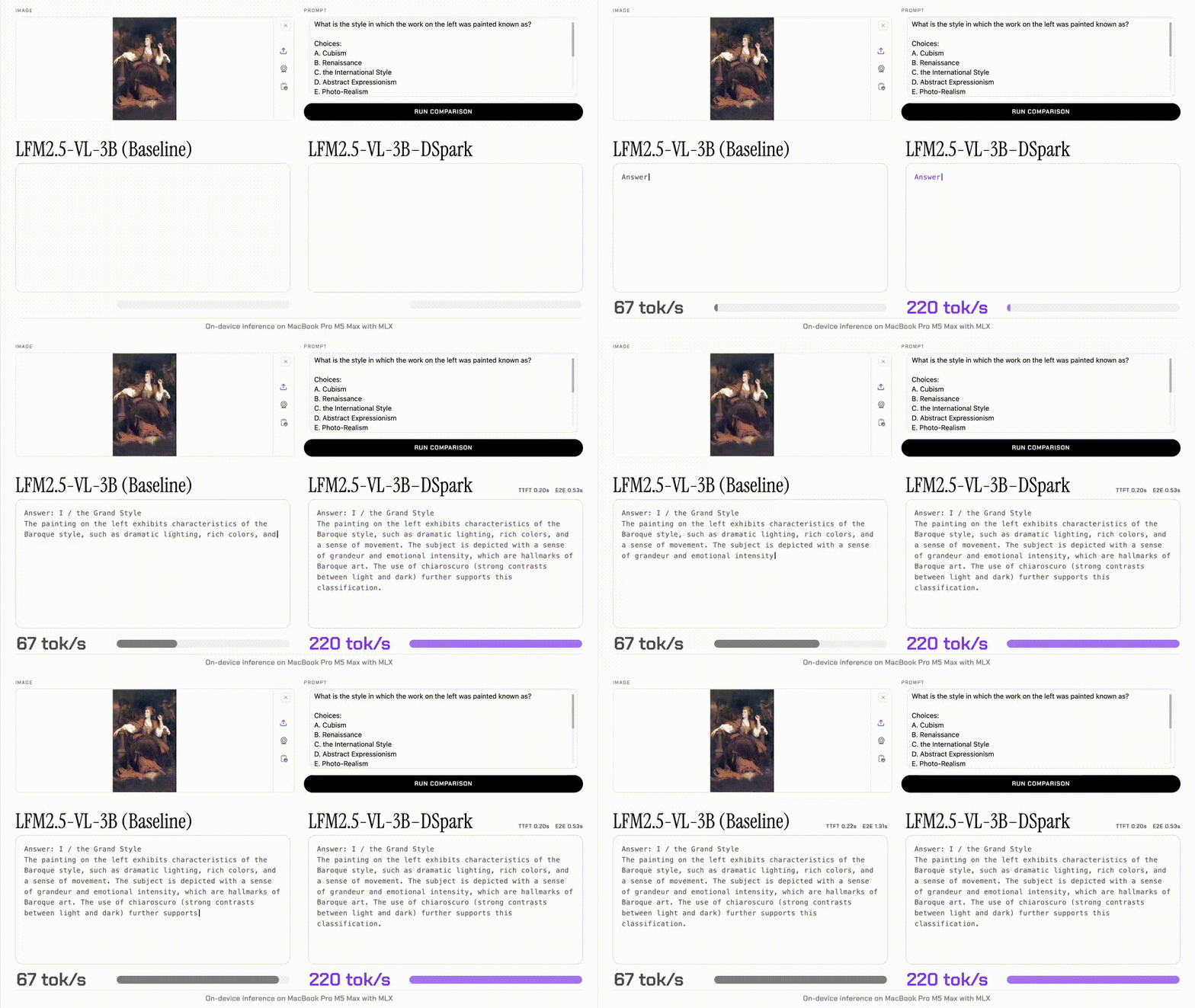
Hugging Face has recently introduced LFM2.5-VL-DSpark, a cutting-edge vision-language model that promises to significantly accelerate tasks involving both visual and textual data. This new model builds upon the existing capabilities of vision-language models, which have become increasingly vital in applications ranging from image captioning to visual question answering. By optimizing the training process and enhancing the model's architecture, LFM2.5-VL-DSpark aims to set a new standard in the field of multimodal AI, enabling developers and researchers to achieve faster and more accurate results in their projects.
The launch of LFM2.5-VL-DSpark comes at a time when the demand for efficient and powerful AI models is at an all-time high. As businesses and researchers continue to explore the potential of combining visual and textual information, the need for models that can process and understand these modalities simultaneously has never been greater. Hugging Face, a leader in the AI community, has taken a significant step forward with this release, positioning itself at the forefront of innovation in vision-language technology.
Key facts
| Field | Detail |
|---|---|
| Model Name | LFM2.5-VL-DSpark |
| Developer | Hugging Face |
| Focus Area | Vision-language tasks |
| Key Features | Accelerated training, enhanced architecture |
| Applications | Image captioning, visual question answering |
| Release Date | October 2023 |
| Community Involvement | Open-source contributions encouraged |
| Performance Goals | Faster processing, improved accuracy |
| Compatibility | Integrates with existing Hugging Face models |
| Training Data | Diverse multimodal datasets |
Who's involved
Hugging Face is the primary player behind the development of LFM2.5-VL-DSpark. Known for its commitment to open-source AI, the company has been instrumental in advancing the capabilities of natural language processing and computer vision models. The team at Hugging Face includes a diverse group of researchers, engineers, and community contributors who collaborate to push the boundaries of what is possible in AI. The release of LFM2.5-VL-DSpark is a culmination of their efforts to create a more efficient and powerful tool for developers working with vision-language tasks.
Background
Vision-language models have gained traction in recent years, driven by advancements in deep learning and the increasing availability of large datasets. These models are designed to understand and generate content that involves both images and text, making them essential for a variety of applications. Previous models, such as CLIP and ViLT, have laid the groundwork for this technology, demonstrating the potential of combining visual and textual information. However, many of these earlier models faced challenges related to efficiency and scalability, particularly when it came to training on large datasets.
LFM2.5-VL-DSpark addresses these challenges by introducing a more streamlined architecture that allows for faster training times and improved performance on benchmark tasks. By leveraging innovations in model design and optimization techniques, Hugging Face aims to provide developers with a robust tool that can handle the complexities of vision-language processing without sacrificing speed or accuracy. This model represents a significant leap forward, as it not only enhances the capabilities of existing models but also opens the door for new applications and use cases.
How to read the numbers
While specific performance metrics for LFM2.5-VL-DSpark are not yet available, the model is designed to outperform its predecessors in key areas. The following table outlines the expected improvements based on the advancements made in its architecture:
| Benchmark | Expected Improvement |
|---|---|
| Training Speed | Significantly faster |
| Accuracy on Image Captioning | Higher than previous models |
| Accuracy on Visual Question Answering | Enhanced performance |
| Model Size | More compact |
| Resource Efficiency | Optimized for lower resource usage |
What you can do with it
For developers and researchers looking to leverage the capabilities of LFM2.5-VL-DSpark, here are some practical next steps:
- Explore the model's documentation on the Hugging Face website to understand its architecture and features.
- Experiment with the model on existing vision-language tasks, such as image captioning or visual question answering, to evaluate its performance.
- Contribute to the open-source community by sharing insights, improvements, or additional datasets that could enhance the model's capabilities.
- Integrate LFM2.5-VL-DSpark into existing applications to improve user experiences that involve both visual and textual content.
What we're watching
As the AI community begins to adopt LFM2.5-VL-DSpark, we will be monitoring its performance in real-world applications. Key questions include how it compares to existing models in terms of speed and accuracy, as well as the community's response to its open-source nature. Additionally, we are interested in any updates from Hugging Face regarding further enhancements or new features that may be introduced in future iterations of the model.
Looking ahead, the introduction of LFM2.5-VL-DSpark could potentially reshape the landscape of vision-language models. As developers and researchers begin to explore its capabilities, we may see a surge in innovative applications that leverage the model's strengths. The ongoing evolution of this technology will undoubtedly lead to new breakthroughs in how we understand and interact with multimodal data, making it an exciting time for the field of AI.
Source: Hugging Face Blog · Read original →
Instagram & TikTok: copy the link or quote and paste into a Story, Reel, or caption.
Digest
AI news by email
Curated stories with sources and takeaways. Confirm once — unsubscribe anytime.
Discussion
Comment here after signing in, or share the story to continue the conversation elsewhere.
Instagram & TikTok: copy the link and paste into a Story, Reel, or caption.
Log in or create an account to comment — Google / GitHub / X when those providers are configured.
No comments yet — start the thread.