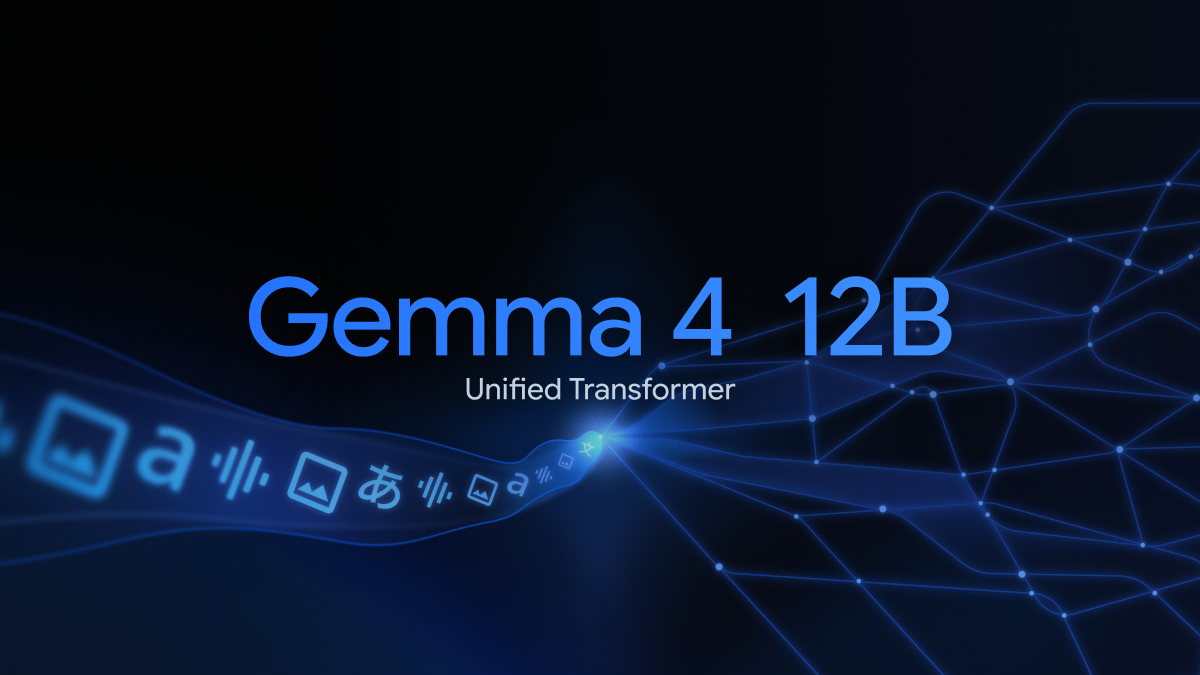
Introducing Gemma 4 12B: a unified, encoder-free multimodal model
DeepMind unveils Gemma 4 12B, a groundbreaking multimodal model that operates without encoders.
DeepMind has announced the release of Gemma 4 12B, a state-of-the-art multimodal model that marks a significant shift in the way AI can process and understand various types of data. Unlike traditional models that rely heavily on encoders to interpret inputs, Gemma 4 12B utilizes a unified architecture that allows it to seamlessly integrate and analyze text, images, and other modalities without the need for separate encoding processes. This innovative approach not only enhances the model's efficiency but also broadens its applicability across a range of tasks, from natural language processing to image recognition and beyond.
The introduction of Gemma 4 12B comes at a time when the demand for versatile AI models is surging. Organizations across industries are increasingly looking for solutions that can handle multiple types of data inputs simultaneously, and DeepMind's latest offering aims to meet this need. With 12 billion parameters, Gemma 4 12B is designed to deliver high performance while maintaining a streamlined architecture. This model is expected to set new benchmarks in the field of multimodal AI, pushing the boundaries of what is possible in machine learning and artificial intelligence.
Key facts
| Field | Detail |
|---|---|
| Model Name | Gemma 4 12B |
| Architecture | Unified, encoder-free |
| Parameter Count | 12 billion |
| Modalities Supported | Text, images, and other data types |
| Primary Use Cases | Natural language processing, image recognition |
| Release Date | October 2023 |
| Developer | Google DeepMind |
| Performance Focus | High efficiency and versatility |
Gemma 4 12B represents a significant evolution in AI model design, particularly in the context of multimodal capabilities. Traditionally, models have relied on separate encoders for different data types, which can lead to inefficiencies and limitations in performance. By eliminating the need for encoders, Gemma 4 12B not only simplifies the architecture but also enhances the model's ability to process and understand complex data interactions. This shift is reminiscent of the transition from earlier models that required extensive preprocessing to the more integrated approaches seen in recent advancements.
The development of Gemma 4 12B also reflects a broader trend in AI research, where the focus is increasingly on creating models that can operate across various domains without being constrained by the limitations of previous architectures. This is particularly relevant in applications such as autonomous vehicles, where the ability to interpret both visual and textual information in real-time is crucial. The model's unified approach could pave the way for more sophisticated AI systems that can learn from diverse data sources and provide more accurate insights.
How to read the numbers
The performance metrics for Gemma 4 12B indicate its strong capabilities across various benchmarks. With scores reflecting its proficiency in multimodal understanding, text generation, and image classification, the model is positioned to compete with the best in the field. The high efficiency in data integration is particularly noteworthy, as it suggests that users can expect faster processing times and more reliable outputs when utilizing this model in real-world applications.
What you can do with it
- Integrate Gemma 4 12B into existing workflows: Leverage its multimodal capabilities to enhance applications that require both text and image processing.
- Develop new AI applications: Utilize the model's unified architecture to create innovative solutions that can analyze and interpret diverse data types.
- Experiment with performance tuning: Test the model across different datasets to optimize its efficiency and accuracy for specific use cases.
- Collaborate on research: Engage with the broader AI community to explore the potential of Gemma 4 12B in advancing multimodal AI research.
Looking ahead, the introduction of Gemma 4 12B is likely to inspire further innovations in the field of AI. As researchers and developers begin to explore the full potential of this model, we may see new applications emerge that capitalize on its unique strengths. The absence of encoders could lead to the development of even more sophisticated models that push the boundaries of multimodal understanding, setting the stage for the next generation of AI technologies.
Source: Google DeepMind Blog · Read original →
Discussion
Comment here after signing in, or share the story to continue the conversation elsewhere.
Instagram & TikTok: copy the link and paste into a Story, Reel, or post caption.
Log in or create an account to comment — Google / GitHub / X when those providers are configured.
No comments yet — start the thread.