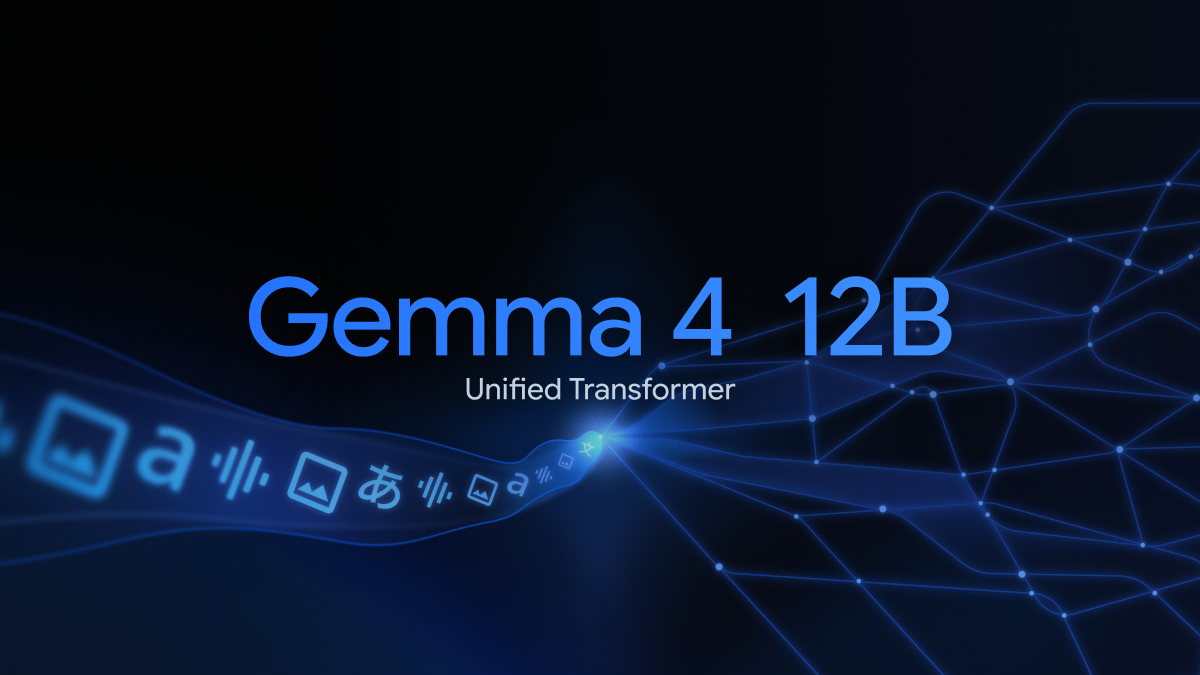
Introducing Gemma 4 12B: a unified, encoder-free multimodal model
Google DeepMind launches Gemma 4 12B, a revolutionary encoder-free multimodal AI model.
Google DeepMind has officially unveiled its latest innovation, the Gemma 4 12B, a multimodal AI model that operates without traditional encoders. This groundbreaking development marks a significant shift in how AI can process and integrate various types of data, including text, images, and possibly audio, all within a single framework. The decision to eliminate encoders is particularly noteworthy, as encoders have been a staple in many AI architectures, serving as the backbone for understanding and transforming input data into a format suitable for processing.
The Gemma 4 12B model is designed to enhance the efficiency and effectiveness of AI applications across multiple domains. By removing the encoder component, DeepMind aims to streamline the processing pipeline, potentially leading to faster and more accurate outputs. This model is expected to set a new standard in the AI field, particularly in areas that require the integration of diverse data types, such as natural language processing, computer vision, and audio analysis. The implications of this technology could be vast, impacting everything from content creation to automated customer service solutions.
Key facts
| Field | Detail |
|---|---|
| Model Name | Gemma 4 12B |
| Type | Multimodal AI model |
| Encoder Usage | Encoder-free |
| Primary Focus | Integration of text, images, and audio data |
| Developer | Google DeepMind |
| Expected Applications | Content creation, customer service, and more |
The introduction of Gemma 4 12B comes at a time when the AI community is increasingly focused on developing models that can seamlessly handle multiple forms of data. Traditional models often rely on separate encoders for different data types, which can complicate the architecture and slow down processing times. By contrast, Gemma 4 12B's unified approach could simplify workflows and enhance performance in real-time applications. This innovation aligns with the growing trend in AI research to create more holistic models that can better mimic human-like understanding and interaction with the world.
Moreover, the move towards encoder-free models is reflective of a broader industry shift towards efficiency and scalability. Companies are continuously seeking ways to reduce computational costs while improving the capabilities of their AI systems. The success of Gemma 4 12B could inspire other organizations to explore similar architectures, potentially leading to a new wave of multimodal AI solutions that prioritize speed and integration.
Looking ahead, the implications of Gemma 4 12B extend beyond its immediate capabilities. As developers and researchers begin to explore its potential, there will likely be a surge in interest regarding its applications in various sectors. The model's performance in real-world scenarios will be closely monitored, particularly in tasks that require the synthesis of different data types. Additionally, the AI community will be eager to see how this encoder-free approach influences future model designs and whether it can be replicated successfully in other contexts.
Source: Google DeepMind Blog · Read original →
Discussion
Comment here after signing in, or share the story to continue the conversation elsewhere.
Instagram & TikTok: copy the link and paste into a Story, Reel, or post caption.
Log in or create an account to comment — Google / GitHub / X when those providers are configured.
No comments yet — start the thread.
